Compared to 10 years ago, buying or renting a house in Italy costs significantly more, especially when it comes to rentals. As emerges from a study by Immobiliare.it, which analyzed the evolution of prices of studio, two-room and three-room apartments in Italy and in 20 main cities, between 2016 and 2026, prices have increased. For example, the sales prices of two-room apartments increased by 21% nationally, while the rents of three-room apartments increased by 50%.
The increases have not been uniform across the territory, and there are cities bucking the trend: Trieste is at the top of the price increases for two-room and three-room apartments for sale, while Brescia has recorded the greatest increase in rents for three-room apartments (+63%). Milan continues to stand out for its particularly high values, while in cities such as Catania and Genoa the sales prices of certain types of real estate have actually decreased.
The most recent data from the Real Estate Observatory of the residential market indicate that on average the average price requested for the purchase of a house in Italy is 2,229 euros per square meter, an increase of 4.99% compared to the same period of the previous year. The most expensive regions in which to buy a house are Trentino-Alto Adige, Liguria and Lombardy, while the cheapest are all found in the South. The rental market also presents very marked differences around the national average price of €15.1/m2, with an increase of 5.52% in the last twelve months: Valle d’Aosta is the region where rents are most expensive, Molise is the one with the lowest average prices.
How much house prices increased in Italy from 2016 to 2026
According to the analysis by Immobiliare.it Insights, over the last ten years the Italian real estate market has recorded increases in prices for all three types of housing considered.
In the sales sector, the greatest increase concerns two-room apartments, with a +21% compared to 2016, followed by studio apartments (+15%) and three-room apartments (+13%). Growth was even more marked in the rental market, where rents increased by 46% for studios, 49% for two-room apartments and 50% for three-room apartments. In the case of three-room apartments, the percentage increase in rent was almost four times that of the sales prices.
It is important to point out that these increases are nominal, i.e. they do not take into account the inflation recorded during the decade, and that the data reflect the market values of properties offered for sale or rent, which do not necessarily coincide with the final prices of the transactions.
The regions in which apartments cost the most, the ranking: Trentino, Liguria, Lombardy
According to data from the Real Estate Observatory of the residential market, the regions with the highest average prices in October 2026 are:
- Trentino-Alto Adige (€3,778/m2)
- Liguria (€2,840/m²)
- Lombardy (€2,819/m²).
In particular, in Trentino-Alto Adige the average prices are highest in the province of Bolzano (€4,848/m2) and the most expensive houses in the province are found in some of the most renowned tourist locations in the Alps, in the heart of the Dolomites, such as Val Gardena and Val Badia. In the most exclusive municipalities the price of houses reaches more than three times the regional average.
In particular, the 5 municipalities in the province of Bolzano with the highest average house prices are in fact:
- Selva di Val Gardena (13,375€/m2)
- Santa Cristina in Val Gardena (10,529€/m2)
- Ortisei (9,239€/m2)
- Corvara in Badia (9,233€/m2)
- Badia (€8,433/m2).
If the mountains dominate the general ranking, some of the most prestigious seaside resorts still reach very high prices. Even in Liguria (the second most expensive region), in some seaside locations the cost of housing is much higher than the regional average. The most expensive province is Savona (3,664€/m2) and here the prices exceed 5,000 euros per square meter in the municipalities of:
- Alassio (5,951€/m2)
- Bergeggi (5420€/m2)
- Laigueglia (5338€/m2)
- Finale Ligure (5059€/m2)
- Borgio Verezzi (5036€/m2).
In third place among the regions where it costs the most to buy a house we find Lombardy (€2819/m2) and in particular the province of Milan (€4180/m2). Above all, the city of Milan is leading the way with a significant gap compared to all the other municipalities with €5,667/m2: more than double the national average.
The municipality of Milan is also the regional capital with the highest average prices, followed by Florence (€4,787/m2) and Rome (€3,894/m2).
In the table below, however, the 10 cities with the greatest increases in prices of two-room apartments for sale according to data from Immobiliare.it.
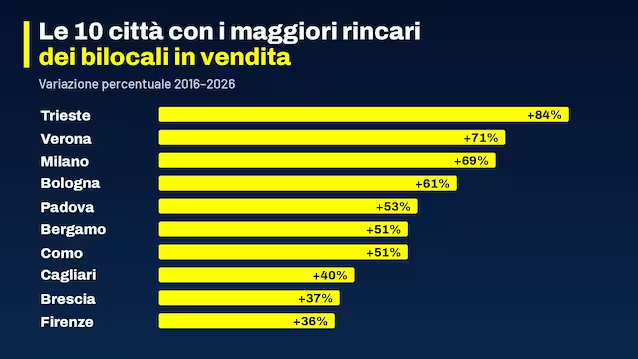
Not all cities have seen housing prices grow: Catania is the only one among those analyzed to record a decrease for all three types, with declines of 6% for studio apartments, 3% for two-room apartments and 14% for three-room apartments. In Genoa, however, the prices of two-room apartments (-6%) and three-room apartments (-11%), while in Palermo a slight drop was noted for three-room apartments (-1%).
The areas with the highest rents
Regarding real estate rentals, the regions with the most expensive rents according to the Observatory are:
- Aosta Valley, (€24.16/m2)
- Lombardy (€19.05/m²)
- Tuscany (€17.34/m²)
Also in this case some of the municipalities with the highest prices are located in mountain tourist resorts. In particular, the three Aosta Valley municipalities that exceed €30/m2 are all concentrated in the Gressoney Valley: Gressoney-La-Trinitè (€35.85/m2), Gressoney-Saint-Jean (€35.81/m2) and Gaby (€35.75/m2)
Even in Lombardy, the cost of rent is once again driven by the province of Milan (21.48€/m2), while in Tuscany by the province of Florence (20.14€/m2).
Furthermore, among the regional capitals, Milan also maintains the record for rents, with €22.52/m² per month. This is followed again by Florence (€21.64/m²) and Rome (€19.75/m²).
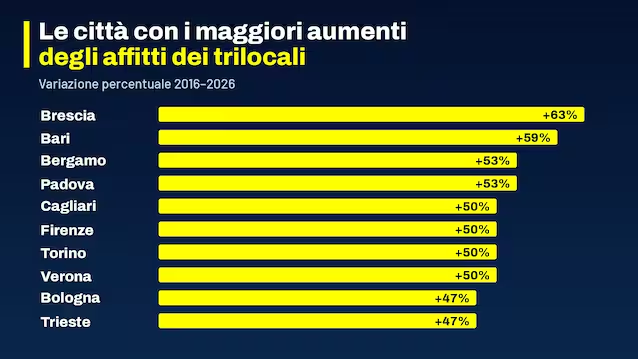
In all 20 cities examined in the Immobiliare Insights study and for all housing types, rents have increased by at least 19% in the last ten years. For studio apartments, the greatest increase was recorded in Padua, where rents grew by 59%, followed by Brescia (+58%) and Venice (+56%). In the case of two-room apartments, Bari leads the ranking, with an increase in prices of 56%, followed by Padua (+55%). Bergamo, Brescia, Turin and Trieste instead share an increase of 52%. For three-room apartments, the record goes to Brescia, where rents grew by 63%, reaching 10.8 euros/m² per month. In second place we find Bari (+59%), followed by Bergamo and Padua (both +53%).
Where houses cost less: the Southern regions
The regions where it costs less on average to buy a house are all in the South:
- Calabria (978€/m2), especially in the province of Reggio Calabria (840€/m2), in particular in the municipality of Anoia (247€/m2)
- Molise (1051€/m2), with the lowest prices in the province of Isernia (683€/m2) and specifically in the municipality of Castelverrino (213€/m2)
- Sicily (1192€/m2), especially in the province of Caltanissetta (639€/m2), in particular in the municipality of Delia (313€/m2)
If instead we focus on the regional capitals, the ranking changes slightly. The cheapest is Catanzaro with €1,024/m2 (over five times less than the cost of a house in Milan), followed by Campobasso with €1,070/m2 and Potenza with €1,291/m2.
The houses with the lowest average rents are found in these regions:
- Molise (6.84€/m2), with the lowest prices in the province of Isernia (6.68€/m2), in particular in the municipality of Macchiagodena (5.75€/m2)
- Basilicata (€7.63/m2), especially in the province of Potenza (€6.78/m2) where the lowest rents are found in the municipality of Avigliano (€4.56/m2)
- Abruzzo (8.35€/m2), in particular in the province of Chieti (7.09€/m2) where the average is driven downwards by the municipality of Arielli (4.81€/m2).
The podium of the cheapest regional capitals is also slightly different: Campobasso (€6.75/m2), Potenza (€7.01/m2) and L’Aquila (€8.01/m2).
All these numbers highlight how the geography of the Italian real estate market is strongly linked to tourist demand, the availability of building land and the presence of large cities. On the one hand, there are in fact some locations where the demand for second homes and high-end properties is concentrated on a relatively limited supply. On the other hand, there are numerous small municipalities in the hinterland, where demand is much more limited and prices can drop to a few hundred euros per square meter.