The new ISTAT report «Health: an achievement to be defended» draws a snapshot of life expectancy in Italy today and how it has changed over time. Today, Italy is confirmed as one of the longest-living countries in the world, with a life expectancy at birth reaching 83.4 years. From 1990 to 2024, men have gained approximately 8 years of average lifespan, while for women the increase has been approximately 6 and a half years. This reached 81.5 years for males and 85.6 for females respectively. If instead we look at the median age at death – that is, that value that divides the population into two equal halves, between those who die first and those who die later – in 2023 it stands at 81.6 years for men and 86.3 for women. Looking at the territories, the Marche, Umbria, Molise and Tuscany lead the ranking for the “national median at death”, while the Campania closes the ranking.
The ranking of the regions: Marche tops the podium
The ISTAT report highlights the differences in average life expectancy between the Italian regions, highlighting a gap of approximately 4 years between the longest- and least-lived regions. In fact, we go from less than 82 years of age in Campania to over 86 in the Marche, with a clear disadvantage for many of the most populous regions of the South.
As of 2023, the national median at death in the entire Italian population (therefore counting both men and women) is 84.4 years. Below this value we find Valle d’Aosta (84.3 years), Puglia (84.1), Lazio (83.9), Calabria (83.8), Sardinia (83.5) and Sicily (83.3) and finally Campania (81.9 years). On the other side of the ranking we find the Marche in the lead (86.1 years), followed by Umbria (85.9), Molise and Tuscany (85.7), Emilia-Romagna (85.5), Abruzzo and Liguria (85.4), Basilicata (85.3) and the autonomous province of Trento (85), Piedmont and Veneto (84.8), Friuli-Venezia Giulia (84.7), Lombardy (84.6) and the Autonomous Province of Bolzano (84.5).
When gender and territoriality intersect
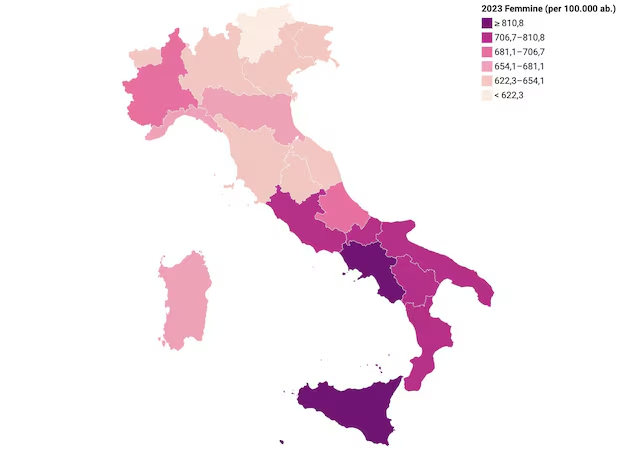
There has always been a significant difference, in Italy and beyond, between the life expectancy of men and women. But it is interesting to look at how geographical origin also influences gender mortality. For example, the ISTAT report shows how mortality has changed from 1990 to 2023. The reduction is clear, equal to approximately 43% among men and 40% among women. The Centre-North leads the list with drops of more than 50%, while in the South the reduction stops at around 35%. Below we can see the mortality data for 2023 (deaths per 100,000 inhabitants) in the various Italian regions, divided by males and females.
The new challenges of longevity
In Italy we live longer and longer, but this longevity brings with it new health and social challenges. The diseases typical of advanced age – tumors, cardiovascular problems and multimorbidity – now affect 13 million people. Much of the progress in longevity comes from a historical leap: infant mortality has plummeted. In 1870, over 230 out of 1000 children did not make it to their first year; in 2023, they are just 2.7 per 1000 live births, among the lowest values in the world.
But living longer also means living with more chronic diseases. Tumors today represent over a quarter of deaths (26.3%), while cardiovascular diseases reach 30%, becoming the main killer since the mid-twentieth century. Diabetes and hypertension are also growing: not only due to the aging of the population, but also thanks to earlier diagnoses, timely checks and unhealthy lifestyles.