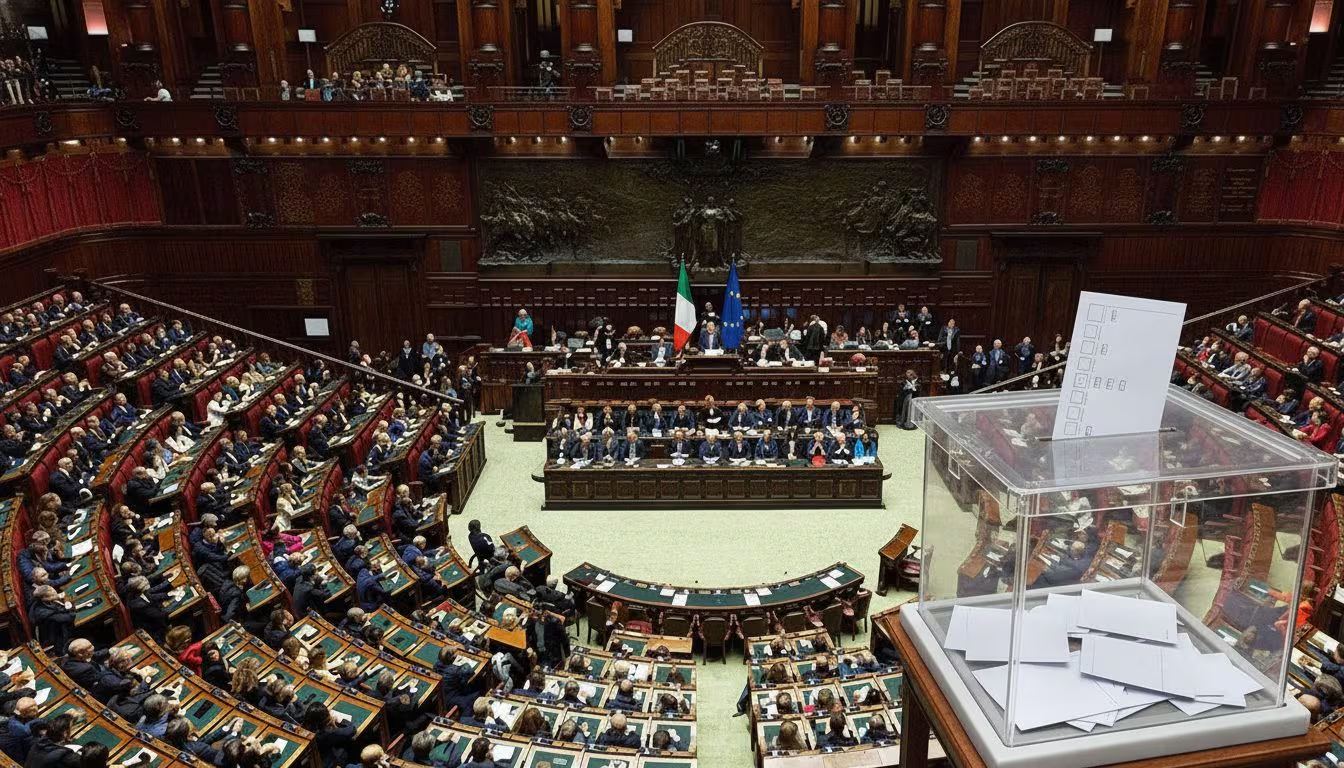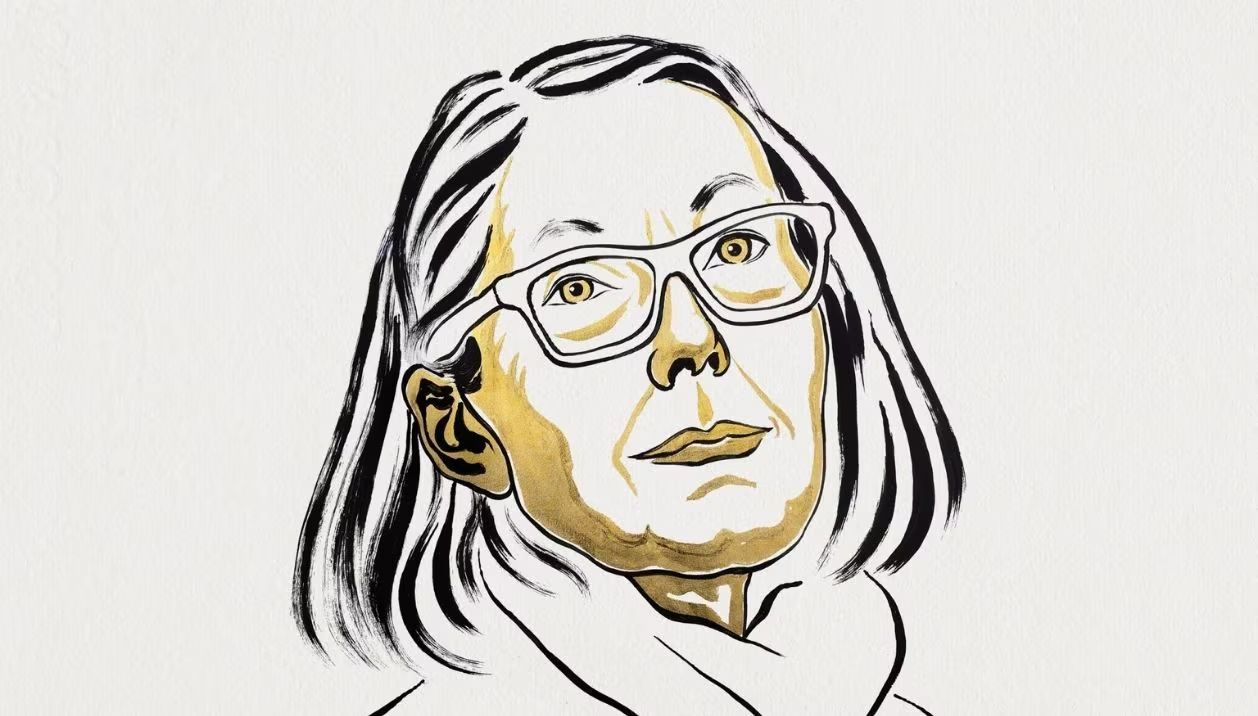
After the Nobel Prize for Medicine, the Nobel Prize for Physics and the Nobel Prize for Chemistry, today the Nobel Prize for Literature 2026 to the Canadian writer Anne Carsonpoet, essayist, translator and scholar of the classical world. The announcement came on Thursday October 8, 2026 by the Swedish Academy, which awarded her for a literary production capable of connecting contemporary literature with Greek and Latin literature. The official motivation in fact speaks of a “bold and inventive” production which, through a playful dialogue with the classical tradition, has created new forms for contemporary literature.
But until a few minutes before the announcement it was practically impossible to know for sure who would win. Unlike other important literary prizes, the Nobel does not publish either the candidates or an official shortlist: nominations, evaluations and documents relating to the selection remain secret for 50 years. That’s why every announcement is a real surprise. And this is also why, every October, predictions, favorites and possible surprises multiply around the Nobel Prize for Literature.
Why the Nobel Prize for Literature is so unpredictable
When it comes to other major literary prizes we are used to shortlists, finalists and nominated books. With the Nobel it works differently. The selection process begins many months before the announcement, and those who propose a name can be, among others, members of academies, university professors of literature and linguistics, previous winners of the Nobel Prize for Literature and representatives of writers’ organizations. However, it is not possible to self-nominate.
From these proposals comes a first list, which we can already imagine to be very extensive. In fact, according to what was reconstructed by the Swedish Academy itself, it can historically understand about 200 names. The Nobel Committee for Literature first narrowed it down to around fifteen candidates and then, towards the end of May, to one shortlist of five nameswhich the members of the Academy study and discuss in depth during the summer.
The point is that none of these lists are made public; this means that the lists of “favorites” that circulate every year in various newspapers and blogs do not necessarily correspond to the real finalists of the Academy. And the history of the award is full of results that are difficult to predict. It also happened in 2024 with Han Kangwho was not among the most popular names on the eve and became the first South Korean author to receive the Nobel Prize for Literature.
Anne Carson, in reality, he had been one of the recurring names in Nobel predictions for years and even in 2026 he was among the authors considered possible winners.
Who is Anne Carson, extraordinary Canadian poet
Born in Toronto in 1950Anne Carson is a figure impossible to place in just one category: she is a poet, essayist, translator, classicist and teacher. He studied classics at the University of Toronto and throughout his career has consistently combined creative writing with the study and translation of ancient texts. He has taught at numerous North American universities, including Princeton and McGill, focusing in particular on Greek literature and culture.
Precisely this double identity, of scholar and writer, characterizes much of her production. In fact, in his books poetry, essay, narrative, literary criticism, theatrical dialogue and translation can coexist, often without it being possible to establish precisely where one genre ends and another begins. One of the best known examples is Autobiography of the redoriginally published in 1998, in which Carson starts from fragments of the Gerioneid by the Greek poet Stesicoro and transforms the monster Geryon, defeated by Heracles in mythology, into the protagonist of a modern novel of education and love written in verse.
Another fundamental text is Eros the bittersweetborn from his academic work and dedicated to the conception of desire in Greek literature, starting with Sappho. In this case philology, philosophy and literary reflection become part of a writing that goes beyond the boundaries of the traditional university essay. Among the other works translated into Italian we find Economy of the lost, The beauty of the husband, Decreation, It was a cloud, Like water and, more recently, The wrong standard.
The most recognizable aspects of his work
According to the Swedish Academy, Anne Carson was honored
«for his bold and inventive work which, in a playful dialogue with the classical tradition, created new forms for contemporary literature».
The phrase summarizes well one of the most recognizable aspects of his work: the classical world is not just a repertoire of myths to be told again, but is living material to be dismantled and recombined. Characters, fragments and texts from ancient Greece are transported into the present and related to contemporary forms, languages and problems.
The same goes for her work as a translator: her versions of Sappho and the Greek tragedians are a central part of her research on language. In Autobiography of the Red, for example, the Geryon of archaic poetry becomes an adolescent in love with Heracles; in Norma Jeane Baker of Troypublished in Italy with the title It was a cloudCarson instead relates Helen of Troy and Marilyn Monroebringing together Greek tragedy and contemporary culture.
This is also why defining her simply as a “poet” risks being reductive. His production continually questions the distinction between poetry and prose, translation and rewriting, essay and creative work. With the victory in 2026 Anne Carson also becomes the dnineteenth woman to receive the Nobel Prize for Literature.
Indeed, among the 122 winners until 2025 we find 18 women. The first was the Swedish writer Selma Lagerlöfawarded in 1909. In recent years, however, the female presence has become much more frequent: since 2013 Alice Munro, Svetlana Aleksievič, Olga Tokarczuk, Louise Glück, Annie Ernaux and Han Kang have won. At the time of the victory he remains the youngest Nobel Prize winner for Literature in history Rudyard Kiplingwho was 41 years old when she received the award in 1907. The oldest is however Doris Lessingawarded in 2007 at 87 years old.
Italy has conquered 6 from 1901 to today
The Nobel Prize for Literature is awarded by 1901 and, until 2025, has been awarded 118 times to 122 people. The number of prizes does not coincide with that of the winners because on four occasions the recognition was awarded simultaneously to two people.
Italy has conquered so far six Nobel Prizes for Literature: the first was Giosuè Carducciawarded in 1906. Twenty years later the Nobel came to Grazia Deleddain 1926: still today she is the only Italian woman to have obtained the recognition. They followed Luigi Pirandello in 1934, Salvatore Quasimodo in 1959 ed Eugenio Montale in 1975. The last Italian to win the Nobel Prize for Literature was instead Dario FoIn the 1997. This means that in 2026 they have passed 29 years old since the last Italian victory.
In more recent years the prize has crossed very different countries, languages and literary forms. In the 2020 the American poet won Louise Glückfollowed in 2021 by the British naturalized Tanzanian writer Abdulrazak Gurnahwhose work specifically addresses colonialism, migration and identity. In the 2022 the Nobel went the French way Annie Ernauxknown for a writing that intertwines personal memory and collective history. In the 2023 the Norwegian was instead rewarded Jon Fosseauthor of novels and plays characterized by an essential and experimental style.
In the 2024 came the victory of the South Korean Han Kangthe first South Korean author to receive the recognition, awarded for poetic prose capable of dealing with historical traumas and the fragility of human life. Finally, in 2025the Nobel was awarded to the Hungarian writer László Krasznahorkaiawarded for a work defined by the Academy as “visionary”, capable of reaffirming the power of art even in the face of apocalyptic scenarios. In 2026 this long history is added to this Anne Carson.