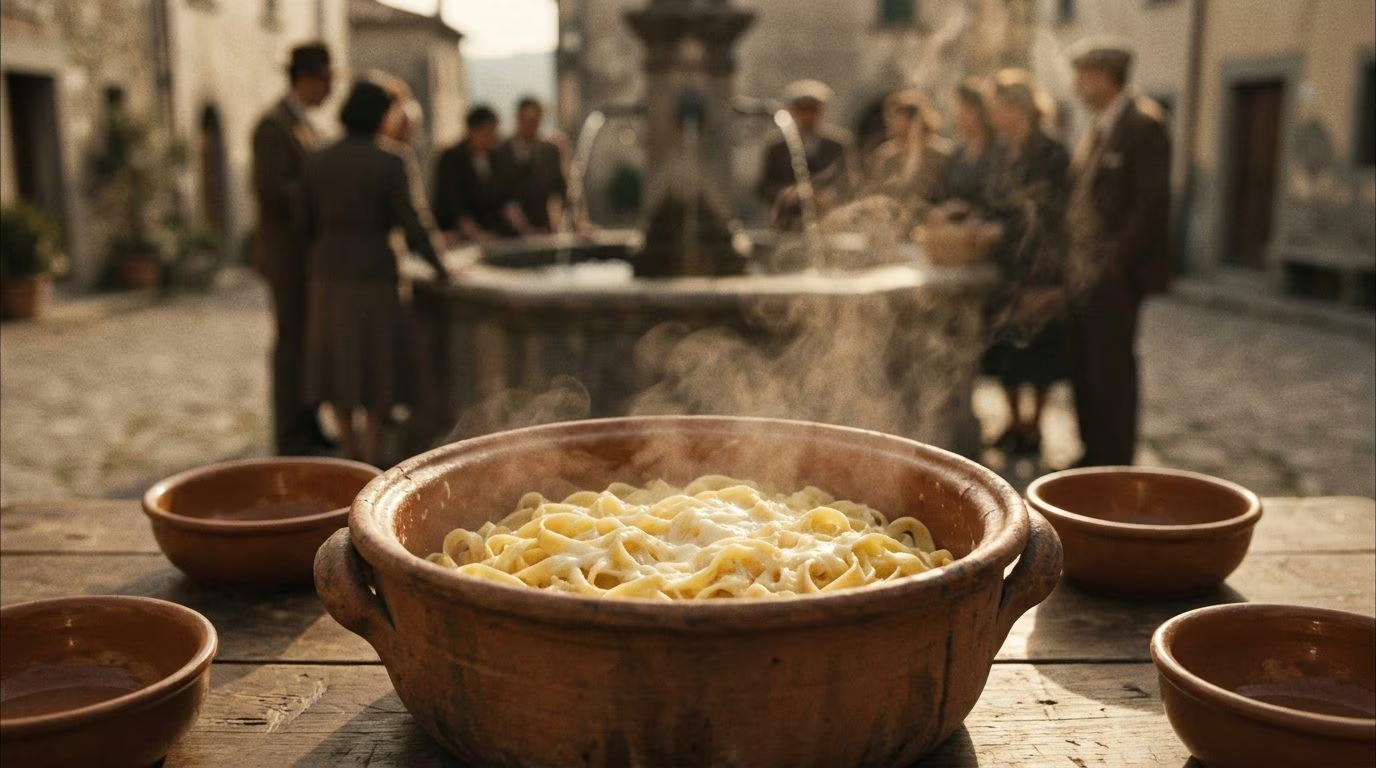
Anti-fascist pasta is a popular tradition born in Italy during the Second World War which is still passed down throughout the country today. A symbol that originated on 25 July 1943 in the province of Reggio Emilia, when the Cervi family, to celebrate the fall of Mussolini, distributed tons of pasta with butter and cheese for free. Since then, the historic Antifascist Pastasciutta of Casa Cervi has been commemorated, which has generally become one of the symbols of the Italian Resistance, even on occasions such as April 25th, the day in which the liberation of Italy from the fascist regime and occupation by the Nazis is celebrated.
How the tradition of anti-fascist pasta was born: the history
The birth of this dish dates back to 25 July 1943, the date on which Benito Mussolini was dismissed from the position of Prime Minister by sovereign Vittorio Emanuele III, after 21 years of regime. The following day the King appointed Army Marshal Pietro Badoglio as the new head of government. The war, despite the fall of fascism, continued, with many innocent victims.
That same July 25th, in Gattatico, Reggio Emilia, after a day of work in the countryside, the Cervi brothers and sisters were informed of the fall of Mussolini and to celebrate the news that marked the end of the dictatorship they cooked and distributed pasta to the whole town. The “recipe”, very simple, included pasta seasoned with butter and parmesan. The Cervi brothers procured flour for kneading, butter and cheese and prepared tons of pasta (it is said that it was 380 kilos!), which they transported with a cart to the square in Campegine, to share and celebrate.
Pasta, a popular food, became one of the symbols of the Resistance, precisely in a historical period in which Mussolini asked to consume rice instead of pasta, since it was produced self-sufficiently in Italy unlike wheat. The Duce was supported in his propaganda by the futurist Filippo Tommaso Marinetti, who The Manifesto of Futurist Cuisine he called for the abolition of pasta for health and patriotic reasons, considering it a food not suitable for fighters.
«I announce the next launch of futurist cuisine for the total renewal of the Italian food system, to be made suitable as soon as possible to the needs of the new heroic and dynamic efforts imposed on the race. Futurist cuisine will be freed from the old obsession with volume and weight and will have, as one of its principles, the abolition of pasta. Pasta, however pleasing to the palate, is a traditionalist food because it weighs down, makes us ugly, deceives us about its nutritional capacity, makes us skeptical, slow and pessimistic. On the other hand, it is patriotic to favor rice as a substitute.” Marinetti declared on the radio. The manifesto was then published two weeks later on The Gazzetta del Popolo of Turin on 28 December 1930.
The Cervi brothers and family
Originally from the lower Reggio Emilia area, the Cervi were a large family of farmers-sharecroppers: the parents, Alcide Cervi and Genoeffa Cocconi, had nine children. Seven males (Gelindo, Antenore, Aldo, Agostino, Ferdinando, Ovidio, Ettore) and two females (Diomira and Rina). The Cervi family moved to rent the Campi Rossi farm, in Gattatico, in 1934, taking advantage of a very low rent, which depended on the difficulty of cultivating those lands. These did not scare them and on the contrary, motivated them, pushing them to adopt new cutting-edge cultivation techniques. They were the first in the area, in 1939, to purchase a tractor.
From the beginning of Mussolini’s regime, the family proved to be profoundly anti-fascist: Aldo, the third of the brothers, was already locked up in Gaeta prison for 3 years at the end of the 1920s. Here he read Gramsci and Marx and brought back their teachings when he returned to Gattatico, spreading together with his brothers all those books that had been prohibited by fascism, the communist newspaper l’Unità and participating in subversive activities, including leafleting, sabotage of factories that produced weapons destined for war, as well as attacks against fascist garrisons, in which to collect resources intended for those who had deserted the military service and were hosted in the Campi Rossi. Among the guests of the “Cervi gang” there were also many former Soviet prisoners and foreign partisans who fought for the Resistance.
Their activism cost them dearly. On the night between 24 and 25 November 1943, the soldiers of the Italian Social Republic surrounded the house and engaged in a firefight which forced the partisans to surrender. The brothers, their father Alcide and other partisans, including Quarto Camurri, were arrested, and the Cervi house was engulfed in flames. The seven brothers, together with Camurri, were shot by the fascists in retaliation at dawn on 28 December 1943.
The Deer Museum in Gattatico
Today in Gattatico, on the Campi Rossi, a farm of around 16 hectares located in the middle of the Po Valley, between Parma and Reggio Emilia, stands the Cervi Museum: here, on the land where the Cervi arrived in 1934 to cultivate it, the memory of the Resistance and the history of the peasant movement is preserved. Open all year round, from Tuesday to Sunday, the museum and the memory it preserves are kept active by the Alcide Cervi Institute, established on 24 April 1972 in Reggio Emilia on the initiative of the National Farmers’ Alliance (now the Italian Farmers’ Confederation), the National Association of Partisans of Italy, the Province of Reggio Emilia and the Municipality of Gattatico.