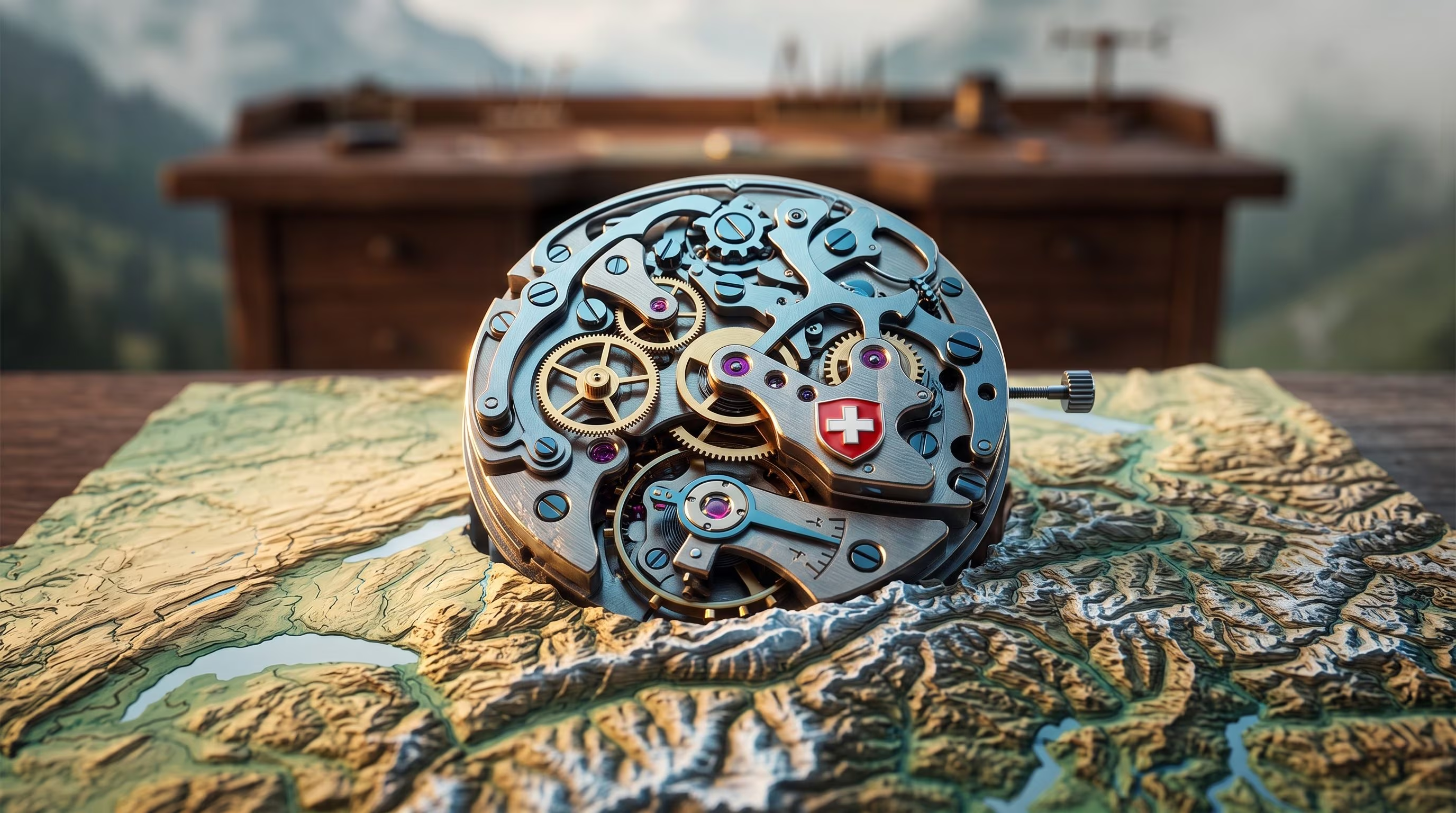
Among the many excellent products “Swiss made“, the Swiss watch, from models for the general public to collector’s pieces with an astronomical cost, is certainly one of the most recognised, appreciated and widespread throughout the planet: the country is so famous throughout the world thanks to a combination of history, religion and precision craftsmanship. A reputation that does not arise from an advertising campaign conceived on the table, but from a long and varied tradition, in which the geopolitical and religious events of the Old Continent, the Swiss territory and the ability to transform a refined artisan activity into a highly qualified industry.
The birth of Swiss watchmaking: Calvin and the Protestant Reformation in the 16th century
To begin to understand how Swiss watchmaking art became what it is today, we must start from the great religious transformations that swept Europe during the sixteenth century. According to tradition, in fact, the origins of Swiss watchmaking have their roots in the history of the city of Geneva, at the time deeply marked by the Protestant Reformation.
Geneva was home for a time to the French theologian Jehan Cauvin, known in Italian as John Calvin, who helped transform the city into one of the main centers of European Protestantism. Among other things, in his severe conception of customs, Calvin condemned the ostentation of luxury and discouraged the display of jewels and precious objects: in this climate of moral austerity, the Genevan goldsmiths and artisans had to reinvent themselves by shifting their production to watchmaking. Unlike jewellery, in fact, watches were not accessories to show off one’s wealth, but functional tools for work and necessary for punctuality in production activities.
The Huguenots, the French Protestants persecuted for their doctrine and many of whom found asylum in Geneva, also contributed to further encouraging the spread of the practice, bringing with them artisanal knowledge and technical skills in metalworking and mechanical components.
Artisanal work and rural tradition: the 17th century and the établissage
During the seventeenth century, the practice of watchmaking gradually spread to the mountainous regions of the Jura. Here, the territory was unsuitable for forms of extensive agriculture and the long months of winter inactivity forced the inhabitants of the valleys to integrate their peasant work with other occupations: the production of components for watches could be carried out in private homes and required relatively simple tools.
It was not necessary for each craftsman to build a watch entirely by himself: each could specialize in the creation of a very specific component or in carrying out a particular task, and then assemble everything and create a finished product. A bit like a widespread assembly line, which later became identified with the name of établissage. This particular organization of work gave rise to a coordinated network of small artisan workshops, in which a specific know-how it was passed down from generation to generation.
An increasingly specialized production from the 18th and 19th centuries
During the eighteenth century this practice became increasingly efficient: being a watchmaker became a specialized job in all respects, requiring increasingly technical and complex knowledge and skills. Watchmaking then began to change the structure of the territory: the most emblematic case was that of the cities of La Chaux-de-Fonds and Le Locle, in the Canton of Neuchâtel, which transformed from rural centers into industrial cities with homes, laboratories, services and warehouses, and subsequently factories, organized according to production. In 2009, UNESCO recognized the history and value of this urban landscape, including the two cities in the list of World Heritage Sites.
During the nineteenth century, the fame of Swiss watches was now consolidated throughout Europe and had also undermined the historic productions of France and the United Kingdom, bringing the creation of watches increasingly towards industrial reality, while never abandoning the meticulous attention to detail, typical of artisanal activity.
The 20th century and modern reality: the Swiss made watch
At the end of the twentieth century, Swiss watchmaking entered into crisis due to the innovation that would have revolutionized the market on a large scale: that of the quartz watch. Technology that allowed more precise watches to be made with lower production costs and, consequently, more accessible sales prices.
The answer did not come with an attempt to compete on a large scale with new technology, but from concentrating the fruit of its tradition on the high range, transforming the mechanical watch into a synonym of high quality, combining the layered knowledge of a centuries-old tradition with the most modern designs.
In 2020, UNESCO inscribed expertise in watch mechanics and art in the List of Intangible Cultural Heritage of Humanity.
Is Swiss made still synonymous with quality?
Swiss made is not just a generic reference to “made in Switzerland”, but a brand, an indication of origin strictly regulated by the Swiss legislative system, which regulates standards, raw materials and production processes. To give an example, with regards to industrial products, at least 60% of production costs must be made in Switzerland and a significant phase of manufacturing must take place within the country’s borders.
Rules which, obviously, also relate to the creation of watches: this means that in order to be defined as Swiss made, a watch must comply with specific requirements: as we were saying, at least 60% of the production costs must be supported in Switzerland, the technical development, assembly and final control must be carried out in Switzerland.
Switzerland today remains one of the world’s main centers of high-end watch production. In 2025, exports from the watch industry reached 25.6 billion francs. A result which, despite the market fluctuations and the now very strong international competition, still gives us the dimension of the role that watch production has in the country’s economy.