THE’Crusca Academy is considered the highest reference body for the Italian language. Its noble intent is to remove all doubts about morphology, syntax, spelling, neologisms, lexicon and many other aspects of our speech. Among the many doubts to be removed from readers there is also the one connected to the origin of its name: why “bran”?
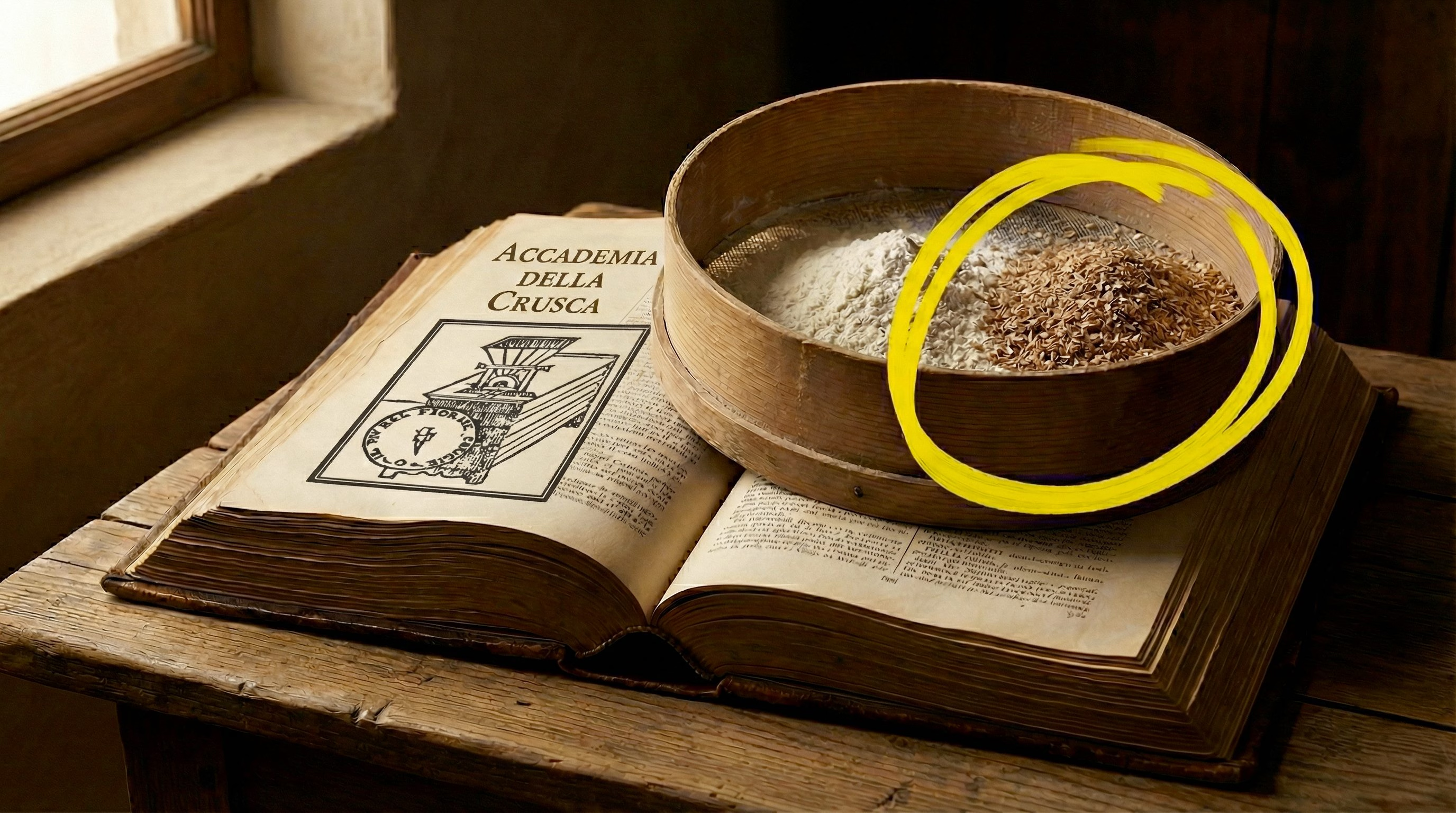
It’s one food metaphor born during Italian Renaissanceand more precisely in the Florentine gastronomic culture of the 16th century. The Academy was founded in 1583 in Florence – where it still has its headquarters, in the Medici Villa of Castello – by a group of writers and intellectuals of the time, who shared the objective of purification and defense of the Italian language.
As in any self-respecting group, over time they asked themselves how they should identify themselves and so they chose a symbol that metaphorically represented their project. Their intent was to sift, eliminate the superfluousretaining only the “good” of the Italian language, exactly as a miller separated the refined flour from the branthe rawest part of the wheat that is separated during milling. This external residue is the unrefined peel of the raw material that was discarded in the production of bread, because it was not suitable for direct use in bread making, as it was full of impurities compared to fine and well-sifted flour.
The linguistic metaphor that gives the Academy its name was born exactly from this image. The name “bran” has nothing derogatory in itself, but serves as a reminder of the selection of words and linguistic uses most suitable for building and defending a valid and coherent Italian. The metaphor is not limited only to the name of the group, but also applies to the roles attributed to the founders of the Academy.
Traditionally, they are:
- Giovan Battista Detiknown as Sollo: term to indicate something soft, soft;
- Anton Francesco Grazzinithe Lasca: a freshwater fish, a reference to the relaxed character of the founder;
- Bernardo CanigianiGramolato: freshly processed wheat or bread, which is in the processing phase;
- Bernardo Zanchinithe Macerato: process of soaking or processing the flour;
- Bastiano de’ RossiInferigno: a type of rustic, dark bread, made with lightly sifted, therefore bran-like flour;
- Lionardo Salviatithe Infarinato: perhaps the most obvious appeal. It was Lionardo who gave the most decisive push for the transformation of the Academy.
The gastronomic parallelism even extends to coat of armsdepicting a sieve with falling grains.
The symbolic choice reflected an era in which the written and spoken language was undergoing rapid transformations, with more and more neologisms due to the growing diffusion of the press and of Italy’s local languages in literary and official texts. The group of scholars wanted it that way safeguard cultured and literary Italian from contaminations and drifts considered too provincial or vulgar, “popular” understandings, as well as creating a unique point of reference for the Italian language. Today we know that the concept of language is very complex and is linked to linguistic, sociolinguistic and historical factors; but at the time it was felt necessary to find a standard to refer to, especially in a multicultural context such as Renaissance Italy.
The name remains symbolic even today; Crusca is not, in fact, an entity that imposes rules from above, but rather an institution that observes, collects and analyzes the real uses of the Italian language to sift through them, study them and propose solutions to linguistic doubts that torment Italian speakers and trigger heated debates. The intervention of the Academy – now led by President Paolo D’Achille, elected on 28 April 2023 – is sometimes essential when we ask ourselves what is the correct use of expressions such as “rather than”, the validity of linguistic solutions introduced by modern needs, or even knowing whether to use the plural to talk about multiple pregnant women.
In this sense, the Academy today does not discard the uses of the linguistic varieties of Italian, but helps to distinguish between consolidated use And emerging use of the terms, underlining that the traditional historical meaning and the expressive innovation of the modern era are often two sides of the same coin. Crusca is able to give value to language as cultural nourishment remembering that the language still remains a living organism to be observed.