On 4 November 1922, in the Valley of the Kings in Luxor (Egypt), on the west bank of the Nile near Thebes, the British archaeologist Howard Carter (1874-1939) identified access to a tomb that had remained hidden for 3,300 years. It was the tomb of Tutankhamun (1341–1323 BC), the young, twelfth ruler of the 18th Dynasty (1543–1292 BC) who ascended the throne at the age of about eight (according to other sources, at nine). Later, his name would become one of the best known of ancient Egypt not for his political exploits, but precisely for this extraordinary discovery.
The excavation campaign, financed by Lord Carnarvon (1866-1923) – whose premature death a few months after the opening fueled the famous legend of the “curse of Tutankhamun” – would have yielded one of the most complete and best preserved funerary objects ever found in an Egyptian royal burial.
Identified with the acronym KV62, the tomb is rather peculiar. It has relatively small dimensions and an unusual plan compared to that of other royal tombs in the Valley of the Kings.
The small size and spatial organization have led us to think that the tomb may have been created from the spaces of another underground structure: a recent theory in fact sees it as part of a larger and unknown complex, perhaps the tomb of Nefertiti (1370-1330 BC), one of the wives of Tutankhamun’s father, Akhenaten (1375-1334/1333 BC), and perhaps also the young man’s stepmother pharaoh.
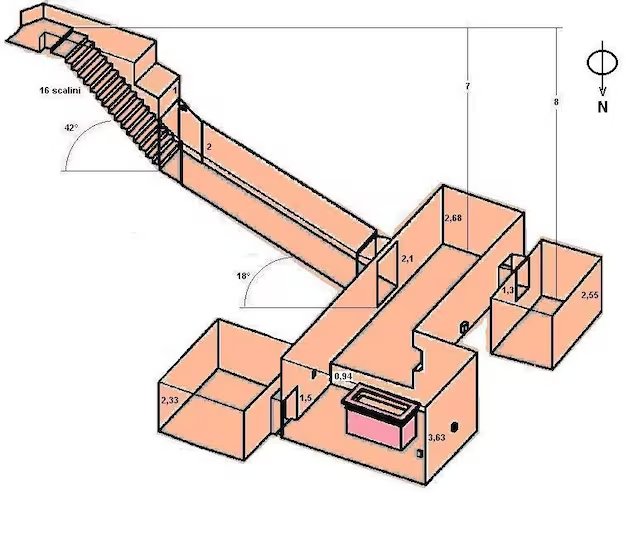
The discovery began almost by chance, when the first steps of a staircase in the rock re-emerged under the remains of some workers’ huts in the necropolis before Carter’s eyes. From there, a descending corridor leads to the antechamber, which leads to the funerary chamber, flanked by the Treasury. A further room, the annex, can be reached through an opening in the antechamber. There are therefore four main rooms: Antechamber, Funeral Chamber, Treasury and Annex.
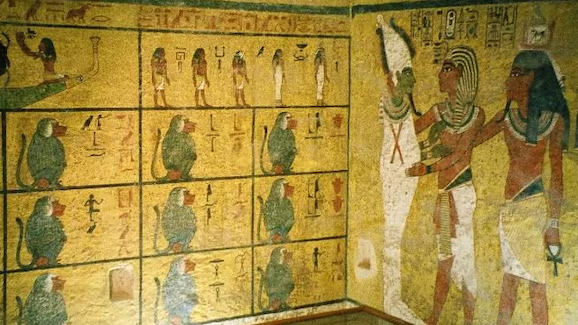
Only the walls of the burial chamber were decorated, with scenes related to the funeral ritual and the sovereign’s journey into the afterlife.
The choice of such a small and secondary space, if we consider the models of the Valley of the Kings, would seem to highlight how the sovereign’s death came suddenly (according to analyzes he died of tropical malaria and due to a series of debilitating bone malformations), and his funerary rites were performed hastily.
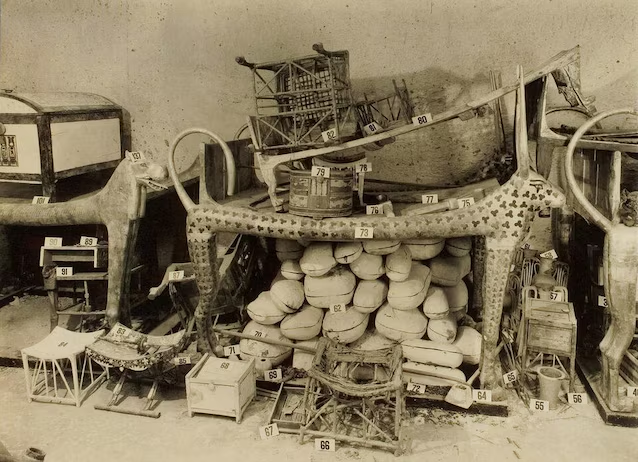
Even the way in which the kit was arranged seems to go in this direction. This, despite being placed in a certain order, appears disproportionate for such a small tomb. The arrangement of the objects made it difficult to move within the rooms. The kit included around 5,000 artefacts, piled up in the rooms. In the antechamber Carter found furniture, ceremonial beds with animal heads, caskets, vases, baskets and parts of dismantled carts.
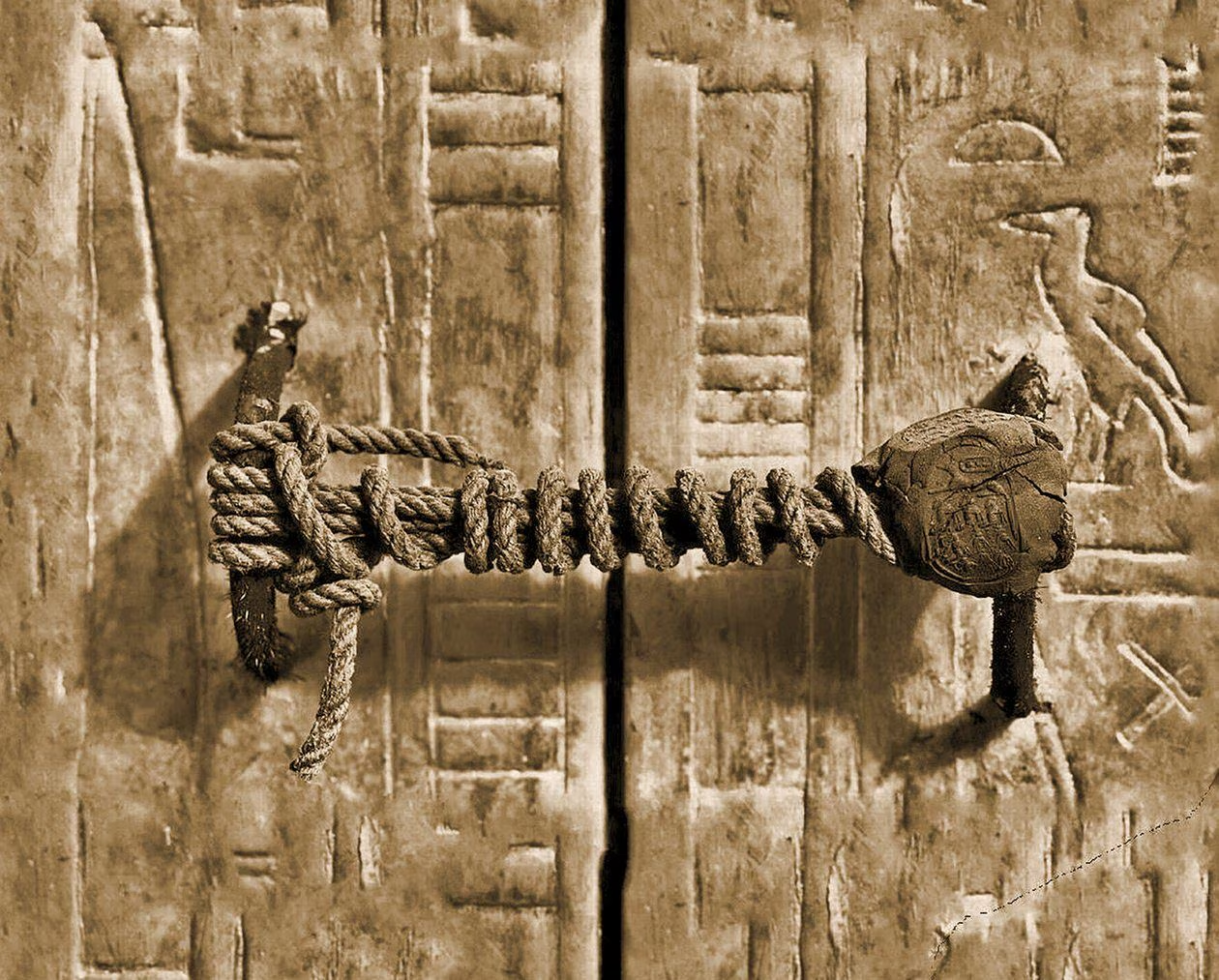
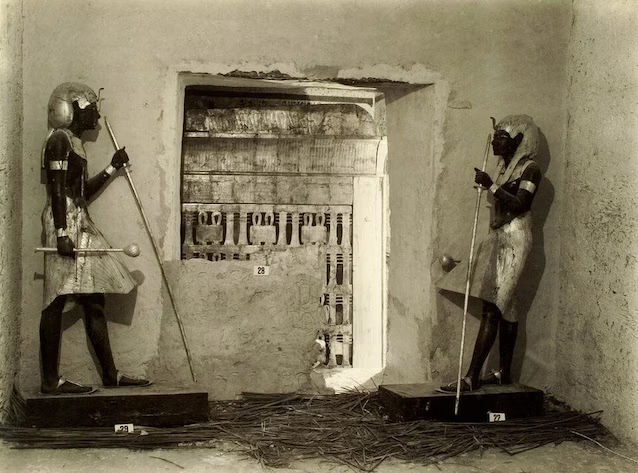
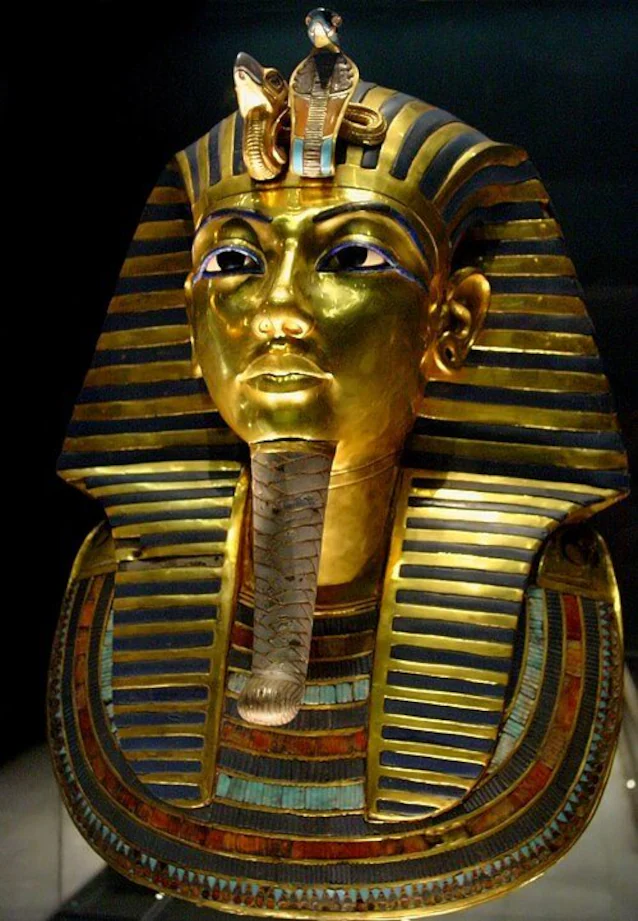
Two life-size statues of the pharaoh guarded the access to the burial chamber, whose official seals were opened on February 16, 1923. Here there were four large golden wooden shrines, placed one inside the other, enclosing a red quartzite sarcophagus. Inside there were three anthropomorphic sarcophagi, also inserted into each other. The innermost one, made of solid gold, weighed about 110 kilograms. The sovereign’s mummy was protected by the famous golden funerary mask, along with jewels and amulets.
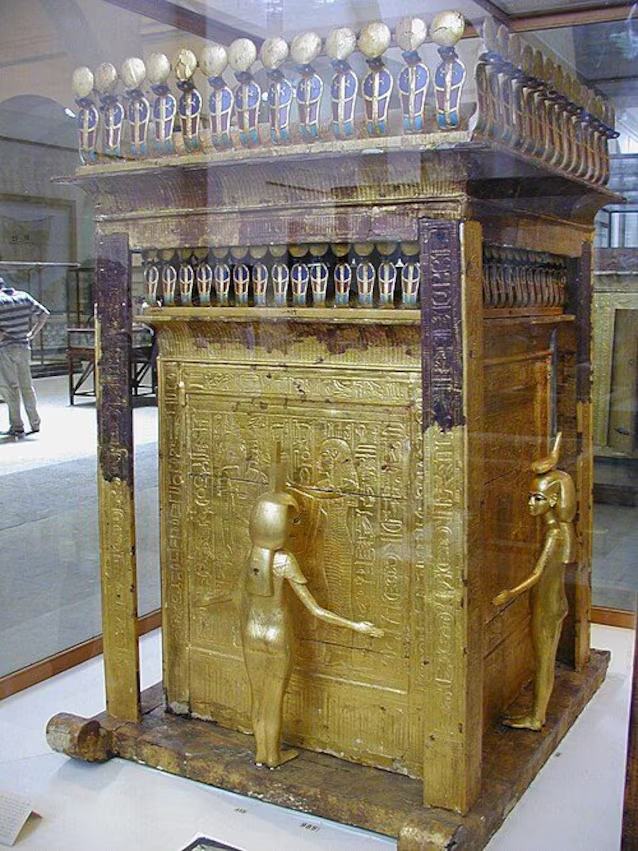
The Treasury housed the container of the alabaster canopic jars, protected by a golden shrine and flanked by statuettes of female deities. Inside, four small golden sarcophagi contained the king’s mummified organs. There were also models of boats, ritual statues and other caskets. The Annex, used as a warehouse, contained oils, ointments, foods, wine, furniture and numerous other objects of daily use. Among the finds recovered there were also clothes, footwear, weapons, sticks, jewels and war chariots: a set that documents both the ritual needs of the burial and the material life of the court.
Tutankhamun ascended the throne around 1332 BC, still a child, in a period of profound religious transformation. His predecessor Akhenaten had promoted the exclusive cult of the solar disk Aten, reducing that of traditional deities. During the reign of Tutankhamun, which lasted about ten years, the previous cults were restored and Amun, the traditional creator god, returned to occupy a central position in Egyptian religion. The ruler, born Tutankhaton, took the name Tutankhamun as part of this change. He died around 1323 BC, aged around eighteen or nineteen.
Tutankhamun’s fame among his contemporaries therefore does not depend so much on the political weight of his reign, certainly short and of little importance, but on the extraordinary quantity of intact objects returned from his tomb.
In Egypt, the tombs of pharaohs were often looted just a few years after their burial, or reused and stripped in subsequent periods, whether it was that of another dynasty, the Greeks, the Romans or the Arabs.
Tutankhamun’s tomb actually suffered two brief violations in ancient times, but remained the most intact royal burial ever found in the necropolis. The reason it was not completely looted is that it remained hidden and forgotten for millennia under piles of debris and rubble from subsequent excavations.
This tomb is a heritage which – also thanks to the photographic documentation created by Harry Burton during the excavation – has allowed us to closely study the material culture, funerary practices and life of the Egyptian court of the 14th century BC, whose legacy is still visible today. In fact, while the sovereign’s mummy he still rests in his tomb in the Valley of the Kings, almost all of the extraordinary grave goods are kept and displayed at the Egyptian Museum in Cairo.