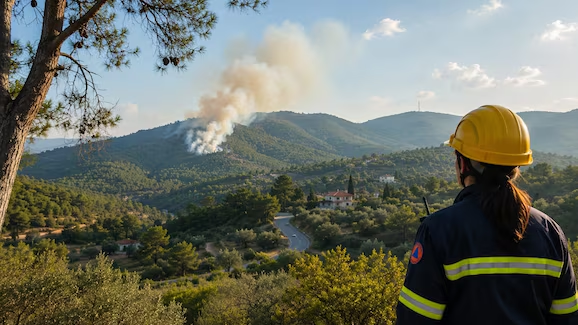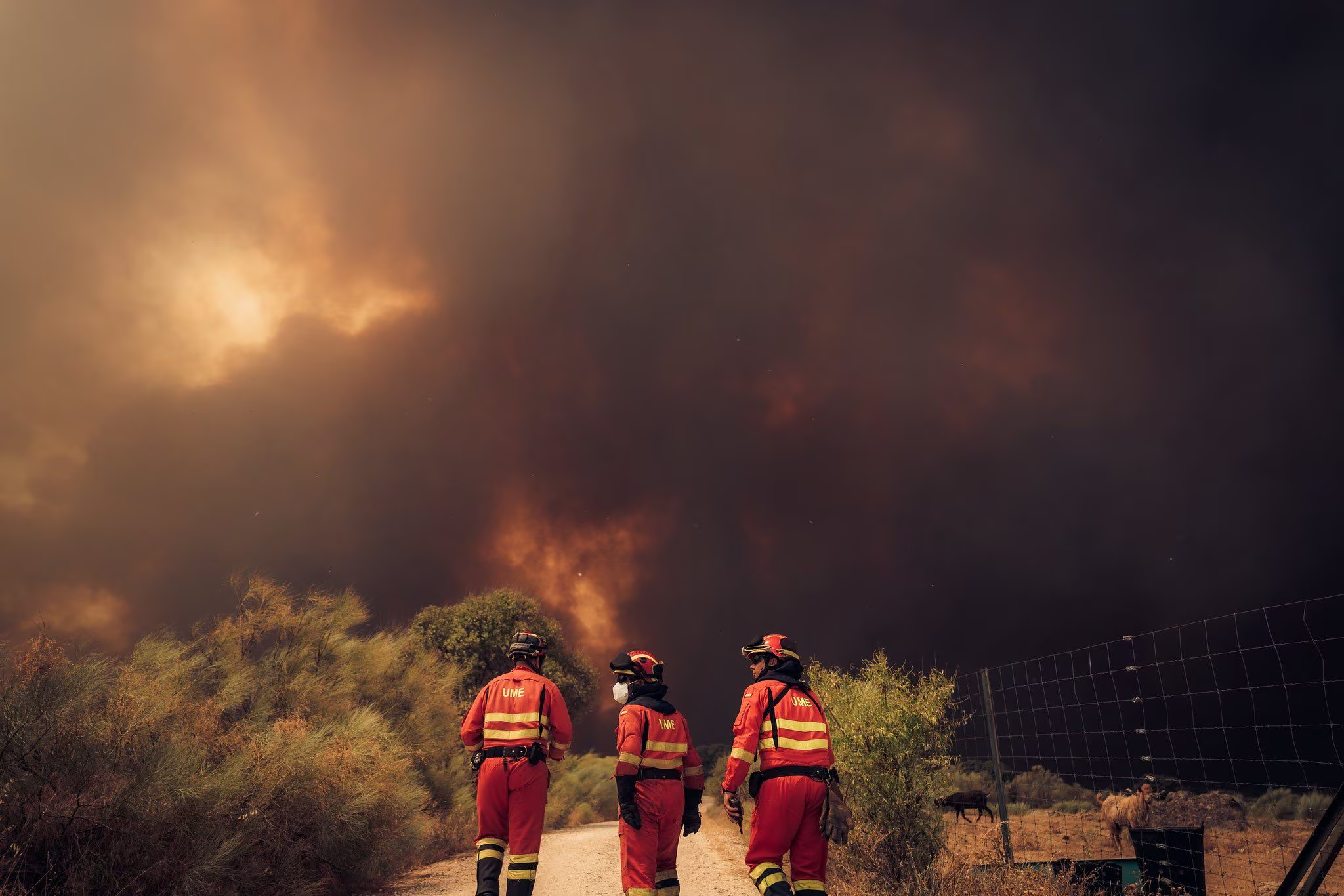
Mediterranean Europe is in the grip of fires: in Spain and France over 325,000 people have been evacuated, with the Madrid government declaring a national emergency. In Italy, meanwhile, a fire on the Gargano forced the evacuation of beaches and campsites, with tourists and swimmers removed and Canadians in action on the Mediterranean scrub, while critical situations were also recorded in Molise. Also to be considered are the fires recorded in Sicily in recent weeks and the large fire on Monte Faeta in Tuscany, which occurred last May: these events demonstrate how the period of maximum fire risk is becoming increasingly long and critical, also due to climate change.
Spain, however, is certainly the most affected country, with numbers from the Spanish Ministry for Ecological Transition (MITECO) giving the measure of the disaster: as of 26 July the burned area in Spanish territory was 152,678 hectares, a figure almost 6 times higher than that of the same period of the previous year. To be clear, according to Copernicus data, from the beginning of the year to 22 July, 378,000 hectares were lost across the EU, of which 152,000 were burned in the Iberian country.
In Spain, the fires in Burgohondo and the Community of Madrid burned over 50,000 hectares together, forcing the preventive evacuation of municipalities such as La Adrada, while forestry teams fought other critical fronts in extreme conditions, from Los Gallardos to Madrid’s Sierra Oeste. Meanwhile, beyond the Pyrenees, south-western France is dealing with the Gironde fire, with displaced people exceeding 220,000.
Beyond the numbers, there’s a question that comes back with every wave of fires: why do these forest fires seem impossible to stop? Forest fires are certainly complex phenomena, to which it is impossible to give simple solutions. However, wanting to summarize, we could say that the answer lies in two concepts that experts use more and more often: the so-called “sixth generation fires” and the threshold beyond which a fire ceases to be capable of being extinguished.
What are “sixth generation” fires: rapid and unpredictable fires
The Spanish Ministry for Ecological Transition (MITECO) defines sixth generation fires as fires that generate “extreme behavior” and “uncertain scenarios” and which can overload the emergency management system. These are therefore not just any fires: they are complex fires with rapid expansion and very high intensity, in which the flames can exceed the speed of 6 km/h, i.e. between six and twelve times the speed of a normal fire.
Although there is no standard definition, these fires (also called “megafires”) are characterized by being extreme in terms of size, behavior or impact on both the anthropic and eco-systemic components, with disturbances that are often persistent and have very serious consequences. According to research published in Global Ecology and Biogeography, fires of this type typically exceed 10,000 hectares. Among their distinctive features are therefore the very high intensity, the very high speed of propagation, the simultaneity of outbreaks and a behavior that is difficult to predict even for the forecasting software used by AIB (forest firefighting) analysts to define the possible ways in which the fires will expand.
But why are these fires defined as “sixth generation” in Spain? The classification was born from the work of two Catalan specialists, Antoni Rifà and Marc Castellnou, who in 2007 defined five generations of fires based on the fuel, the characteristics of the fire (perimeter, intensity and speed of spread), the territorial and temporal context and the actions necessary for extinguishing. The sixth generation arrived later: in 2017 the fires that hit Chile, reaching 60,000 kW/m and burning 467,000 hectares, defined a new generation, the sixth.
One of the points that is important to reflect on is that these extreme phenomena do not arise by chance, but develop and expand in areas that have become particularly fragile and vulnerable over time. The high accumulation of biomass, due to the abandonment of forestry and agricultural practices, together with drought and high temperatures (inevitably related to climate change), are the main predisposing factors that make an area highly vulnerable to the passage of flames and create the basis for the birth of sixth generation fires. The fuel accumulates for years in poorly managed forests (where preventive silviculture interventions are often absent): at that point extreme heat and drought, related to an anthropic (malicious or negligent) or natural (for example lightning) trigger source, are enough to trigger the disaster.
The mechanism starts from the enormous quantity of heat released, which pushes hot air, smoke and water vapor to rise with great speed, forming imposing convective columns. These give rise to pyrocumulus clouds and in some cases to real storm clouds associated with the fire.
The situation becomes complicated when the column loses stability and collapses: that collapse generates strong gusts of wind and sudden changes in the direction of the flames and projects embers and incandescent material hundreds of meters away, opening new fronts almost simultaneously. In a certain sense, these fires alter the surrounding atmospheric conditions, fueling their own spread.
What does it mean that the extinction threshold has been exceeded
Here we get to the heart of the question: why is it so difficult to manage and put out these fires? Because in most cases, these forest fires have exceeded the so-called “extinction threshold”. In other words, it means that these fires have reached such an intensity that any intervention is no longer effective (regardless of the number of vehicles deployed) and the only alternative is to let the fire burn out on its own, consuming the available fuel.
What happens, then, when you cross that threshold? In moments of maximum intensity the teams cannot directly attack the flames safely: therefore, the strategy changes radically. We move on to protecting the population and infrastructure, anticipating the path of the fire and waiting for an opportunity, which can come from a change in weather, from a reduction in available fuel or from the arrival of the fire in an area in which, through preventive silviculture interventions, the right AIB infrastructures have been created to be able to face and “withstand” the impact of the flames.
In Spain this scenario has translated into precise operational choices. The Community of Madrid has asked the government to activate Operational Situation 3 of the INFOMA plan, openly speaking of a “critical situation” in front of three fires simultaneously beyond the capacity of extinction between Madrid, Castile-La Mancha and Castile and León.
As Carlos Novillo, head of emergency management of the regional government of Madrid, explained, in these conditions the regional firefighters, the municipal ones and the military emergency unit are no longer trying to put out the fire, but to save the lives and property of the evacuated citizens. In other words, we agree to let a front burn in a controlled manner in order to avoid greater human disasters.
As reported to Geopop by Silvano Somma, forestry doctor, we must also mention the importance of the “fire paradox”: unlike what one might think, in fact, it is possible to use fire against fire both in the prevention and active fight phases.
In these cases, we talk about “prescribed fire” and “counterfire”. The first consists in preventively burning, in very specific weather windows, certain portions of forest (mostly strips) during the autumn and spring period, eliminating fine fuels from the area, which are those that would favor the passage of a possible fire on this surface.
These are therefore portions of territory, strategically chosen, which will act as “anchor points” and “firebreaks” when a fire sets foot in that area, with the aim of slowing down its progress, reducing its intensity and allowing teams and vehicles to operate and, often, to stop it.
Counterfire, on the other hand, represents a real technique of using fire against the fire, in the active fight phase, with the ignition of a line of fire which, due to air movements due to the convective currents caused by the main fire, will continue in the direction of the latter, taking away fuel (and therefore energy) from it.