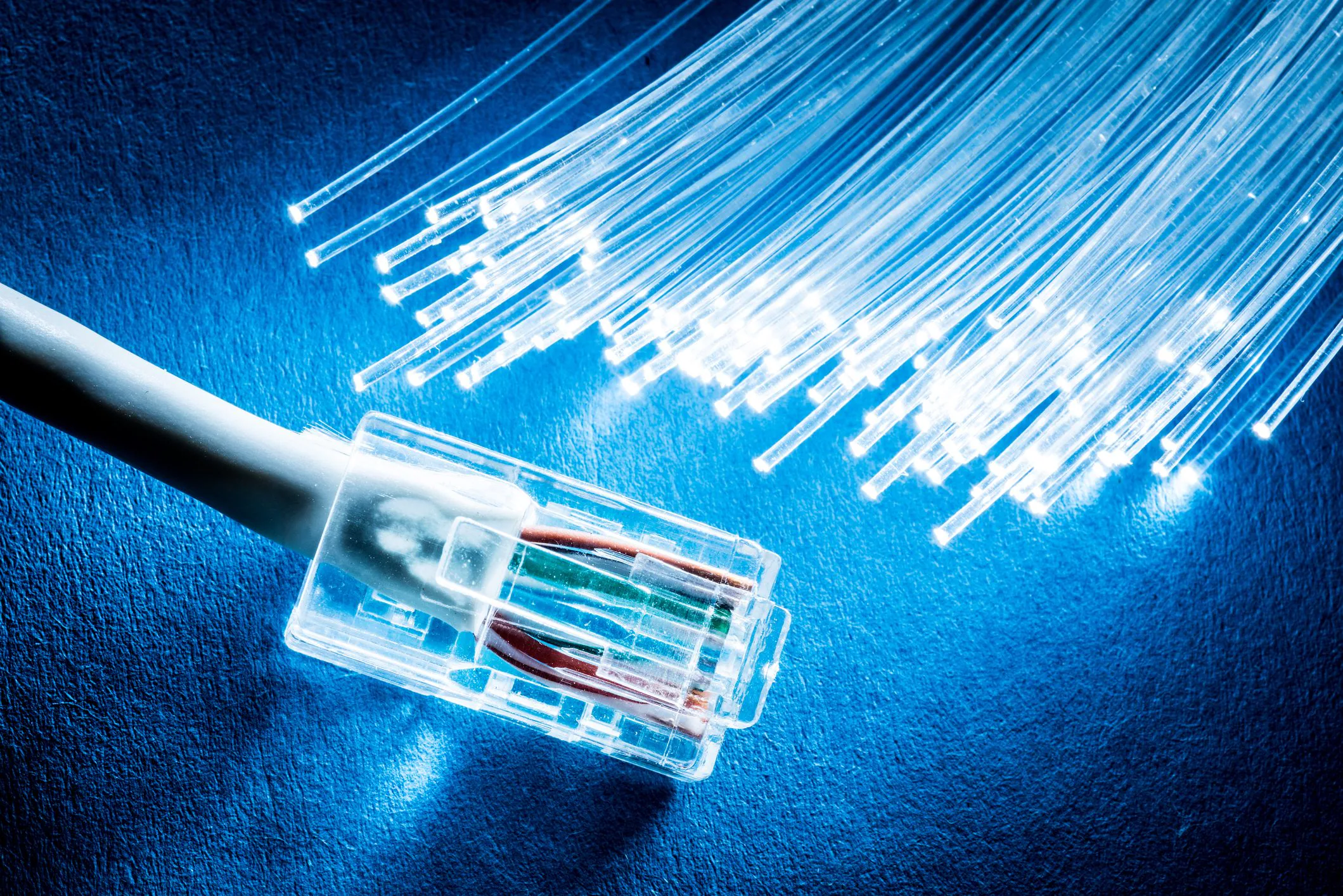
Much of the Internet travels inside very thin threads of glass. Every message sent on WhatsApp, every TV series watched in streaming and every video call with a person on the other side of the globe generates data that often travels thousands of kilometers in the form of light pulses. It is thanks to optical fiber that the network is able to transport enormous quantities of information in a few moments, making many of the digital activities possible that are taken for granted today.
Yet the history of this technology is much older than the Web and even modern computers. Its origins date back to the nineteenth century and are the result of almost two centuries of scientific discoveries, engineering intuitions and progress in the processing of materials. From a simple laboratory demonstration to one of the most important infrastructures of the digital age, here’s how fiber optics has changed the way the world connects.
From the first optical demonstrations to the idea of guiding light
The theoretical basis of optical fiber was born in the first half of the 19th century. In 1841 the Swiss physicist Daniel Colladon showed how a beam of light could follow the path of a jet of water thanks to the phenomenon of total internal reflection. Shortly thereafter, French physicist Jacques Babinet helped further popularize the principle.
The demonstration was simple, but revolutionary: it showed that light could be guided along a defined path instead of propagating freely in space.
The same physical principle used during those experiments is still the basis of the functioning of optical fibers today. At the time, however, no one imagined that that curious demonstration would lay the foundations for one of the most important innovations in modern telecommunications.
From medicine to the first optical fibers
For decades the possibility of guiding light remained primarily a topic of scientific interest. It was only in the twentieth century that the first practical applications began to appear.
In the 1950s, several researchers developed bundles of transparent fibers capable of carrying images. This technology quickly found use in the medical field, allowing the creation of the first flexible endoscopes, instruments that allowed the inside of the human body to be observed in a less invasive way than the techniques available up to that time.
Despite these advances, fiber optics was still far from becoming a telecommunications solution. In fact, the fibers available at the time dispersed much of the transmitted light, making it impossible to send signals over long distances.
Charles Kao’s intuition that changed telecommunications
The turning point came in 1966 thanks to the work of the engineer and physicist Charles Kao together with his colleague George Hockham.
At the time, many experts believed that high signal losses were an unavoidable limitation of glass. Kao instead came to a different conclusion: the problem was not the principle of the optical fiber, but the impurities present in the materials used to produce it.
In his study, Kao demonstrated that, by using extremely pure glass, it would be possible to drastically reduce the attenuation of light and transform the optical fiber into a medium suitable for transmitting information.
Kao also estimated that to make fiber optics truly competitive it was necessary to reduce attenuation to less than 20 decibels per kilometer, a goal that at the time seemed extremely difficult to achieve.
The intuition proved correct and paved the way for a new era of telecommunications. For this contribution Charles Kao received the Nobel Prize for Physics in 2009 and is today remembered as the “father of optical fiber”.
The birth of modern fiber optics
The practical confirmation of Kao’s theories came in 1970, when a group of researchers from the US company Corning, composed of Robert Maurer, Donald Keck and Peter Schultz, managed to create an optical fiber with an attenuation level low enough to make it usable in communication networks.
The new fiber developed by Corning achieved an attenuation of approximately 17 decibels per kilometer, exceeding the threshold indicated by Kao and demonstrating the feasibility of long-distance optical communications.
In the following decades, production techniques improved further and the introduction of semiconductor lasers made it possible to transmit ever greater quantities of data. What until a few years earlier seemed like a theoretical objective was becoming an industrial reality.
From telephone networks to connections between continents
Between the 1970s and 1980s, fiber optics began to spread in the telecommunications infrastructures of numerous countries.
The advantages compared to copper cables were obvious: greater transmission capacity, less sensitivity to electromagnetic interference and the possibility of covering longer distances without degrading the signal.
One of the most important moments in its history came in 1988 with the commissioning of TAT-8, the first transatlantic fiber optic cable. The system connected North America and Europe and could handle up to 40,000 simultaneous telephone conversations, an enormous capacity for the time and significantly higher than that of previous transoceanic connections.
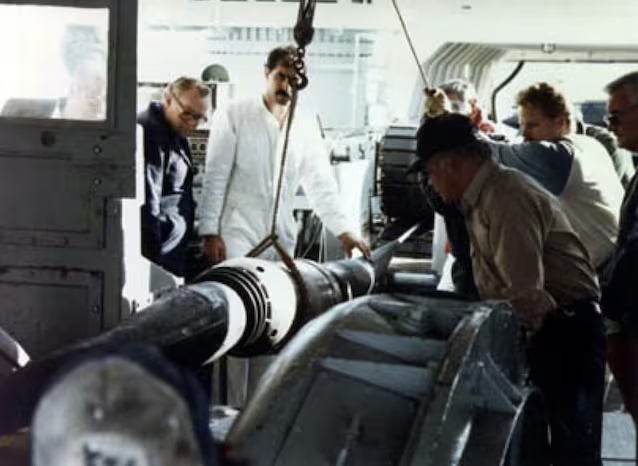
From that moment on, optical fiber progressively became the new standard for long-distance communications.
The undersea cables that keep the planet connected
When thinking about the Internet, satellites are often considered the primary means of global communication. In reality, most of the world’s data traffic travels through a gigantic network of undersea fiber optic cables laid on the ocean floor.
These infrastructures connect continents, nations and large data centers through hundreds of thousands of kilometers of links. Light pulses flow inside them, carrying information at very high speeds.
Submarine cables today represent a strategic component of the digital economy. Services such as streaming platforms, social networks, cloud computing, video conferencing and artificial intelligence systems directly depend on their ability to transfer enormous amounts of data in a very short time.
How fiber optics changed modern communications
Today, optical fiber is the basis of modern digital communications. Almost all information transmitted online passes through optical networks that cross cities, countries and oceans. Its diffusion has made increasingly faster Internet connections and advanced digital services possible.
What was little more than a physical demonstration in the 19th century has become the invisible foundation of global communication. Behind countless daily digital activities lies a long history of scientific research, technological innovation and intuitions that have transformed a thin thread of glass into one of the most important inventions of the digital age.