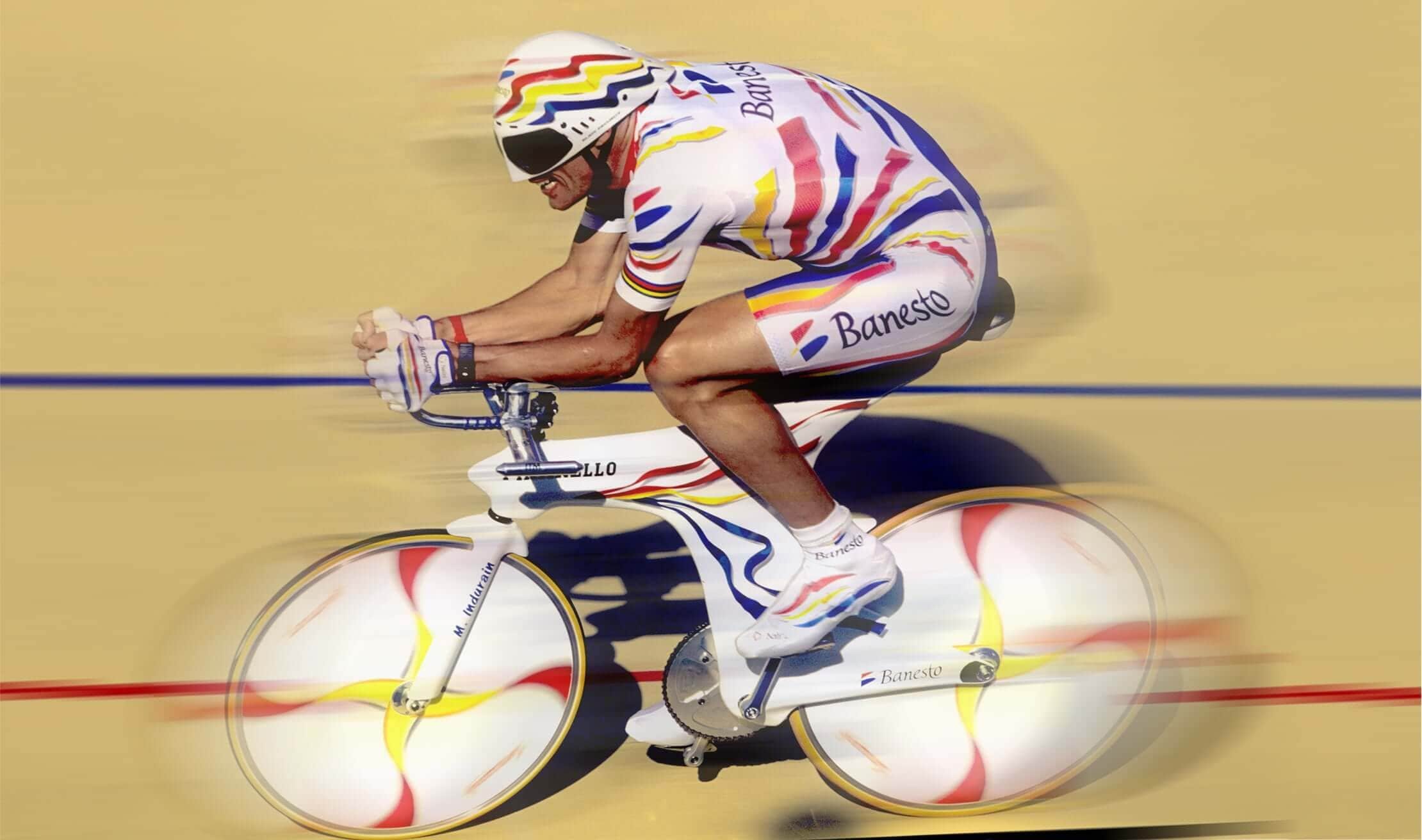
On January 19, 1984, at the velodrome in Mexico City, Francesco Moser set out to set the hour record with a bicycle that weighed almost double the one with which Eddy Merckx had set the record twelve years earlier: approximately 9.6 kg versus 5.75 kg. In cycling, where the obsession with lightness is almost a dogma, it seemed like a glaring mistake. It wasn’t: that day Moser covered 50.808 km in 60 minutes, erased Merckx’s record and four days later returned to the track to beat himself, bringing the record to 51.151 km. Ten years later Miguel Indurain would do something similar with the Pinarello Espada, a carbon frame born from the work of a Formula 1 engineer. Today, both of those bicycles would be disqualified before they even started: not because they have become obsolete, but because the International Cycling Union (UCI) has written specific rules to prohibit similar prototypes.
At 50 km/h the enemy isn’t weight, it’s air
If we try to take our hand out of a car window at 50 km/h and then at 100 km/h, the push of the air on our hand doesn’t double, it quadruples. In fact, air resistance increases with the square of the speed, and the power needed to overcome it even increases with the cube.
The result is that, above 40 km/h on a flat road, aerodynamic resistance absorbs more than 90% of the power produced by the cyclist. In an hour record attempt the effect is extreme: the track is flat, there are no hills or repeated accelerations and the speed remains practically constant for an hour. In those conditions the weight of the bicycle is almost irrelevant, because it only matters at the start, and precisely for this reason the Moser designers made a choice that at the time seemed to go against the trend: exchanging kilos in exchange for “shape”. The lenticular wheels alone of the record-breaking bike weighed 4.6 kg of the total 9.6. Furthermore, it is not so much the bicycle that generates the resistance but the cyclist’s body. A record-breaking bike, therefore, must not only be aerodynamic: it must allow the athlete to reduce the surface area of the body exposed to the air to a minimum.
Moser’s bike: solid wheels of different diameters
The project of Moser’s hour record bicycle bears the signature of Professor Antonio Dal Monte, physiologist and biomechanist of the CONI Sports Science Institute, with long experience in the world of aeronautics. The vehicle was tested in the Pininfarina wind tunnel, near Turin, in one of the first cases in which a bicycle and its rider ended up in front of an instrumented air flow.
The project thus created had some peculiarities that had never been seen on a track bike and which made that model iconic:
- Lenticular wheels: wheels without spokes, replaced by two solid carbon fiber shells. The advantage is intuitive: the spokes of a normal wheel are dozens of small obstacles that spin in the air and mess it up, while a smooth and continuous surface lets it slide. Wind tunnel tests indicate approximately 70% less resistance than a traditional spoked wheel when the wind comes from the front.
- The smallest front wheel: Moser mounted a 26″ in front and a 28″ in the rear. A lower front wheel allows you to lower the handlebars and therefore flatten your back: less surface exposed to the air, less resistance.
- The bull’s horn handlebar: compared to a road handlebar, it forced the arms to stay low and narrow along the body, further restricting the silhouette that the cyclist offered to the wind. The frame, made of steel with curved tubes, was designed precisely to support that posture.
A final ingredient that made that record possible was altitude. The Mexico City velodrome is located at approximately 2,240 meters, where the air is less dense than at sea level and offers less resistance at the same speed. The downside results in less oxygen for the muscles, which is why Moser moved to Mexico weeks earlier to acclimate.
The preparation also included autoblood transfusion: blood was drawn from the runner a few weeks before the test and it was reinfused shortly before the effort. The result of this practice involves an increase in red blood cells in circulation and therefore in the oxygen reaching the muscles, an even more precious advantage at altitude, where oxygen is scarce. In January 1984 the practice was not yet banned: the IOC Medical Commission outlawed it the following year.
Indurain’s Espada: the chassis designed in Formula 1
In the early 1990s Pinarello developed the Espada, a bike to attempt the hour record with Miguel Indurain, winner of 5 consecutive Tours de France and two Giri d’Italia between 1991 and 1995. It was the first carbon frame in Pinarello’s history and only four examples were built, all tailor-made for Indurain.
The leap compared to Moser’s bike is substantial: a traditional bicycle, even the most refined, remains a set of tubes joined together, and at each junction the air encounters an edge and starts to swirl. Carbon, on the other hand, can be shaped in molds: the Espada was built as a single piece, with a tapered profile similar to that of a wing, so that air could flow along the entire surface without hitches. Here too, the front wheel was smaller than the rear one, for a total weight of 7.5 kg. On 2 September 1994, at the Bordeaux velodrome, the Spaniard covered 53,040 km, the first man to cover over 53 kilometers in one hour.
Because today those bicycles would be outlawed
Between 1993 and 1996 the race for prototypes and the most extreme aerodynamic solutions was unleashed. Scotsman Graeme Obree took the record to 51.596 km on a home-built bike, with a “praying mantis” position and arms folded under his chest: the UCI banned it in 1994. Obree then invented the “superman” position, arms extended forward, which Chris Boardman used in September 1996 to set 56.375 km, a record destined to stand for twenty-six years. That position was also banned in October 1996. After all, if the body generates most of the resistance, that is where you gain the most.
In the same month the UCI approved the Lugano Charter, the document which still inspires the technical regulations today and which affirms the principle of the “primacy of man over machine”. These rules are quite stringent and are the reason why neither Moser’s bike nor the Espada could compete today. The UCI technical regulations require, among other things, that the two wheels have the same diameter and that the frame be of a “traditional model”, i.e. built around the classic triangle. The bicycle cannot weigh less than 6.8 kg and prototypes are also banned: to attempt a record the vehicle must be a model that can be purchased by anyone.
What is left of those bicycles
Of all the studies surrounding those bicycles, very little remains, except the most extreme forms. Lenticular wheels are still allowed in time trials and track time trials, one-piece molded carbon has become the industry standard and above all the idea that an aerodynamic bike beats a lightweight bike has passed. Confirmation came in 2022, when Filippo Ganna took the record to 56.792 km on a 3D printed bike with geometries inspired by humpback whale fins, finally surpassing Boardman’s 56.375 km.
It’s a similar dynamic to that seen in swimming with polyurethane suits in 2008-2009: a regulation doesn’t stop the technology, it channels it. Moser and Indurain’s bikes didn’t disappear because they didn’t work, they were banned because they worked too well.