Italian Republic Day is celebrated to remember the historic institutional referendum of 2 and 3 June 1946, aimed at deciding whether Italy would remain a monarchy or become a Republic after the end of the Second World War and the fascist regime. It is the main civil celebration of our country together with that of April 25, to which it is connected because, without the liberation from the fascist dictatorship and Nazi occupation, the Democratic Republic could not have existed.
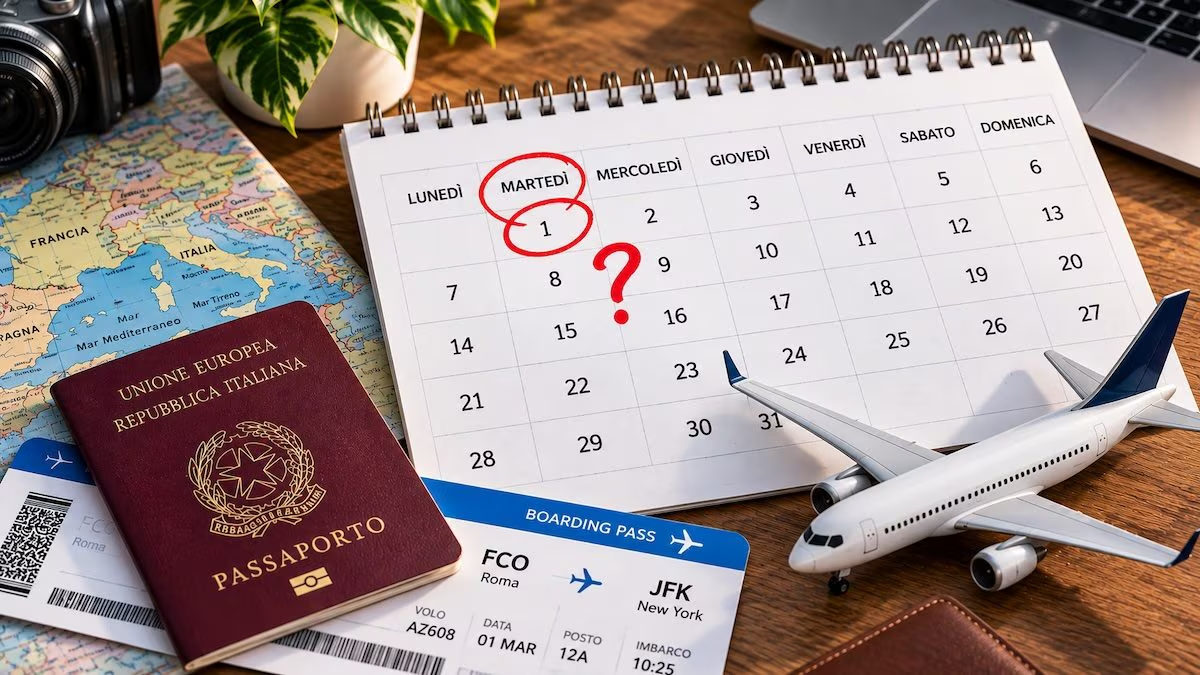
This year it is celebrated on Tuesday. Organized since 1947, Republic Day was officially established as a national holiday on 27 May 1949, with Law n.260, and transformed into a movable holiday in the 1970s: it was celebrated on the first Sunday of June and, for economic reasons, 2 June ceased to be a public holiday. The holiday was reinstated in 2001 at the behest of president Carlo Azeglio Ciampi. The celebration includes various rites, the most important of which is the military parade which takes place in Rome in via dei Fori imperiali and which has been held since 1948.
What is Republic Day on 2 June 2026
Italian Republic Day is celebrated every year on 2 June to remember the institutional referendum of 2 and 3 June 1946, through which, as we know, Italian citizens chose to abolish the monarchy and establish the Republic. The holiday of June 2nd therefore celebrates the very foundation of the State in which we live and has a value similar to that of July 4th for the Americans (anniversary of the Declaration of Independence in 1776) or July 14th for the French (anniversary of the storming of the Bastille during the Revolution in 1789).
The holiday of 2 June is intrinsically linked to the other great Italian civil holiday, that of 25 April, which celebrates the liberation from fascism and Nazi occupation. In fact, it was precisely the liberation that allowed the institutional referendum to be called and the Republic to be established; without the liberation, there would not have been a democratic Republic in Italy, but an authoritarian fascist dictatorship and citizens would not enjoy the freedoms and rights guaranteed by the Constitution.
The celebration of June 2nd is one of the most important rites of Italian civil religion: like all modern states, our Republic also needs symbols and celebrations that consolidate citizens’ sense of belonging and celebrate the institutions.
The history of the celebration of the 1946 referendum
A holiday to celebrate the establishment of the Italian Republic was organized as early as 1946, a few days after the referendum: since the results were proclaimed by the Court of Cassation on 10 June, the government declared 11 June a holiday, despite the fact that the Republic had not yet been officially established and the sovereign Umberto II, theoretically, was still head of state.
The holiday of 2 June was celebrated for the first time in 1947, the first anniversary of the referendum, at a time when the Constituent Assembly had not yet finished its work and the Constitution of the Republic had not been written. The main protagonist of the 1947 celebration was the provisional head of state, Enrico De Nicola (he did not yet have the title of President of the Republic, as the Constitution was not in force).
In 1949 the holiday was officially established and June 2 became a “red day” on the calendar, with schools and offices closed. It remained so until 1977, when, due to economic constraints (it was the period of oil shocks and austerity) the government decided to transform the celebration into a movable feast: it was celebrated on the first Sunday of June (no longer on day 2), so as not to miss a day of work. The June 2nd holiday was reinstated in 2001 at the initiative of President Carlo Azeglio Ciampi, who was particularly attentive to the valorization of national symbols. Since then the festival has always been celebrated.
The rites of the day: the military parade and other traditions
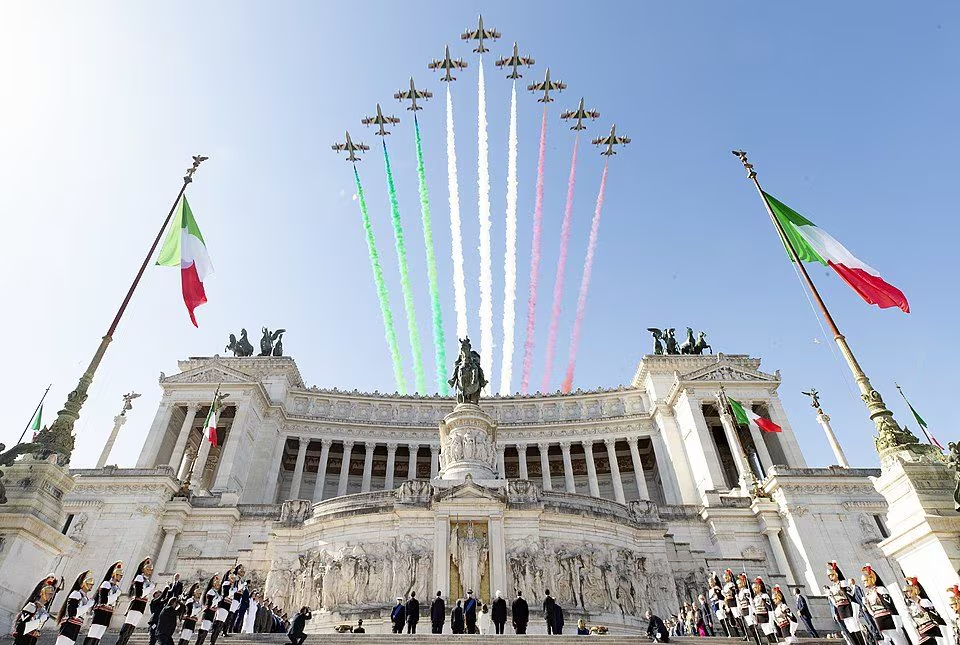
The celebration of June 2nd includes various rites and takes place in all provincial capitals. The most important celebration, as is logical, is that of Rome. The ceremony requires that in the morning the President of the Republic lay a laurel wreath at the tomb of the unknown soldier at the Altar of the Fatherland, near the Vittoriano, where the flag raising also takes place. At the end of the ritual, the tricolor arrows take flight, crossing the skies of Rome leaving trails of white, red and green colours.
Afterwards, the president reviews the military departments and moves to via dei Fori imperiali, where the parade takes place, the most important and characteristic event of the festival. The parade was first organized in 1948 and was held regularly until 1975. It was eliminated from the program in 1976 due to the earthquake in Friuli and the following year, when the celebration became a movable festival, it was replaced by a more sober military ceremony in Piazza Venezia. In the 1980s the parade was first reinstated and later abolished again (obviously, when June 2 was not a holiday, the parade was held on the first Sunday in June). It was definitively restored in 2000, by will of President Ciampi.
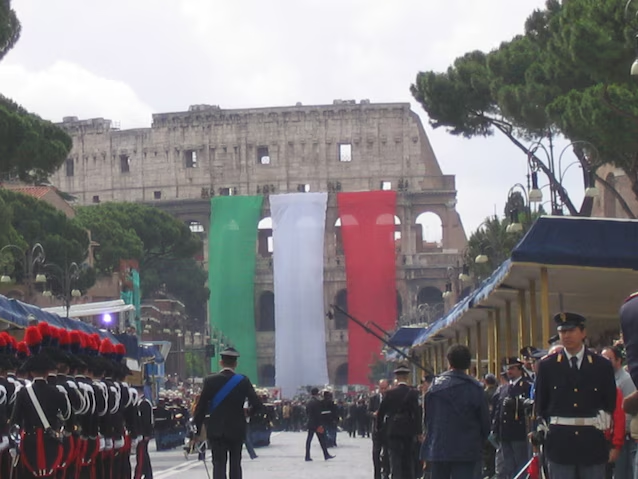
Participating in the parade are departments of the four armed forces (army, navy, air force and carabinieri), as well as the police, fire brigade, civil protection and the red cross. The highest representatives of the institutions attend, together with the President of the Republic.
In addition to the ceremony in Rome, celebrations are held on June 2nd in all the provincial capitals. Abroad, Italian embassies organize receptions and ceremonies.