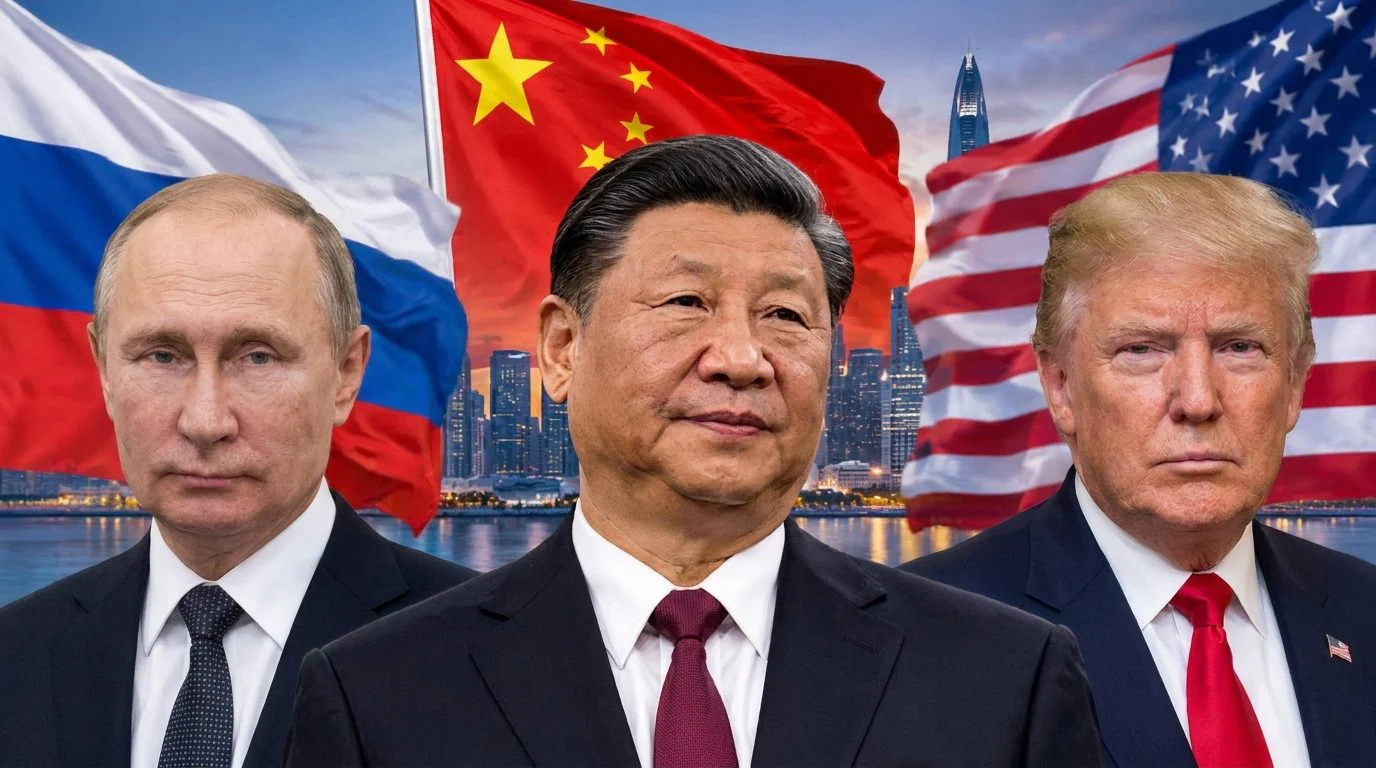
Today, November 19, 2026, a historic meeting is scheduled in Shenzhen, China: US President Donald Trump, his Chinese counterpart Xi Jinping and his Russian counterpart Vladimir Putin will hold a trilateral summit, the first in history which directly involves the leaders of the United States, Russia and China.
The meeting will be organized on the sidelines of the annual APEC summit (Asia-Pacific Economic Cooperation), the organization for economic cooperation between the countries of Asia and the Pacific.
The importance of this trilateral is clear, to the point that some analysts have defined it as a “Yalta 2.0”, comparing it to the Yalta Conference of February 1945 when the United States, the United Kingdom and the Soviet Union began to define Europe’s spheres of influence for the post-World War II period, coordinating the final phases of the war against Nazi Germany.
However, for most experts this parallel does not hold: today’s Russia is not the Soviet superpower of ’45 and, above all, the summit seems more like an image operation than a table capable of producing concrete decisions for the future.
The three leaders, in fact, have agendas, visions and strategic objectives that are too different from each other to be able to achieve a concrete result, at least in the short term.
The trilateral will not be a new “Yalta Conference 2.0”
In February 1945, in the city of Yalta in Crimea, the leaders of the United States, the United Kingdom and the Soviet Union (Franklin D. Roosevelt, Winston Churchill and Iosif Stalin respectively) met to decide on the structure of Europe after the end of the Second World War, already taking the defeat of Nazi Germany as a given.
Since then, the name “Yalta” has become synonymous with the division of spheres of influence between great powers, until it resurfaced in 2026 on the occasion of the first summit in history between China, the USA and Russia.
In Shenzhen, however, the picture is profoundly different compared to Yalta: first of all, the actors have changed, with China taking the place of the United Kingdom and Russia no longer being the superpower that emerged victorious in 1945 after having contributed decisively to the defeat of Nazi Germany, taking control of much of Eastern Europe.
Today, Moscow finds itself locked in a war of attrition against Ukraine that has lasted for over 4 years and, above all, Putin is much weaker as a global leader, isolated from much of the West (especially Europe) and with an International Criminal Court arrest warrant for war crimes.
But the main difference with Yalta is that, in this case, the three leaders do not have a common goal. The Yalta Conference had a very specific purpose: to defeat Nazi Germany, coordinate the post-war occupation and divide up each other’s areas of influence.
And, regardless of the tensions and incompatibilities that already existed between the 3 powers (and which would later give rise to the Cold War), the common objective was clear and shared by all participants: today, in Shenzhen, there is no comparable common goal.
Each of the three leaders arrives with their own agenda which is largely irreconcilable with that of the others: according to several analysts, at this summit there are too many worldviews and too many competing strategic interests to produce significant agreements.
However, there is a position that, at least apparently, seems to be shared by all three states: the idea that issues of global importance should be dealt with directly by the great powers, excluding or in any case limiting the involvement of other states.
Even on this, however, analysts highlight how Beijing is still trying to preserve its image as a multilateral mediator, avoiding further compromising relations with Europe.
In any case, among the notable absentees at this summit there are countries that we will continue to hear about in the future: Ukraine (and more generally Europe), Iran, Taiwan.
And, as is often repeated in the world of geopolitics, “If you’re not on the table, you’re on the menu”: if you’re not at the table, you’re on the menu. Translated: if you do not participate directly in the decisions that concern you, you will end up being controlled or divided among other stronger powers.
What Trump, Putin and Xi Jinping really want from this meeting
Trump, Putin and Xi Jinping therefore arrive in Shenzhen with different and largely irreconcilable objectives. But what are they really looking for from this summit?
Russia and Vladimir Putin are looking for recognition: in reality, Moscow needs to recreate a “Yalta-style” context, in which the great powers decide the fate of nations considered minor. In this case, clearly, the focus is on Ukraine, for which Putin aims to obtain Xi’s support to push Trump to maintain pressure on Kiev.
In short, Russia hopes that this table will serve to strengthen its image (after years in which it was isolated globally) and thus lead to a solution to the war that is advantageous for itself: the mere fact that Washington shows itself willing to negotiate with Russia can weaken not only Ukraine, but also Europe.
We must consider that for Putin isolation is not only a problem of image, but also and above all of strategy: a single Russia also weighs less in the relationship with China. And between Moscow and Beijing, beyond appearances, there is no real alliance. An isolated and weaker Russia risks coming to the table as a subordinate partner, and not as an equal.
China, on the other hand, by hosting the summit, aims above all to show its ability to gather the leaders of the two great powers around itself, a useful message for Xi Jinping especially with regards to internal public opinion, in view of next year’s Party Congress, which should award him a fourth mandate as general secretary.
Precisely for this reason, Beijing is also looking for “spectacle, not substance” as reported by some analysts: an event controlled in every detail, without surprises, which serves to strengthen the leader’s authority also and above all on the internal level.
Finally, as regards the United States, in Shenzhen they will try to address arms control: the New START treaty, which limited the strategic arsenals of the United States and Russia, expired in February and Trump would like to draw up an agreement that also includes China, which so far has rejected trilateral negotiations, claiming to have a much smaller (but still rapidly growing) arsenal.
Among other things, after the serious defeat of his party in the midterm elections, Donald Trump is looking for success on a global level: in the next two years, his power will be partly reduced due to an opposition-led Congress and the President could therefore shift his focus to foreign policy, looking for new international stages where he can stand out.
In short, the result is a meeting that counts above all in terms of visibility and image. Experts do not expect significant decisions: the symbolic value of the event weighs heavily, which offers Putin a place alongside the two most powerful leaders in the world and places the United States in the same room as the major authoritarian regimes.
Several analysts describe it as little more than a geopolitical theater: even those who defend its usefulness define it more as a precedent for the future than as a summit that will lead to concrete results.