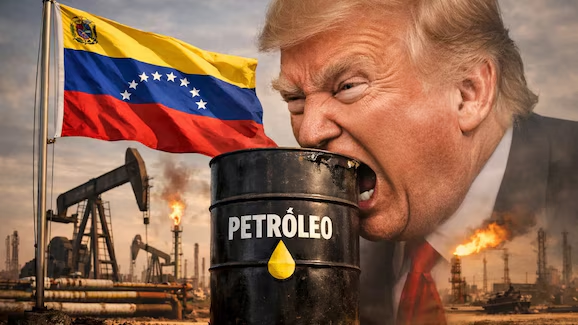
After the air raids on Venezuela and the capture of President Maduro together with his wife, Donald Trump recently announced that the United States will receive between 30 and 50 million barrels of oil from Venezuela, which will be free from sanctions and which can be resold at market prices. At the same time Trump asked the current Venezuelan President interim Delcy Rodriguez to sever any economic relations with China, Cuba, Iran and Russia, Venezuela’s main allies and economic partners in the oil field. In this context, President Trump’s already well-known aims on Greenland have also come back to the fore, expressing the need for US national security to control it or – even – purchase it from Denmark.
Venezuela is one of the countries richest in oil deposits: the agreement
I am pleased to announce that the transitional authorities in Venezuela will deliver between 30 and 50 million barrels of high-quality, sanctions-free oil to the United States of America. This oil will be sold at market price and the proceeds will be managed by me, as President of the United States of America, to ensure that it is used for the benefit of the Venezuelan people and the United States!
Remember that Venezuela is one of the countries richest in oil deposits in the world: according to the US Energy Information Administration it has around 20% of the world’s reserves, equal to around 303 billion barrels. To date, also following the harsh sanctions imposed by the United States, Venezuela produces around 1 million barrels a day – around 0.8% of global crude oil production. The national oil company, Petróleos de Venezuela Sociedad Anónima (PDVSA), was once one of the most important in Latin America, but the lack of investment and mismanagement of PDVSA have led to a huge decline in production over the last 20 years: until 2000 production was around 3.2 million barrels per day (mbd).
U.S. international sanctions against the Venezuelan government and a deep economic crisis have contributed to the decline of the country’s oil industry, along with a lack of investment and maintenance, according to the EIA. All this has made Venezuela a place shaken by economic crises and external shocks. Meanwhile, the Beijing government accuses the United States of having violated international law, underlining that Venezuela is a sovereign state and therefore possesses “full and permanent sovereignty over its natural resources and its economic activities”.
Greenland is an important strategic point for the Arctic Route
Following the events linked to Venezuela, in recent days President Trump has once again returned to addressing the Greenland issue, declaring that control of the island constitutes a priority for the national security of the United States and even expressing his desire to purchase it from Denmark.
During the Cold War, the island had already been used as a base for ballistic missile testing, the US military notably used Thule Air Base (now Pituffik NATO Base), located in the municipality of Avannaata in northern Greenland.
The island is an important strategic point in the international context for the control of the Arctic Route, which crosses the Arctic Ocean along eight different states. This route is almost entirely controlled by Russia, given the extent of Siberia, but is becoming increasingly relevant due to the melting of ice in the area. Undoubtedly, however, one of the main reasons for US interest is linked to the wealth of raw materials and energy sources in the Greenlandic territory.
Greenland, in fact, is rich in vast deposits of hydrocarbons and minerals, such as gold, platinum, zinc, nickel, uranium and rare earths. These minerals and rare earth elements are essential components in emerging technologies, especially in the energy sector, such as electric vehicles and wind turbines, as well as having applications for national security in the field of advanced military technologies: drones and missile guidance systems above all. Unlike others, the Greenlandic deposits of rare metals are still little exploited and explored, also due to the difficulties linked to climatic conditions: they are in fact found beneath thick layers of ice that are difficult to access. Furthermore, the logistics and extraction infrastructures present on the island are not yet fully developed.
The similarities between Venezuela and Greenland
Numerous international observers and analysts have compared the situations of the two countries, declining them based on US ambitions and strategic interests. The interest both for Greenland – for the control of the Arctic Route – and for Venezuela – to reaffirm US “hegemony” over the territories of Latin America and to stem the Russian and Chinese presence in those territories – is common to both.
Secondly, the component linked to the control of energy and mineral resources is undoubtedly strong in both cases, albeit with the necessary differences mainly linked to the accessibility of resources and mineral deposits. Therefore, both the economic and energy supply aspects and the military-strategic one to limit the Chinese and Russian presence in these territories are a common denominator for Venezuela and Greenland, together with a clear desire to reaffirm the hegemony and greatness of the United States in the international context.
What are the differences between the two cases
The Prime Minister of Greenland, Jens Frederik Nielsen, however, wanted to underline the difference with Venezuela, downplaying President Trump’s statements. First of all, Greenland is a country that has a democratic political system and is formally part of the Kingdom of Denmark, despite enjoying a status of autonomy. We are talking about a Special Territory of the European Union – despite not being part of the EU – of a country allied with the United States, and under the NATO umbrella.
On the contrary, Venezuela had a President and a government not recognized by the United States and ten other countries (Paraguay, Argentina, Costa Rica, Chile, Ecuador, Guatemala, Panama, Peru, Dominican Republic and Uruguay) considered an authoritarian regime and also internationally isolated from a defense point of view. Indeed, although China and Russia have always expressed their support for Venezuela, also condemning Trump’s action from the point of view of international law, to date none of these powers provides support in defensive terms to Venezuela.
Greenland, being under the NATO umbrella, enjoys a completely different position. Furthermore, the hypothesis of a military intervention in the country or coercive actions – such as those which occurred in Venezuela – in the case of Greenland seems remote, compared to a “diplomatic” or negotiation route, including the absurd hypothesis of purchase from Denmark.