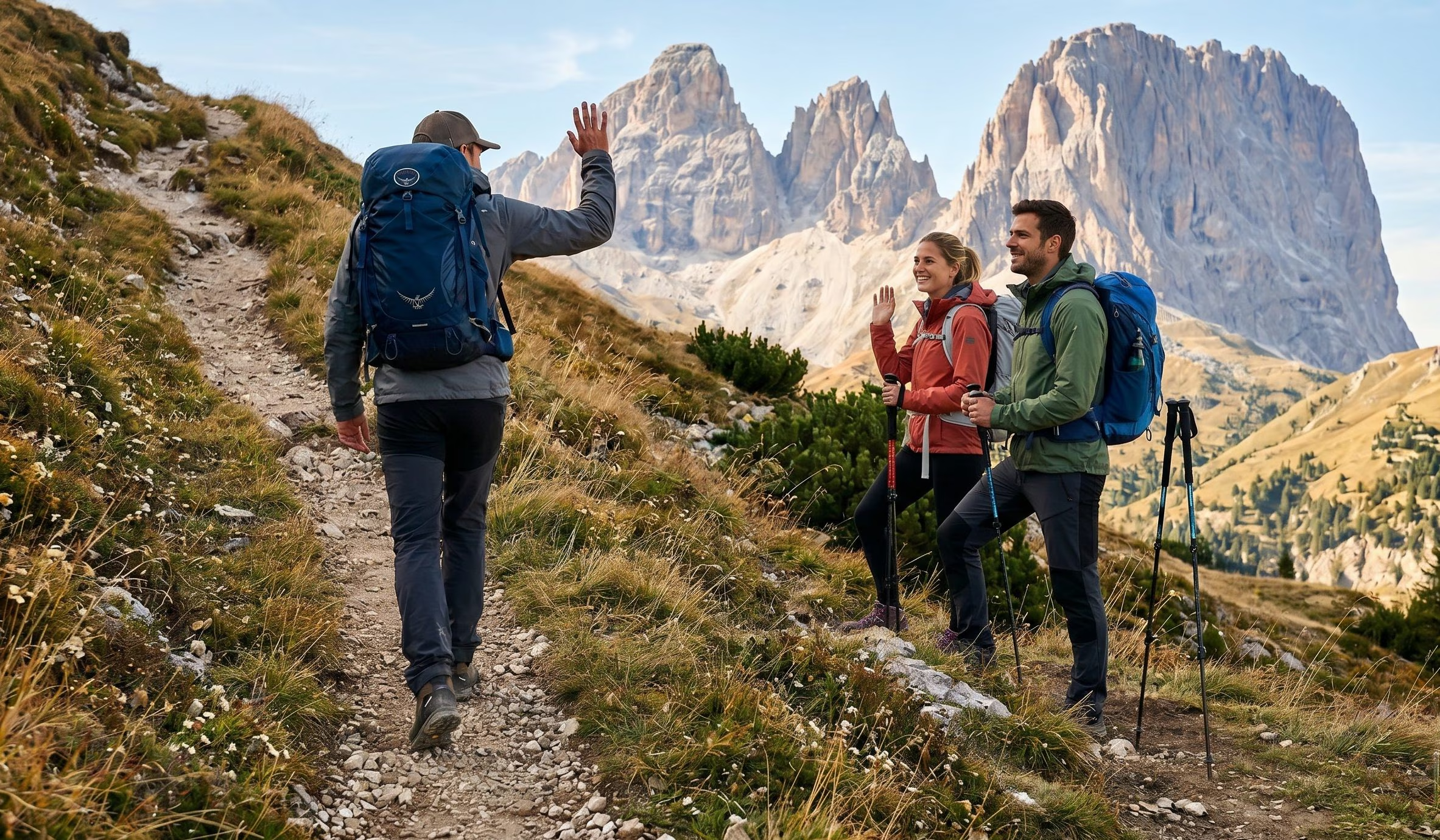
It may have happened to you, when going for a hike in the mountains, that you come across other walkers and receive a greeting – which, out of good manners, you will certainly have reciprocated.
This is a widespread custom that has various cultural and social meanings and functions that we may not expect, but which prove important in cases of emergency. In fact, it is not just a question of courtesy and a way to strengthen the sense of community and respect between hikers, demonstrating a form of mutual altruism made spontaneous and necessary by the exceptional nature of the mountain, but also a gesture that can contribute to safety on the paths.
The mountain greeting is a way to create community
The idea has often been described in outdoor literature and dissemination that, in isolated contexts such as mountain ones, contact between strangers tends to generate rapid forms of mutual recognition and willingness to cooperate. In this sense, the greeting between hikers is interpreted as an immediate social signal that reduces the distance between individuals and facilitates a collaborative attitude.
Some authors and popularizers of the Alpine environment and nature photography have observed this phenomenon, describing it as a sort of “greeting effect” or “hello factor”, that is, the tendency to establish minimal but significant contact in situations where human encounters are less frequent than in urban environments. The “hello” (often more frequent than the “good morning”, to further reduce the distance) is something that comes more spontaneously to us in an exceptional situation compared to ordinary everyday life. In this context, the greeting does not have a codified or normative function, but represents an informal social practice that is passed down: it helps to create a climate of mutual recognition, which can also be useful in terms of attention and collaboration in the event of difficulties along the way.
In a context of greater silence – to be maintained so as not to disturb the fauna and to allow us and others to hear useful sounds, from natural noises that can alert us to cries or whistles for help from people in difficulty – the greeting acquires an even stronger value, because it expresses the fact that we have noticed the other, especially on narrow paths, where attention is essential to avoid accidents.
Gestures that contribute to safety on the trails
When you meet, in addition to greeting, it is a good idea to point out any dangers, obstacles on the path, landslides and avalanches or poorly visible indications – and, if necessary, give some information as realistic as possible about how long it is until the next refreshment point. This information should not only be shared with hikers, but also with refugee workers because, in turn, they will be able to share information and advice with those who come after us, and at the information points that are often found downstream, in more touristy contexts.
When you meet one or more hikers, mountaineers or skiers, in addition to vocalizing, it is also important to look at each other’s faces. It is useful, in case of emergency, to remember some general elements of the encounter – such as the location of the path, the direction of travel and the weather conditions – which can help any reconstructions in case of reporting to shelters or rescue services.
There is no “official” code that defines the greeting as a safety or monitoring tool, nor are there any standard procedures among hikers: these are good informal practices aimed at making a potentially dangerous environment safer for everyone.
Etiquette during excursions: priorities and refusals
In addition to greeting, among the good practices that demonstrate openness and care for others and that are passed down in the mountains is giving way to those who go faster than us and to those who walk in our direction uphill, when we are going downhill: in general, in fact, it is good to give priority to those who are struggling more than us. And if we have a dog with us, it is always a good idea for it to remain on a leash, to prevent it from interacting with the local fauna or frightening hikers, putting them in danger.
Mountain “etiquette” also contributes to respect for the territory and sustainability: it is essential to always take your waste back to the valley, including fruit peels and food remains. The number one rule is not to leave anything on the path, so as not to pollute or alter the already fragile ecosystems in any way. Even in refuges at high altitude, it is always best not to leave waste that could be disposed of with greater logistical difficulties. This is why it is always a good idea to have a bag with you in which to collect them, including the peels: in fact, even if they are organic and biodegradable waste, they can interfere with the feeding of local animals, altering their behavior.
Speaking of ecosystems: respect for mountain territories and their biodiversity requires not only not abandoning waste, but also not picking flowers or plants – not only because they could be poisonous. Many of the species we find are in fact species protected by local and national regulations, and even occasional collection can contribute to their rarefaction in highly frequented areas. Rather than collecting them, therefore, you can always photograph them!