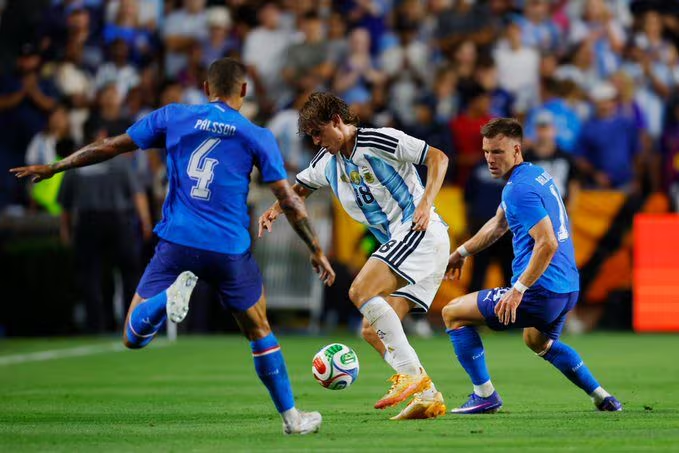
How many footballers we see every weekend in Serie A are playing to win the 2026 World Cup? The answer is 66, with names such as Lautaro Martinez, Kevin De Bruyne, Rafael Leao, Christian Pulisic and Romelu Lukaku: it is a figure that at first glance seems similar to those of the past. But the numbers must be read carefully because in the meantime the tournament has changed profoundly. Since 2026, the World Cup has gone from 32 to 48 teams, and therefore from 736 to 1248 total players called up. Furthermore, for the third consecutive edition, Italy is missing, which in 2006 brought the entire world champion national team made up exclusively of Serie A players. Let’s see then how the presence of our championship at the World Cup has evolved, and whether the data really shows its decline.
From 2006 to today, the progress of Serie A squads and the 2026 list
To understand how Serie A’s presence at the World Cup has evolved, we need to look at the progress of the latest editions. In 2006, the year of the Italian triumph in Berlin, our championship sent 60 players to the World Cup out of a total of 736 called up, 8.2%. The share increased further in the following two editions, reaching an all-time high in 2014. In fact, Serie A brought 80 players to Brazil, over 10% of the total squad, confirming the international weight of a championship that continued to attract foreign stars and top-level prospects from all over the world.
Things changed in 2018, when the share fell below 8%, also due to Italy’s sensational failure to qualify for that edition, the first after sixty years. In 2022 there was a small recovery, while in 2026 Serie A brought 66 players to the World Cup. However, with the expansion of the tournament to 48 teams and 1,248 players overall, its percentage share fell to an all-time low, below 5.5%. A clear drop, but one that needs to be put into context, because the tournament has changed profoundly in the meantime, and with it also the balance of power between the big championships.
In absolute terms, Serie A does not send fewer players to the World Cup compared to twenty years ago (66 against 60). What is decreasing instead is the relative weight of the Italian championship within a tournament which in the meantime has expanded significantly. The expansion to 48 teams has in fact profoundly changed the composition of the tournament. Many of the new places went to national teams from Asia and Africa, expanding the overall pool of players called up well beyond the main European leagues and thus reducing the percentage weight of leagues such as Serie A.
Below is the list of 66 players called up:
- Milan (10)
Alexis Saelemaekers (Belgium)
Koni De Winter (Belgium)
Luka Modrić (Croatia)
Pervis Estupiñán (Ecuador)
Mike Maignan (France)
Adrien Rabiot (France)
Santiago Giménez (Mexico)
Rafael Leão (Portugal)
Christian Pulisic (United States)
Ardon Jashari (Switzerland) - Atalanta (8)
Charles De Ketelaere (Belgium)
Sead Kolašinac (Bosnia and Herzegovina)
Ederson (Brazil)
Odilon Kossounou (Ivory Coast)
Mario Pašalić (Croatia)
Kamaldeen Sulemana (Ghana)
Marten de Roon (Netherlands)
Isak Hien (Sweden) - Inter (7)
Lautaro Martínez (Argentina)
Ange-Yoan Bonny (Ivory Coast)
Petar Sučić (Croatia)
Marcus Thuram (France)
Denzel Dumfries (Netherlands)
Manuel Akanji (Switzerland)
Hakan Çalhanoğlu (Türkiye) - Juventus (6)
Gleison Bremer (Brazil)
Jonathan David (Canada)
Teun Koopmeiners (Netherlands)
Francisco Conceição (Portugal)
Kenan Yıldız (Türkiye)
Weston McKennie (USA) - Bologna (5)
Jhon Lucumí (Colombia)
Nikola Moro (Croatia)
Torbjørn Heggem (Norway)
Lewis Ferguson (Scotland)
Remo Freuler (Switzerland) - Rome (5)
Ndicka (Ivory Coast)
Kone (France)
El Aynaoui (Morocco)
Malen (Netherlands)
Celik (Türkiye) - Naples (4)
Scott McTominay (Scotland)
Kevin De Bruyne (Belgium)
Romelu Lukaku (Belgium)
Mathías Olivera (Uruguay) - Sassuolo (4)
Volpato (Australia)
Muharemović (Bosnia and Herzegovina)
Ismaël Koné (Canada)
Kristian Thorstvedt (Norway) - Como (3)
Nico Paz (Argentina)
Martin Baturina (Croatia)
Assane Diao (Senegal) - Turin (3)
Nikola Vlašić (Croatia)
Marcus Pedersen (Norway)
Ché Adams (Scotland) - Venice (3)
Michael Svoboda (Austria)
John Yeboah (Ecuador)
Marko Farji (Iraq)
- Genoa (2)
Johan Vásquez (Mexico)
Leo Skiri Ostigard (Norway)
- Parma (2)
Alessandro Circati (Australia)
Zion Suzuki (Japan)
- Cagliari (1)
Yerry Mina (Colombia)
- Fiorentina (1)
Marin Pongracic (Croatia)
- Frosinone (1)
Fares Ghedjemis (Algeria)
- Udinese (1)
Jesper Karlström (Sweden)
The weight of the Italians’ failure to qualify
The purely numerical comparison between the editions is inevitably unbalanced by the fact that, from 2018 onwards, Serie A is missing a huge chunk of players called up: those of the Italian national team itself. In 2006, for example, all 23 players of the world champion national team played in Serie A: an era in which our championship was the home of the best Italian talents and beyond.
Today, with Italy out of the World Cup for the third consecutive time, Serie A automatically loses around twenty players who instead enrich the statistics of other championships when their respective national teams participate. This means that the drop in the Serie A share is not only a sign of the championship’s less attractiveness for top-level foreign players, but also a direct consequence of the Azzurri’s failure.
The comparison with the Premier League
If you want to understand how far Serie A is today from the top of European football, just look at the Premier League, which alone provides 154 players at the 2026 World Cup, more than double the Italian championship. An enormous distance, which tells better than any other statistic how English football has become in the last fifteen years the magnet for the best talents on the planet, thanks to an out-of-scale economic capacity and an international appeal that no other league possesses.
Even looking at individual clubs, the gap clearly emerges. Manchester City leads the table with 19 players called up from 12 different national teams, setting a new record in the history of the World Cup and surpassing Barcelona’s previous record (17 in 2022), as reported in the Instagram post below. Alone, the English club brings more players to the tournament than some entire domestic leagues provide.
Milan, the most represented Italian team, stops at 10: a significant figure, but which highlights the distance from the main Premier League clubs.
The comparison with the Premier League, however, also risks distorting the perception of the data. With 66 players in the squad, Serie A remains relatively close to both La Liga (74) and Ligue 1 (78). And if Italy had managed to qualify, adding around twenty players from the Italian league, Serie A would in all likelihood have risen to third place among the most represented leagues at the World Cup. The picture that emerges is therefore that of a championship that has lost ground compared to the Premier League, but which maintains an international dimension comparable to that of the other major European championships.