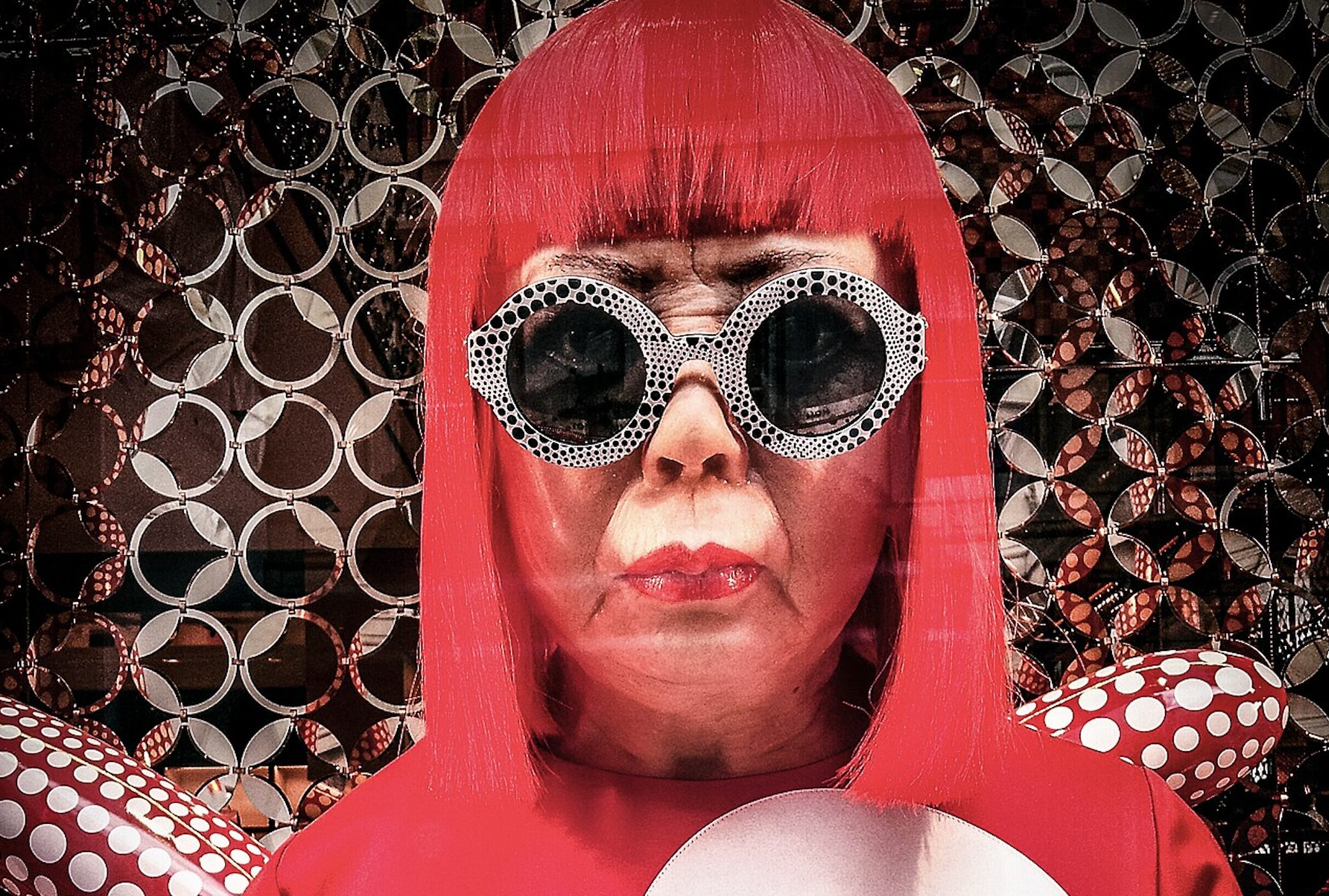
The Japanese artist Yayoi Kusama has often been reduced to the image of the “polka dot artist”, or even the “infinity rooms”. It is true that many of his works obsessively feature the characteristic dots, and that some of his most recent and appreciated installations are the Infinity Rooms, which use mirrors and lights to create very suggestive immersive environments. This, however, does not mean that Kusama, who died last August 14 in Tokyo at the age of 97, did not have an important role in the art of the twentieth century, with many plagiarists, including famous ones, as we will see, and a prestigious international career, made more difficult by a long psychiatric experience. Today she is one of the most loved and best-selling artists in the world. Let’s see his story.
The beginnings of the artist Yayoi Kusama
Yayoi Kusama was born in 1929 in the mountainous region of Matsumoto in central Japan. Her family, who earned their living by growing seeds, gave her a very traditional education: for this reason, when she began to show interest in art around the age of ten, they tried to make her give up. In this period her mother (who even tore her drawings!) forced Yayoi to spy on her unfaithful father with his lovers: the experience was so traumatic that it caused an obsession and hatred for sex that continued throughout her life and greatly influenced her art.
With the outbreak of the Second World War, the young Yayoi also suffered the fate of school children and went to work (up to 12 hours a day) in a parachute factory. He always continued to draw, and throughout his adolescence he exhibited his works publicly.
In 1948, after the end of the war, she convinced her parents to let her go to Kyoto to study painting (in the Japanese modernist nihonga style). He continued his studies in Kamakura, and began organizing prestigious solo exhibitions in the early 1950s. But the conventional approach of her teachers was no longer enough for her, and she decided to move to the United States also on the advice of the famous American painter Georgia O’Keefe, with whom she exchanged letters.
The revolution: Yayoi Kusama in the United States
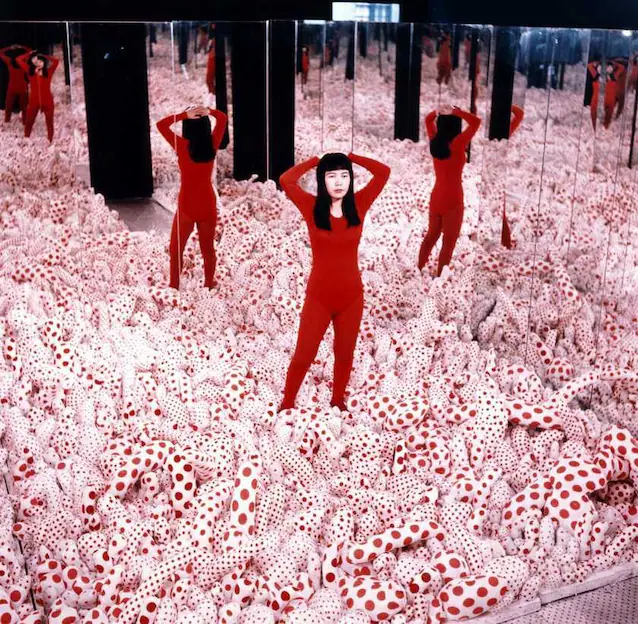
Having moved to New York in 1957, she continued to create incessantly: the local artistic environment, however, took several years to grant her the fame she deserved, and in the meantime famous Pop Art artists such as Claes Oldenburg and Andy Warhol appropriated her ideas. When avant-garde artist Lucas Samaras stole her idea of the mirrored room, the first ever created in the world, Kusama jumped from her apartment window.
Once again, however, she didn’t give up and went back to creating. In 1966 he went to the Venice Biennale uninvited to present his famous “Daffodil Garden,” a powerful critique of the commercialization of the art world. The work itself consisted of 1,500 mirror balls, which she sold for a few dollars each until she was stopped by the police.
Also dating back to this period are the Infinity Net series of paintings, large canvases with endlessly repeated brushstrokes that anticipated the serial techniques of Minimalism and Conceptual Art, and the “Accumulations”, sculptures that depict everyday objects covered by an obsessive series of repeated shapes: these works, also called “Furniture of Compulsion”, were created by collecting objects from the streets of New York (such as a sofa, shoes or an ironing board), which were then covered with forms of white fabric padded with cotton: she identified them as “penises”. The mass of phallic forms, as well as her numerous performances with naked people, reflected Kusama’s efforts to address her sexual anxieties.
Yayoi Kusama from mental hospital to fame
These performances caused great scandal in the USA and Japan; Kusama returned to her native country, but found hostility: after another suicide attempt she sought psychiatric help and was admitted to hospital. Once again, he never stopped creating. She was forgotten for many years, until the Japanese art historian Akira Tatehata managed to convince the government to let her represent Japan at the 1993 Venice Biennale. The exhibition was a worldwide success and finally brought her fame: since then this success, which led her to have her own museum in Tokyo, has never stopped.
Today Yayoi Kusama is the best-selling female artist in the world. Having passed away at the age of 97, she was incredibly prolific and active. You will have seen her in newspapers and on social media with her colorful wigs and an eclectic and flamboyant style: Kusama has always been passionate about fashion, and in the late 1960s she even founded her own clothing company, with daring garments that featured ambiguous openings (which revealed the wearer’s breasts, buttocks or genitals): for her performance “Homosexual Wedding” in 1968, she also designed a wedding dress “orgy” for two people.