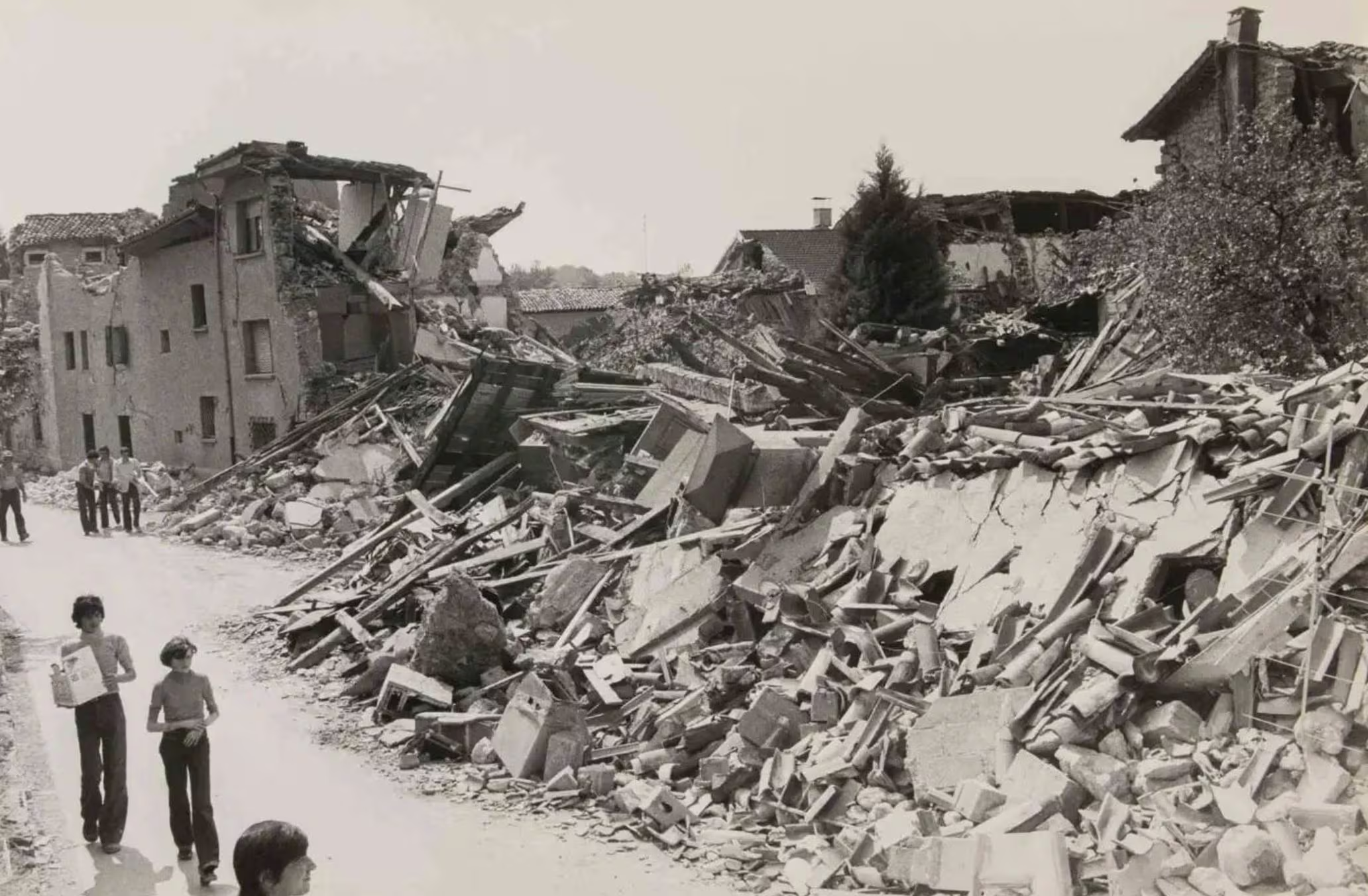
The 1976 earthquake in Friuli was the most violent recorded in Northern Italy in the instrumental era and the fifth most intense earthquake recorded in Italy. At 9.00 pm the earth shook with a violence that had not been seen in the area for centuries: the tremor, with its epicenter in the Gemona area, north of Udine, was of magnitude 6.5 and recorded a value between the ninth and tenth on the Mercalli scale, with total destruction of over 18,000 buildings. 989 people lost their lives and over 100,000 were left homeless. Fifty years later, the Friuli earthquake is also the story of how a devastated territory managed to get back on its feet in a relatively short time thanks to an approach to management and reconstruction called the “Friuli model”, which gave the impetus for the birth of modern Civil Protection with the establishment of territorial operational centers and also worked thanks to widespread integration between public institutions and citizens.
The earthquake of May 6, 1976: the earth shook in the heart of Friuli
At 9pm on 6 May 1976 the earthquake struck the foothills of the eastern Alps. It was a very shallow earthquake, with a depth of only 5.7 km. The epicenter of the main shock, which lasted 59 seconds, was near Gemona del Friuli, but affected an area of 5700 km2 and was felt throughout central-northern Italy and central Europe. The seismic district of the Julian Alps is one of the most complex from a geological point of view in the Alpine chain: here the Adriatic microplate, moving about 2 millimeters per year towards the north, generates a system of slips and reverse faults which before 1976 had not been activated for over four centuries.
The toll was devastating: 989 dead, 2607 injured and over 100,000 displaced in 137 municipalities between the provinces of Udine, Pordenone and Gorizia. The towns closest to the epicenter (Gemona, Venzone, Trasaghis, Bordano, Forgaria, Majano, Osoppo, Artegna, Buja) were completely destroyed. To make the situation worse, landslides and soil liquefaction phenomena were added (especially in the Osoppo area) which blocked roads and hindered rescue operations.
The earthquake was only the beginning of a massive seismic sequence that ended only in September 1977. After the main earthquake and an initial period of relative calm, between 11 and 15 September 1976 there were other tremors of high magnitude, of which the most violent was on 15 September with magnitude 6.1 and caused another 13 victims. After a year the seismic sequence of Friuli counted over 1200 earthquakes. The sequence ended with a magnitude 5.2 shock that had its epicenter in Lusevera, about 10 km east of Gemona.
Emergency management and the revolution of operational centers
In the first hours, thousands of soldiers were mobilised, also thanks to the help of radio amateurs who managed to lead the first interventions since the telephone lines had been destroyed.
The following day the Honorable Giuseppe Zamberletti was appointed by the Government of the time as Extraordinary Commissioner for the coordination of relief efforts. He was immediately given operational carte blanche and an immediate regional allocation of 10 billion lire. First of all, Zamberletti established the Sector Operations Centers (now Mixed Operations Centers) spread throughout the earthquake-stricken territories. Each center hosted a crisis unit which acted as a point of reference for the mayor of the municipality concerned for the management of local emergencies. The mayors had decision-making power over rescue operations, relying on the fact that they knew the needs and specificities of their territory.
It was the first time in Italy that the management of an emergency was decentralized. This model worked very well also due to the shape of the affected areas, mainly composed of small independent urban centres, but it remained a standard which is still part of the operational philosophy of the Civil Protection today. In fact, the model began the modern approach to emergency management in Italy.
Reconstruction after the earthquake
The other challenge faced by Zamberletti was assistance to displaced people and the restoration of essential services. The Extraordinary Commissioner coordinated the transport of approximately 40,000 people to the Friulian Adriatic coast, hosted in hotel and holiday facilities and who were provided with social, health, transport and educational services. In the meantime, prefabricated villages were quickly built in the destroyed areas, which allowed around 70,000 homeless people to return to their municipalities of origin in the spring of 1977, a year after the tragedy.
The choice to return the displaced to their countries of origin also derived from a strong will spread among the earthquake-stricken population. This was one of the central debates that arose even before the emergency phase ended: what to do with the destroyed countries? The choice was summed up in a formula that later became a slogan: “Where it was and how it was”, that is, giving life back to the destroyed towns instead of settling the displaced in other areas. To do this, priority was given to guaranteeing the possibility for the population to return to work: restarting the working machine (especially industrial) was necessary to allow the communities to return to live in their places of origin. This approach was also summed up in a formula that later became famous: “First the factories, then the houses, then the churches”.
Because the “Friuli model” was a success
The one just described was the heart of the so-called “Friuli model”, which was very successful: a year after the earthquake, over 90% of the 450 damaged companies had resumed activity. Employment in the industrial sector exceeded pre-earthquake levels two years after the tragedy. The building reconstruction of the affected areas was also complete and relatively rapid: within 10 years, 17,000 destroyed buildings were rebuilt and all 75,000 buildings damaged by the earthquake were repaired. The guiding principle was to return the destroyed countries as similar as possible to what they were before the earthquake. In Venzone, for example, one of the municipalities most affected by the disaster, the stone blocks of the collapsed buildings were numbered and preserved to be reassembled as they were.
This efficiency was the product of multiple factors that combined in a way that was difficult to replicate. The presence of an Autonomous Region with broad legislative competences allowed direct management of the funds. To this must be added international solidarity, in which the United States participated above all (which had installed the Aviano military base in Friuli) but also many countries that had seen Friulian immigration in the past. The “Friuli model” therefore worked due to various specificities that made the case exceptional in its own way: Zamberletti’s approach and choices, the widespread integration at the territorial level between public bodies and citizens, without neglecting the resilience and social cohesion of the population affected by the tragedy.
This is also demonstrated by the comparison with another tragic earthquake, that of Irpinia which in 1980 devastated Campania and Basilicata causing almost 3000 victims. Even in that case Zamberletti was appointed Extraordinary Commissioner, but the conditions were different: there was no Autonomous Region with extraordinary powers, there was not the same institutional cohesion between local authorities and central government and – last but not least – part of the funds was managed in a questionable or even irregular manner, so much so that in 1990 the parliamentary inquiry known as “Hands on the Earthquake” was established.
How emergency management has changed in Italy: the birth of the Civil Protection Department
Contrary to what is sometimes read, it was not the only earthquake in Friuli that led to the establishment of a permanent civil protection structure. The aforementioned tragedy in Irpinia and the dramatic case of Vermicino, in which little Alfredino Rampi died after falling into a well in 1981, also served this purpose. The Department of Civil Protection was thus officially born in 1982 as a permanent structure capable of intervening in a coordinated manner throughout the national territory. In fact it was the institutionalization of what Giuseppe Zamberletti had implemented six years earlier in Friuli: local operational centers, direct involvement of mayors, decentralized management.
The Friulian seismic sequence of 1976-1977, with its 1200 earthquakes and the work of the Geophysical Observatory of Trieste, confirmed that studying an earthquake in real time was possible. This led to the creation in 1977 of the first permanent seismometric network in Friuli, which later merged into the INGV National Seismic Network which monitors the seismic activity of the entire country in real time.