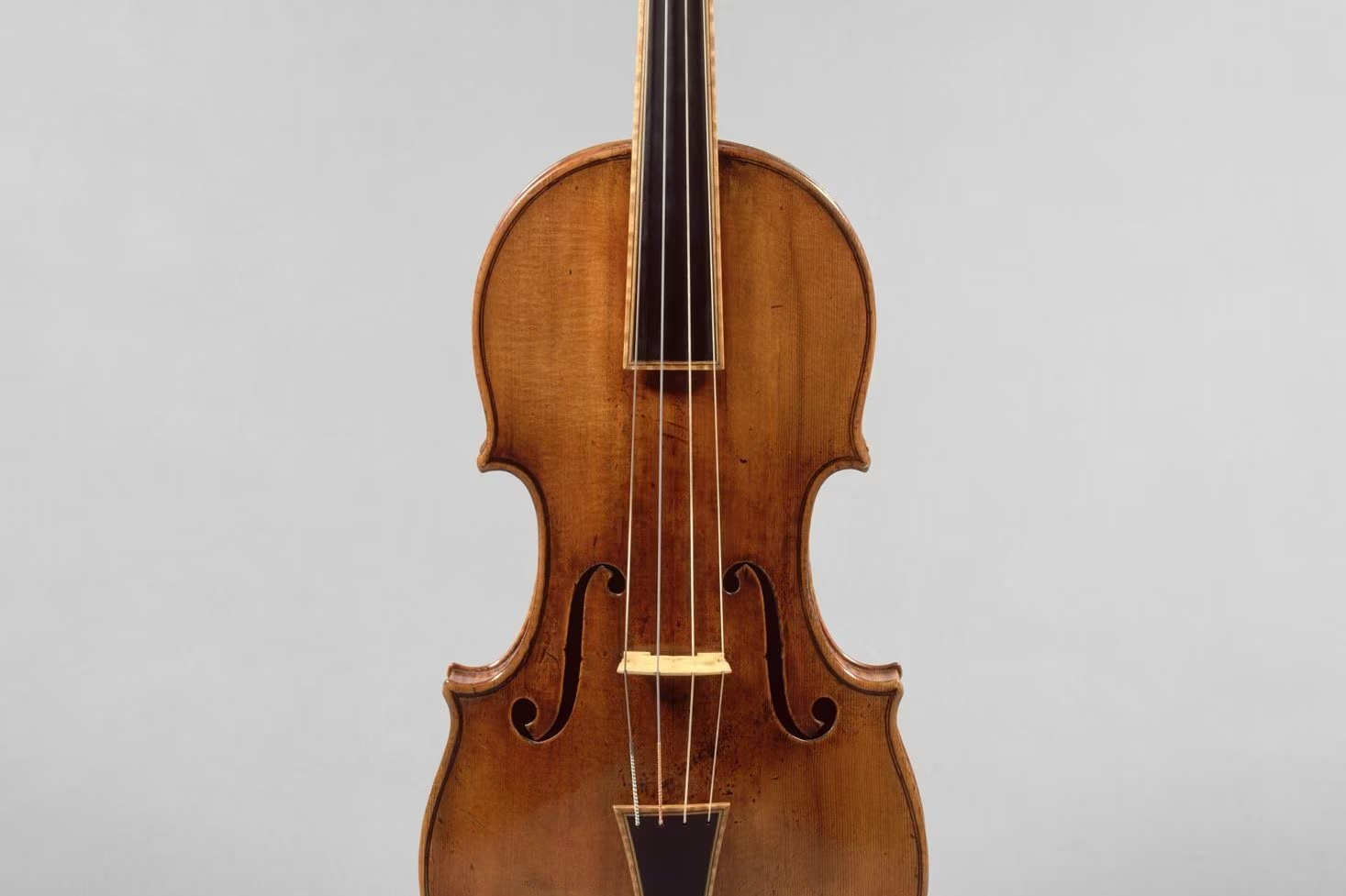
Stradivari are the most famous violins in the world and among the most valuable of all: they can be worth millions of euros due to their extraordinary quality and their rarity (to date there are around 650 examples, of which around fifty are intact). The creations of the famous Cremonese musician, considered among the best luthiers of all time and who lived between the mid-seventeenth century and the mid-eighteenth century, are often considered the pinnacle of the artisanal production of classical violins. For many years, scholars have assumed that it was not only the construction technique that was unique, but also the wood used for the construction of the “soundboards”, i.e. the flat (or slightly curved) surfaces of an instrument that increase its sonority. After centuries of mystery about the origins of this special wood, new research has finally traced its origin: most of the soundboards were made with a particular type of spruce (Picea abies) grown at very high altitudes in harsh climatic conditions.
These climatic conditions are very particular and are identified with the “Maunder Minimum”. But what is it about? Included in the Little Ice Age – that long period from about 1300 to 1850 in which European temperatures were lower than average – the Maunder Minimum is a period of time between about 1645 and 1715, during which sunspots became extremely rare. Reduced solar activity may have contributed to further climate cooling: specifically, average global temperatures would have dropped between 1 and 2°C, affecting tree growth. The resulting wood is particularly dense and homogeneous, ideal for the construction of soundboards.
How did we come to identify this period in such a specific way? The research of the international consortium coordinated by the Italian Institute for the Bioeconomy of the National Research Council analyzed 314 sets of growth rings of 284 original violins by Antonio Stradivari, demonstrating that the luthier often used wood from the same tree to make multiple instruments and that its sources can be traced back to the Eastern Alps.
First, however, a clarification needs to be made. Antonio Stradivari’s production is usually divided into several phases: there is the “early period” (around 1666-1680), the “transition period” (around 1680-1700), the “golden period” (around 1700-1725) and, finally, the “late period” (1725-1737). Comparison with 197 reference chronologies indicated that Stradivari’s early works drew on different and less easily locatable sources. During his “golden age” of production, starting from the early 18th century, Stradivari instead selected only spruce from high altitude forests in Trentino, most likely from Val di Fiemme.
Evidently, the search for the “perfect” shafts in terms of acoustic properties, but also workability and aesthetics was a fundamental element in achieving the peaks of quality in violin making, obviously together with the artisanal and musical qualities of Stradivari.
With this discovery two great results are obtained: first of all, it provides the first large-scale dendrochronological evidence (i.e. dating based on counting the annual growth rings of trees) relating to the geographical and environmental origins of Stradivari wood; secondly, it opens the way to new and exciting perspectives on the interaction between climate, raw materials and musical heritage.