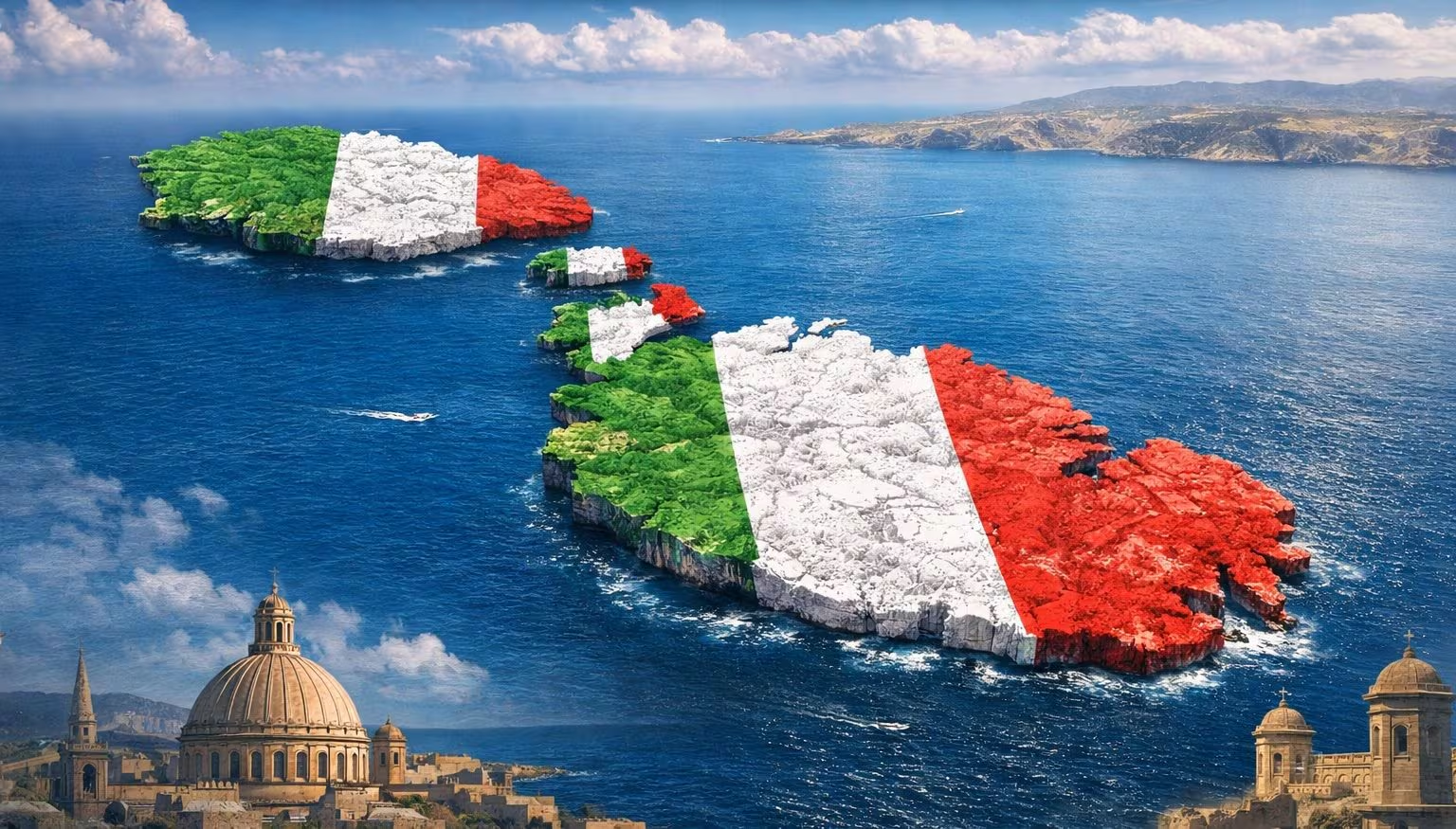
Despite being only 90 km from the Sicilian coast, Malta is not Italian: when the Kingdom of Italy was established in 1861, the Maltese archipelago had belonged to the British Empire for many years. Moreover, the archipelago located in the Mediterranean had never been “Italian”: it had been controlled by the Kingdom of Sicily for a few centuries in the Middle Ages, but the link was severed in 1530. Until the first half of the twentieth century, a pro-Italian movement was active on the island, which however was greatly weakened during the Second World War. In 1964, when British domination ended, Malta chose independence: since 2004 the Republic of Malta has also been a member of the European Union. Today the Maltese, despite undergoing some cultural influences, do not feel Italian in any way and the ruling class of the Peninsula has ceased to make demands of any kind.
The position of Malta, the sovereign state that never belonged to Italy
The Malta archipelago – made up of the three major islands of Malta, Gozo and Comino and some smaller islands and rocks – is located just 90 kilometers from the Sicilian coast and geographically belongs to the Italian region. The archipelago is closer to Italy than islands such as Lampedusa and Linosa (located over 200 km from the Sicilian coast), which instead belong to the Italian Republic.
Malta also undergoes a significant cultural influence from Italy. Until 1934, Italian was one of the official languages of the archipelago and is still spoken, or at least understood, by many inhabitants today. Italian, and more specifically Sicilian, influences are also evident in the cuisine, popular traditions and architecture. In many other aspects, however, Malta is culturally different from Italy: the official language, Maltese (the country’s official language together with English), is a Semitic language deriving from Arabic, although it has undergone Italian influences; the judicial system is modeled on that of the United Kingdom, some customs and traditions (for example, the direction of travel to the left) derive from English domination. What is more important, the Maltese do not consider themselves Italian at all.
Throughout history, moreover, Malta has never been “Italian”, although for some centuries it was controlled by the Kingdom of Sicily.
From the Kingdom of Sicily to the British domination of the archipelago
Over the centuries the Maltese archipelago, by virtue of its position in the center of the Mediterranean, has undergone numerous dominations. In ancient times it was part of the dominions of Rome and Byzantium, until, in the 9th century, it was conquered by the Arabs. In 1091 it was occupied by the Normans and effectively united to the Kingdom of Sicily, of which it continued to be part until the 16th century. Control, in some periods, was more nominal than real. In 1530 Emperor Charles V, who also held the title of King of Sicily, ceded possession of the island to a chivalric military order, the Knights Hospitallers (one of the military orders born in the Holy Land at the time of the Crusades), who since then became known as the Knights of Malta.
Thus, the political link with Sicily was severed. The knights controlled Malta until 1798, when the brief occupation of the French troops began, forced in 1800 to surrender to the siege of the English fleet. Since then the archipelago entered the orbit of London and, with the Treaty of Paris of 1814, was officially annexed to the territories of the British Empire.
Relations between the island and united Italy: annexationist movement and independence
In 1861, when the Kingdom of Italy was established, Malta had been under British domination for almost fifty years. A movement developed in the archipelago which called for annexation to Italy and during the twenty years of fascism it was financed by the government of Rome. The pro-Italian movement, however, was opposed by the English, who in 1942 executed the main exponent, Carmelo Borg Pisani, for high treason. During the Second World War, Malta was repeatedly bombed by Italian and German armed forces, but was never conquered.
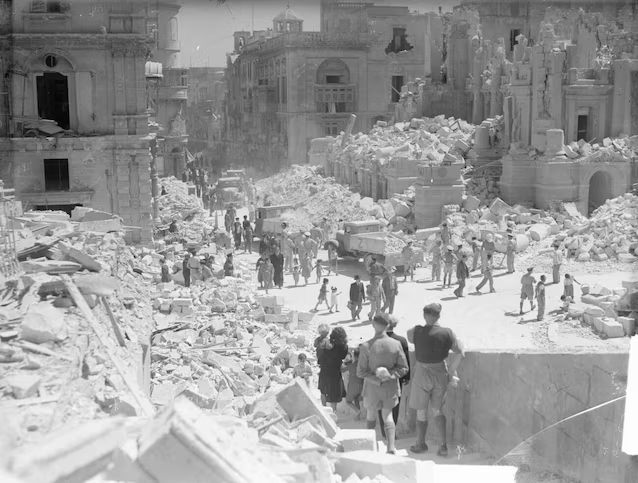
After the war, the pro-Italian movement weakened irreversibly. In 1964 the island gained independence and in 1974 it transformed into a Republic. Italy, ceasing all claims on the archipelago, has maintained very cordial relations with it and, by virtue of a 1980 agreement, is the guarantor of its neutrality: Malta has undertaken not to enter into any alliance and Italy has guaranteed to intervene in the event that the sovereignty of the archipelago is called into question by a third country.