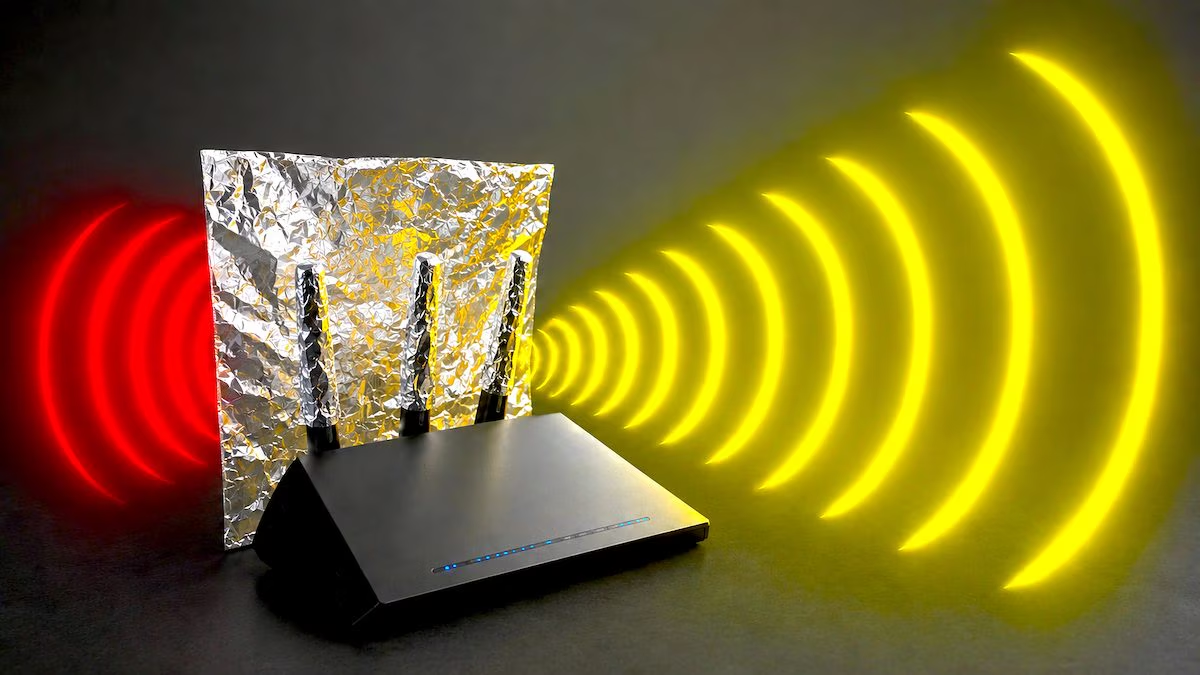
If your home Wi-Fi is slow, you could try building a rudimentary directional reflector of the wireless signal coming from your modem/router at home using tinfoil and a 3D printer. This is what emerges, in a nutshell, from work conducted in 2017 by a team of researchers from Dartmouth College. The physical principle behind this “trick” is solid and well documented: metals reflect electromagnetic waves, including the radio waves that the router uses to communicate with connected devices. Taking advantage of this property to “direct” the wireless signal into the most frequented areas of the home can improve signal reception in the areas where it has more difficulty reaching. Let’s see in more detail how the system works.
The aluminum foil experiment conducted by Dartmouth researchers
The system created by the team of researchers at Dartmouth College It consists of a 3D printed reflector, coated with a thin metal layer, capable of concentrating Wi-Fi coverage in the rooms where it is needed most and reducing it elsewhere. Xia Zhou, an associate professor at Dartmouth and part of the team of researchers who conducted the experiment, explained:
With a simple investment of around $35 and specifying coverage requirements, a wireless spotlight can be custom built to outperform antennas costing thousands of dollars.
Zhou and his team experimented with various types of directional antennas, also testing a rather curious solution that was born almost by word of mouth: placing an aluminum can behind the router to direct radio waves towards a specific area. After several attempts and optimizations, the researchers managed to design structures capable of improving the Wi-Fi signal in specific environments of the home or office. They subsequently developed software, called WiPrint, capable of generating and 3D printing the most suitable shape to “guide” the wireless signal, so as to obtain more efficient signal coverage. Once made, these reflectors simply need to be coated with a thin layer of aluminum.
According to what emerged from the tests, the reflectors created by the group are able to direct the Wi-Fi signal with considerable precision, limiting its diffusion in some areas and instead concentrating it where it is most needed, improving the quality of the connection and reducing the dispersion of the signal towards unwanted areas. But how is all this possible?
Wi-Fi waves can pass through materials such as wood, glass and some concrete walls, but with variable attenuation. Other materials are much more difficult for this type of wireless wave to penetrate. Water, for example, absorbs them significantly, which is why placing an aquarium in front of the router is a very bad idea. Metals, on the other hand, reflect them. This makes them potentially useful as tools for “shaping” wireless coverage, but also sources of disturbance when they fall into the wrong path: a metal cabinet near the router can alter the signal unpredictably, as can mirrors, which contain a thin metal coating.
Home router antennas are generally nearly omnidirectional in the horizontal plane. The signal, therefore, is not “pointed” in a specific direction and, for this reason, part of the signal is also propagated outside your home, for example in your neighbours’ apartment.
This is where the search for comes in Dartmouth Collegepresented in 2017 at the ACM BuildSys conference (Association for Computing Machinery), held in Delft, the Netherlands. The researchers designed an algorithm capable of calculating the optimal three-dimensional shape of a reflector, taking into account the floor plan of the house, the position of the router and the areas where the signal is to be strengthened or attenuated. The reflector, 3D printed and coated with a surface layer of aluminum, is then positioned around the router’s antennas. In tests conducted by the researchers, the tool reduced signal strength by up to 10 dB in unwanted areas, increasing it by 6 dB where required. The system was tested on both the 2.4 GHz and 5 GHz frequencies, the two bands typical of modern dual-band routers.
The opinion of independent experts on the “trick” for slow Wi-Fi
The approach has found the consensus of independent experts. Among these is Swarun Kumar, professor at Carnegie Mellon Universityaccording to which the idea is physically founded and, to use his words, «it makes perfect sense». Also Eric Siu, head of product development at Linksysa company specializing in wireless routers, recognized the principle effectiveness of the technique. Siu, however, was cautious about the DIY use of tinfoil. The reason is purely regulatory: in the United States, the FCC – the Federal Communications Commissionor the telecommunications regulator – imposes precise limits on the maximum power that a router can radiate in a certain direction. Artificially concentrating the signal could technically violate these thresholds. In Europe there are similar regulations managed by ETSI, theEuropean Telecommunications Standards Institute. Now, this doesn’t mean that the home experiment with tinfoil is dangerous, but that carrying it out could potentially violate these regulations.