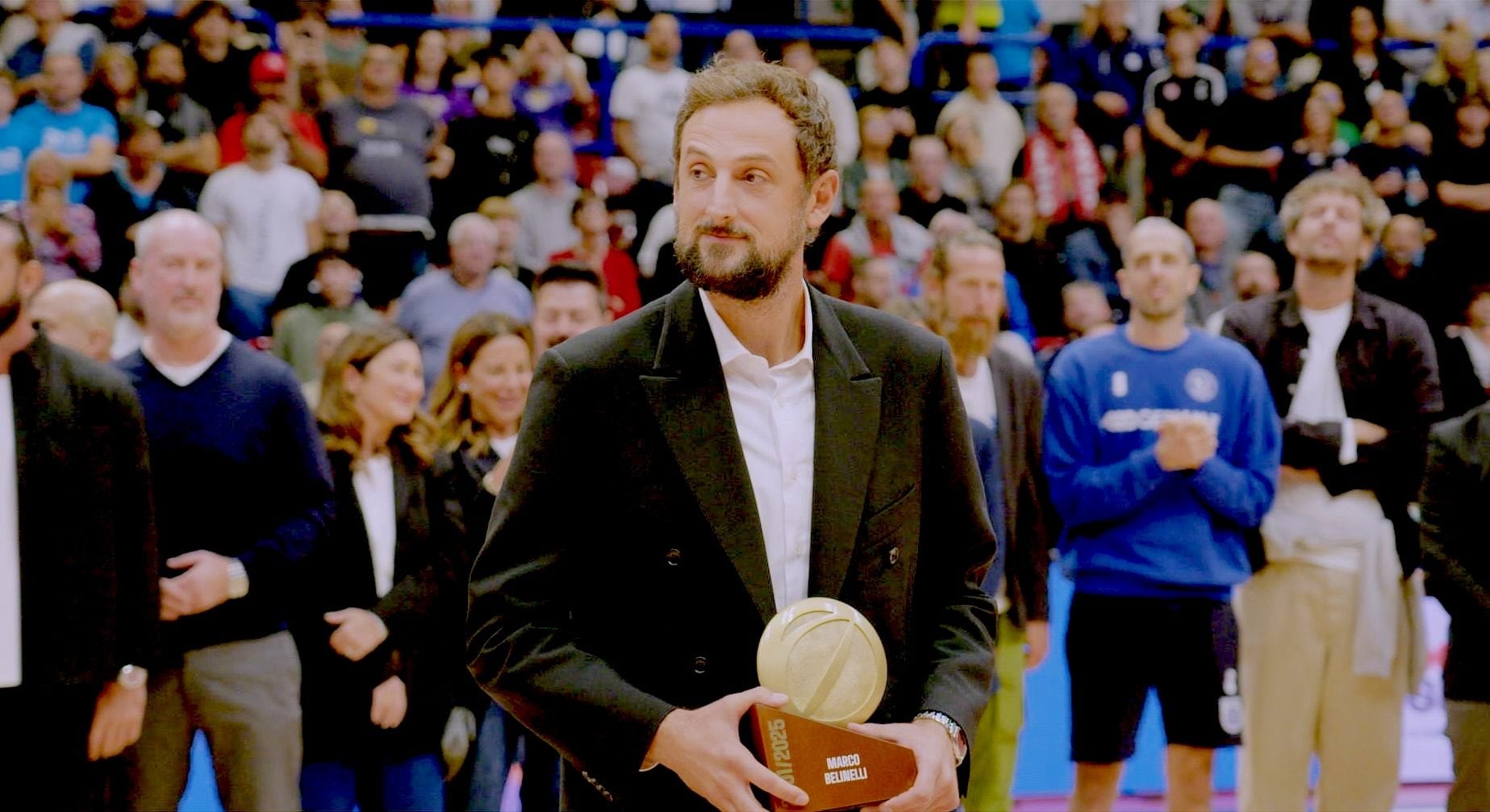
While i 2026 NBA Playoffs they come to life and keep millions of fans glued to the screen even in Italy, we met someone who experienced those Playoffs as a protagonist and a champion. Marco Belinellithe only Italian to have ever lifted the Larry O’Brien trophy, hung up his shoes at 39 years old after a 13-season career in the NBA and a triumphant finish in Bologna, with two championships won with the Virtus shirt.
A story that lives on today also thanks to “The Basketball Dream“, the documentary dedicated to his journey from the dream of a child from San Giovanni in Persiceto (Bologna) to the ring he won with the San Antonio Spurs. And it was from that dream that we started to ask him to tell us what really changes when we enter the second part of the season, where the intensity doubles: the preparation of the body, the management of the mind, the weight of technology, the art of missing a decisive shot without throwing yourself down.
Marco, let’s start with an image. Is there an exact moment when you realized that the NBA Playoffs were a different sport than the regular season?
I really experienced it firsthand in my first Playoffs, with New Orleans against the Lakers. In that series I was marked by Ron Artest and I came home every night covered in bruises. I never complained, on the contrary: I had a great desire, physically and mentally, to understand what the difference really was between an NBA Playoff and everything else.
Because that’s when you understand that everything changes. The game becomes much harder and you are completely denied what you do well: in my case, coming out of blocks, shooting threes. When you think of sensational players like Kobe Bryant or Michael Jordan, what makes you understand how strong they are is precisely that between a regular season game and a Playoff game you don’t feel the difference in their performances, they are almost unstoppable despite all the opposing defenses and preparations.
You played Playoffs in both leagues. What is the biggest difference between an NBA Playoff and a Playoff in Italy?
They are two very different things. In Italy there are few matches, and when the Playoffs arrive you experience them with a particular intensity: there is an attachment to the shirt, to the club, to the fans, to the family that comes to watch you. It’s a lot of emotional pressure. In the NBA, however, the season is very long – 82 games – and you play every two-three days. Stress is of another type, especially physical. You live the regular season games more lightly, saving energy to give everything in the Playoffs. They are two completely different endeavors.
48 hours pass between Race 1 and Race 2. Tell us about your typical day after a Playoff match: what did you eat, how did you sleep, what technologies did you use on your body?
Nutrition is always important, but it must be modulated based on the minutes you play. We have always been followed by nutritionists, both in the NBA and at Virtus. My routine was fixed, I ate the same things the night before and on the day of the match, I slept 6-8 hours at night and on the day of the match an hour of rest in the afternoon. Then a snack before the match to have the right energy.
After the games, especially in the Playoffs, lots of stretching. Targeted preparation with the physical trainer even beforehand, because with age I needed more time to warm up my body. But the most important thing was the muscle massage immediately afterwards, and the cold water tub for 10-15 minutes, I immersed myself up to the navel, every now and then a couple of minutes up to the shoulders. The feeling was precisely that of coming back fresh, ready for the next day, and it also helped me mentally: it was a moment to disconnect.
How much does technology have an impact on energy recovery and management?
Very, very much. When I started there wasn’t this evolution. Today the whole package – nutrition, therapies, cryotherapy – has given me the opportunity to retire at 39. Previously the players retired around 31-33.
Even the way of reading matches has changed: once we worked on sensations and experience, today every movement is monitored. Advanced statistics have changed everything, you no longer just look at points scored, but efficiency, spacing, defensive impact. And workouts are much more personalized thanks to data. In recent years we have been wearing sensors under our shirts (wearableed.) of the match: they tell you in real time when to stop and when you can still push. It’s the thing that changed my career the most and allowed me to rest when my body asked me to.
So numbers, lungs and legs help a lot. But there is one thing that in my opinion is even more important: the head. If I had to give a percentage, does the body or the mind matter more in the Playoffs?
Both. Technology tells you how much you can push and when to slow down, but when you’re on the pitch it’s your head that decides. You want to give 100%, you don’t want to give up just because some data tells you “slow down”. Mental management is the first weapon: if you give up that, you have little left. In the last 5-6 years in the NBA there was a mental coach available for these aspects, but I always managed to stay clear on my own.
Speaking of clarity: you were often the shooter who took the last shot. When you missed a decisive shot, did you have a routine, a word, a gesture to reset and move on to the next action?
I have had a great gift in my career, I have always understood – not as a child, but as I grew up – that mistakes are part of life and basketball. If you think too much about the wrong action, you are already late for the next one.
In point-to-point finals it’s a mental issue, because the adrenaline rises, the heart speeds up, and you have to stay clear. In my career there have been many down moments: games in which I couldn’t make a basket, in which I rushed my shots because I wanted to mentally unblock myself. But I always thought ahead, I never looked back. I was never afraid of negative moments, because I knew that they are fought with work, confidence and repetitions.
You just mentioned adrenaline. Do you recognize, from within, the difference between being just the right amount of energy and being too nervous?
It happened to me, especially when I was young, that I wanted to break the world. You feel that you win the match, you want the decisive ball. Even before the match you say to yourself: “This is a final, I feel it very much”. In those cases, the more you feel it, the more — from my personal point of view — the result is poor. If, however, you face matches, even the most important ones, always maintaining the same routine, in the long run you will achieve consistent positive results.
Having said that, there are players who really need to feel alive, to start aggressively, to have a lot of adrenaline in their body. They exist and it is normal that they exist.
All this led you to win the NBA ring – the only Italian one – and three championships in Italy. If you had to describe that feeling in one word, is it impossible?
With one word it is very complicated. They are all special victories, but I am very attached to Bologna: returning after 13 years of the NBA and winning the scudetto with Virtus, together with my wife, my family and my friends, had a different value from many other victories in the past.
The NBA has been a lifelong dream. As a child I watched videotapes of the Bulls, Lakers, Celtics, and what always stuck with me were the celebrations in the locker room: the attachment to the team, the victory cigar, the delivery of the ring. Really experiencing it with the San Antonio Spurs — Pop’s speech (Gregg Popovich, ed.), the whole family celebrating, the champagne — was one of the best moments.
In the famous video in which you were moved after that victory, what passed in front of you?
It was a very quick moment in which all the complicated moments passed before me, all the sentences and all the people who didn’t believe in me. But in the end, criticism is part of the game, like losses and missed shots. These are all things that, put together, made me become the person and player I was.
We close with a message: to a young boy with the dream of a career in basketball – his “Basketball Dream”, which is the title of your documentary – what would you say?
First of all, to have patience, which many young people today do not have, because they want everything immediately. And to continue working: talent matters, but it’s not enough. The other important thing is to never stop having fun playing, because it is passion that allows you to move forward even when your body is tired and your head is under pressure. And then believe in your own abilities, even when others don’t make you understand. So: passion, patience, hard work.