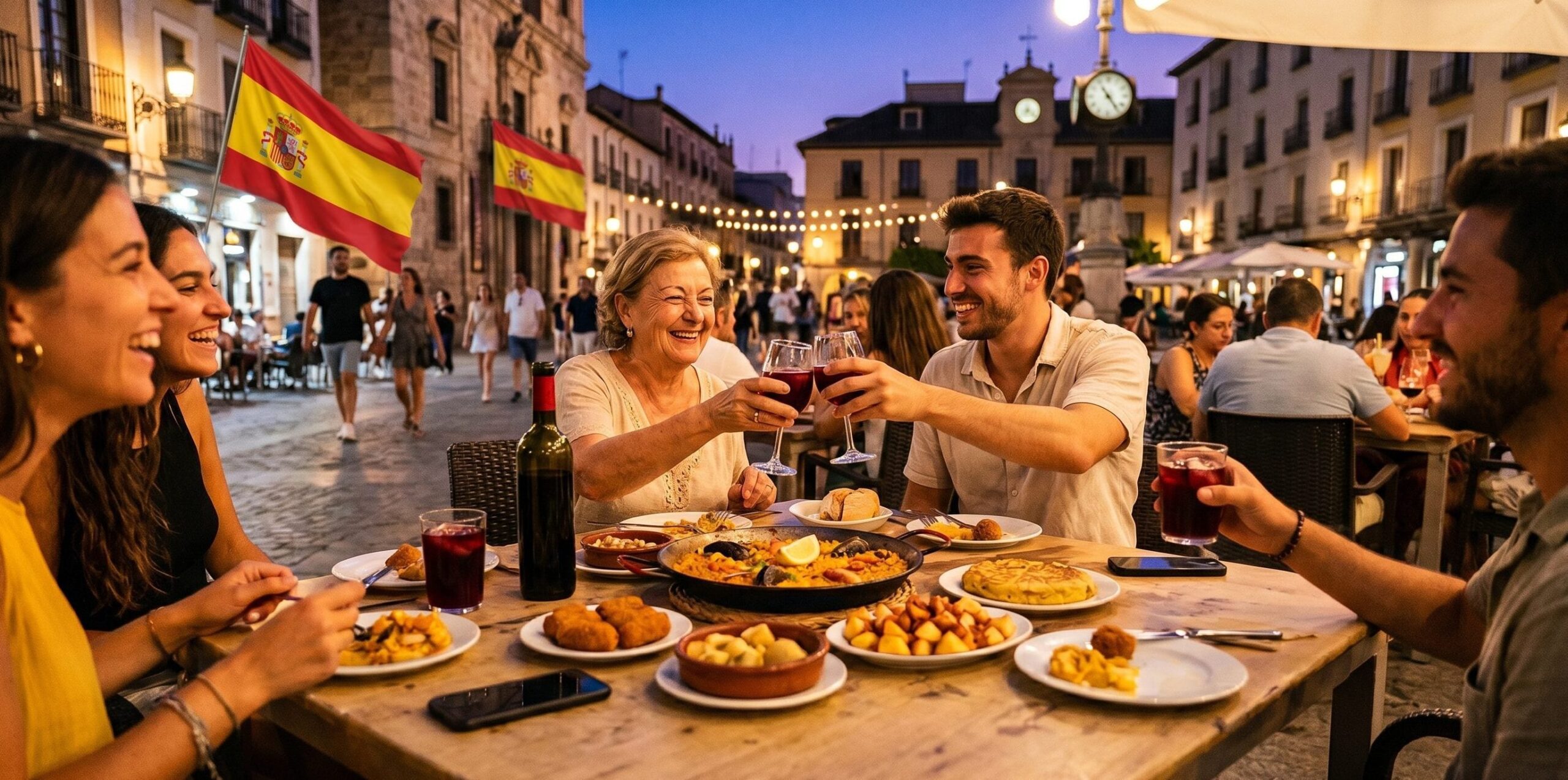
In Spain there is a habit that leaves you a little strange: that of eating “late” compared to other European countries. This habit is one of the most famous ones coming from the Iberian Peninsula, due to the history, politics and time zone of the region. Even today, in fact, Spaniards generally have lunch between 2.00pm and 3.30pm and dinner does not generally start before 9.30pm-10.00pm, times which for much of Europe seem incomprehensible.
We know that every custom is specific to the people who maintain it, but where does this habit come from?
One of the most important explanations concerns the measurement of time from the official point of view, which although today we take for granted, we must consider that once upon a time there was no common agreement between all the countries of the world. Geographically, in fact, Spain is located on the same axis as Ireland, the United Kingdom and Portugal and should theoretically share their time zone. This was exactly the case until 1940, when it originally followed the Greenwich Mean Time (GMT)but then things changed with the regime of dictator Francisco Franco, who moved the time zone in 1940.
Over the years of Francoism the country moved the clocks forward one houra choice desired by Generalisimo to symbolically align himself with Nazi Germany and Italy, his allied countries with which he shared political and ideological affinities. An initially temporary measure that was never abolished; as a result, Spain still lives in a “shifted” time zone compared to today astronomical position of the sun. For this reason, although the Spanish clock says 10pm, biologically the body is closer to 9pm or even 8pm in other areas of the country, resulting in the entire day (consisting of work, lunch, television, dinner, etc.) moving forward.
Added to this is the traditional Spanish daily rhythmin which historically the comida (similar to lunch) is considered the main meal of the day and is much more abundant than dinner. In the past it was common to follow the natural rhythms of the day and interrupt work in the hottest hours of the afternoon, especially in the southern regions, taking a siesta (short afternoon rest after lunch).
There siesta it is a well-known practice in Mediterranean countries and has origins linked to agricultural culture when, at hour sexta Latin (i.e. the time between 12pm and 3pm) people took a break from their daily work to face the intense heat of the central hours of the day. After this long break we went back to work until late in the evening, inevitably pushing dinner towards later times. Even if today the siesta traditional is less widespread in large cities, the cultural model it remained.
Finally, the Mediterranean climate played an equally important role. In many areas of Spain, especially in summer, afternoon temperatures are very high and social life naturally tends to move towards the evening, when the air becomes cooler. Dinner, therefore, is not just a time to eat, but a real social ritual which is awaited by the Spaniards. This also fuels the idea that Spaniards eat dinner at midnight, but in reality most people eat between 9pm and 10.30pm, while eating after midnight is more common during parties, weekend or in the summer period.
Curiously, this custom continues to divide the opinions of the Spaniards themselves today. In recent years there have been debates about the possibility of bringing forward meal times and there has even been talk of returning the country to its old time zone. The reasons vary from those who maintain that Spanish timetables favor a richer and more relaxed social life, while others on the other hand believe that they contribute to too long working days and a chronic lack of sleep.
As mentioned previously, customs and their consistency belong to the people who decide to nourish or extinguish them. In any case, eating late is the result of an almost recent historical and cultural evolution influenced by more ancient popular customs and has transformed the daily way of life of the Spaniards, contributing to making them so different from the rest of the continent.