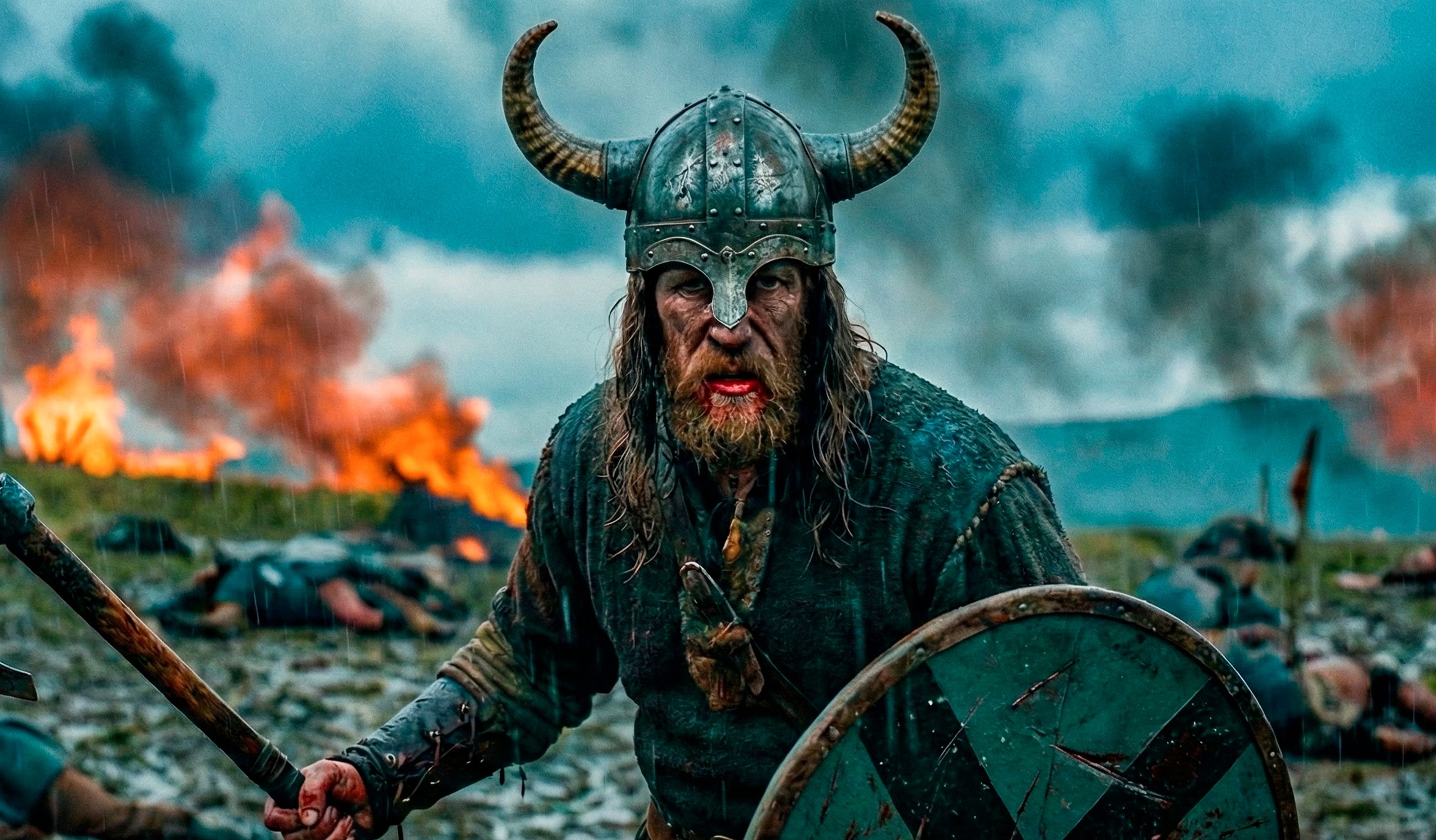
In the collective imagination the Vikings – or rather, the Norse – they were a people of violent, combative people and always equipped with a helmet with horns. This stereotype has been reinforced over time by TV series, films, video games and music albums, even if the reality is very different. In fact, the Vikings never had this type of headgear! So where does this misunderstanding come from? To understand this we need to take a step back in time.
The Viking helmet did not have horns: how the myth was born
The first iconographic correlations between the Norse and horned helmets can be found in the Oseberg tapestry, created in the 9th century AD. Here, in fact, we can see a figure with a horned helmet. Many archaeologists today agree, however, that it was not a common soldier but – probably – a deity: Odin. His would therefore be a helmet of a ceremonial or ritual type, and not a garment actually used on the battlefield. But these considerations are very recent and, consequently, over the centuries the idea began to spread that – perhaps – the Norsemen used to wear these helmets.
Precisely for this reason in the nineteenth century the iconography of this horned headdress was progressively associated with the Vikings, especially by Romantic painters. A decisive contribution to the stereotype came in 1876, when costume designer Carl Emil Doepler designed for the first performance ofRing of the Nibelung of Wagner Nordic warriors with horned helmets: those images toured Europe and were imprinted in the collective imagination.
The Viksø discovery
An apparent turning point occurred in 1942, when a worker collecting peat near Viksø (Veksø), Denmark, accidentally came across two horned helmets in an excellent state of preservation. The objects were delivered to the Nationalmuseet in Copenhagen (the National Museum of Denmark), which began the first analyses. From that moment, the myth of the horned Vikings seemed to receive official confirmation.
But things, as we will see, changed abruptly.
In fact, already in the years of the discovery, some scholars hypothesized that those helmets actually dated back to the Nordic Bronze Age, around 900 BC. This would have automatically excluded any type of link with the Norse peoples, who inhabited those same areas about 1700 years later.
The analyzes conducted in the following decades confirmed this hypothesis: thanks to technical-stylistic investigations and, subsequently, to radiocarbon dating techniques and study of materials, experts established with certainty that the Viksø helmets belong to the Bronze Age, making them completely unrelated to the Viking civilization. The objects were probably for ritual or votive use — placed in a marshy area as an offering — and not military combat equipment.
In summary, no Norse warrior ever wore a horned helmet in battle – or, at least, to date there is no concrete evidence to support it. The stereotype is the product of an overlap between nineteenth-century romantic art, archaeological misunderstandings and a good dose of narrative charm which, even today, continues to survive in the popular imagination.