2025 was the year with the most state wars since 1946, or since the end of the Second World War. This is confirmed by the latest PRIO report (il Peace Research Institute of Oslo), which every year photographs the state of wars on the planet using data collected byUppsala Conflict Data Programme (UCDP), the world’s most comprehensive repository for data on organized gun violence.
Overall, in 2025 around 245,000 people died due to events directly linked to the fighting, compared to 188,000 the previous year: this is the third most violent year recorded since the end of the Cold War. What pushed the toll so high were above all the war between Russia and Ukraine, the bombing of Gaza and by Israel (for a period also engaged in a war against Iran) and the armed conflict in Sudan.
This sad outcome also concerns us Europeans in the first place, not only due to the Russian invasion of Ukraine: our continent, in fact, has become the largest importer of weapons in the world, with a share equal to 33% of total global imports. Such high values have not been seen since the 1960s, at the height of the Cold War.
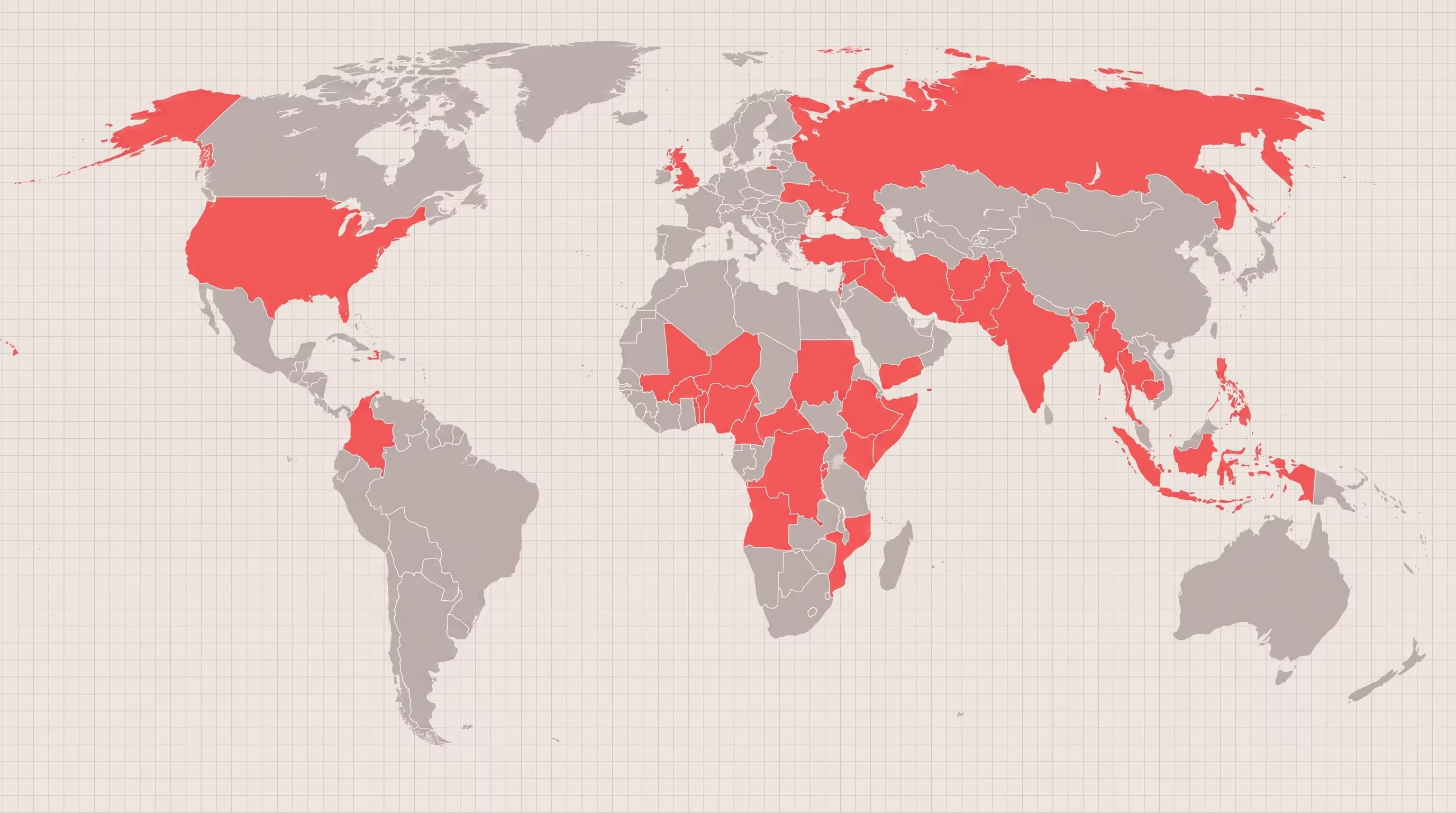
Record of armed conflicts in the last 80 years: the map of the 8 wars between states
In 2025, the UCDP recorded 65 state conflicts (in which at least one of the parties is a state and at least 25 deaths were recorded in a year): this is the highest number since data collection began in 1946. On a quantitative level, this is 6 conflicts more than the previous maximum (59 recorded in 2024) and represents more than double the conflicts recorded 16 years ago, in 2010, when there were 31.
Then there is a detail that should not be overlooked: these 65 conflicts were concentrated in just 35 countries and in the last ten years the gap between the number of conflicts and the countries involved has widened more and more: this means that, today, some states host multiple wars at the same time, in which multiple actors take over, overlapping fronts and a greater risk of the conflict spreading to a regional level.
Myanmar and Pakistan, for example, had five each, while Afghanistan, Cameroon, Mali, Nigeria and Israel faced several in parallel. On average, 1.9 conflicts are underway in each country involved.
This spike in conflicts, however, is neither isolated nor sudden: from 2013 onwards, every year has proved more violent than those of the post-Cold War period. That’s why the report explicitly talks about a new “baseline” of global violence, which is now higher than before: in other words, we are not facing a temporary surge in violence, but a trend that will most likely be long-term.
The problem is that, unlike the past (in which the global scenario was dominated by civil wars), in 2025 interstate conflicts (i.e. fought directly between two or more countries) doubled: in total the UCDP detected 8 (there were 4 in 2024), the highest number ever recorded in the period following the Second World War.
The geographic distribution of the 65 global wars
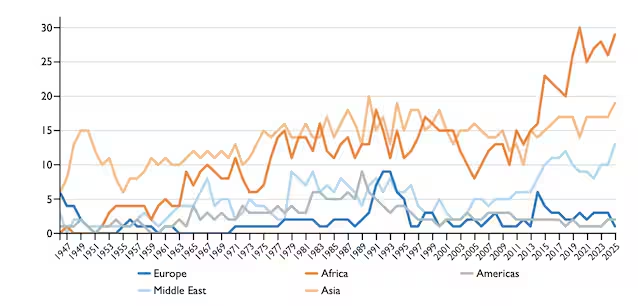
From the point of view of the geographical distribution of the 65 wars, in 2025 Africa confirmed itself as the continent with the highest number of state conflicts (29), followed by Asia (20), the Middle East (13), the Americas (2) and Europe (1).
More specifically, 13 of these conflicts have exceeded the threshold of 1,000 victims: these are the wars that broke out in Burkina Faso, the Democratic Republic of Congo, Ethiopia, Haiti, Iran-Israel/USA, Israel (Gaza), Mali, Myanmar, Nigeria, Pakistan, Russia-Ukraine, Somalia and Sudan. In terms of lives lost, the deadliest of all remains the war between Russia and Ukraine which, according to “Conflict trends: A global overview” carried out by the Peace Research Institute, caused approximately 370,000 combat deaths between 2022 and 2025, the highest recorded number of battle deaths for a single conflict since 1989.
It is no coincidence that in about 10 years, conflicts on the African continent have almost doubled, going from 15 in 2013 to 29 in 2025. This increase, however, is mainly linked to the fact that the same states are hosting more conflicts than before, with clashes increasing in intensity, in particular in Ethiopia, Sudan and the Democratic Republic of Congo.
The Middle East, with 13 conflicts overall, reached its highest level since 1946, while Asia had not seen so many conflicts since 1994 (also due to the increased tensions between India and Pakistan). The Americas remained stable at two (Haiti and Colombia), but with one dramatic exception: in Haiti the victims rose from around 200 in 2024 to over 1,200 in 2025, thanks to the near collapse of the state, the coordinated expansion of the gangs and an international response that arrived too late.