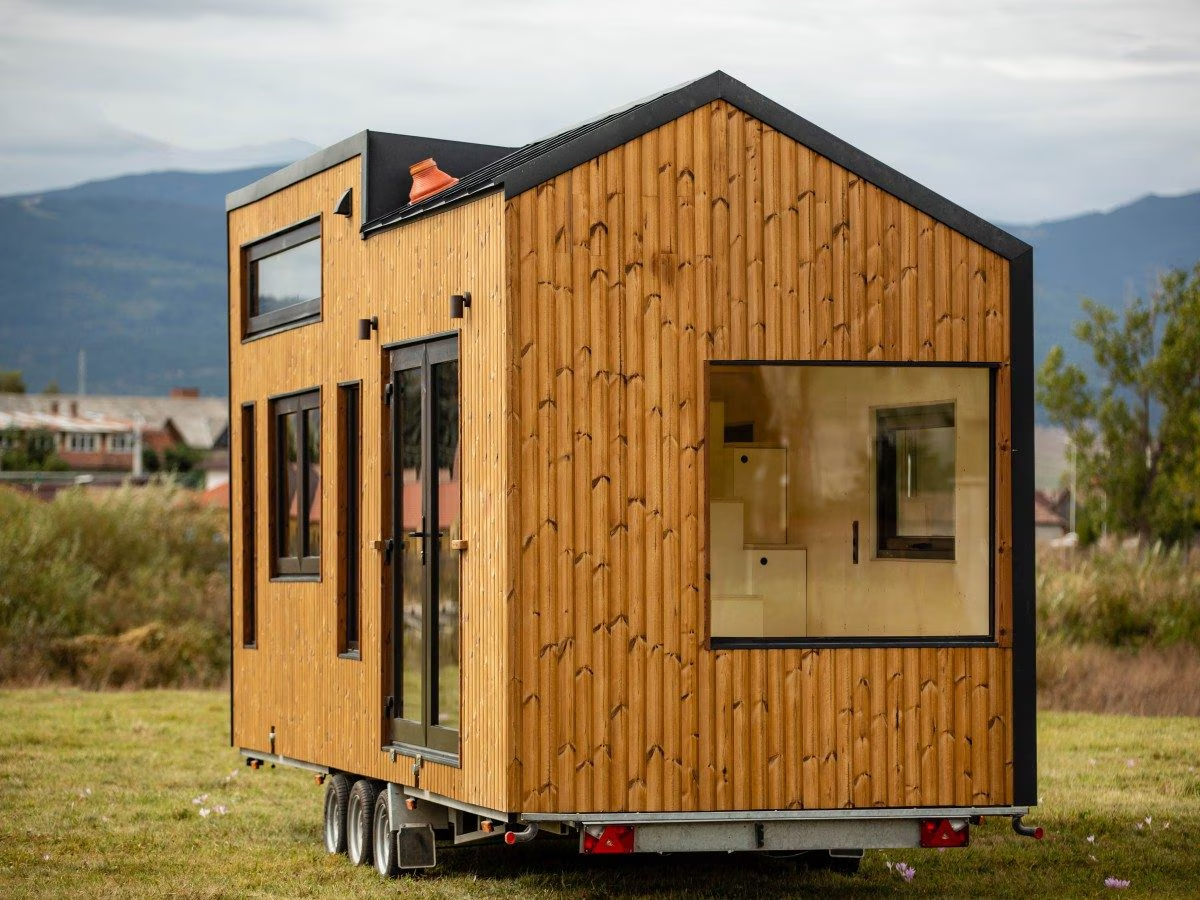
In recent years, the tiny house have established themselves as one of the most visible expressions of contemporary changes in the way of living. These are mobile and sustainable mini houses, generally between 8 and 40 m2, often built of wood and mounted on wheels.
In Italy they are considered, in many cases, to be special approved vehicles and can be positioned on agricultural or building land according to specific regulations. With costs that vary on average between 25,000 and 90,000 euros, these homes represent an independent, flexible and ecological solution.
Behind their essential aesthetics, however, deeper socio-economic dynamics are intertwined: housing crisis, economic transformations, environmental sensitivity and new ways of conceiving well-being and possession. Tiny houses are not just miniature houses, in this sense they transform into a privileged observatory on contemporary society.
What are the tiny house and how the phenomenon was born
Tiny houses are mini houses, generally between 8 and 40 square metres, designed to concentrate all the essential functions of a home in a small space. Many are built of wood, with highly energy-efficient insulating materials, and mounted on approved trailers, so they can be transported without permanent foundations. Interiors often take advantage of space-saving solutions, modular furnishings and mezzanines to optimize every available centimeter.
This movement, the so-called “phenomenon of tiny house”, was born in the United States between the late 1990s and early 2000s, initially as a countercultural response to consumerism and debt resulting from the costs of real estate ownership.
Some experts, such as the scholar Jay Shafer, have contributed to formalizing the concept, promoting homes under 30 square meters as a conscious choice of simplification.
The phenomenon then gained greater visibility after the 2008 financial crisis, when the widespread loss of homes and jobs pushed many people to look for more accessible housing solutions.
From there, the model spread to Canada, Australia and progressively to Europe, with significant experiences in the Netherlands, Germany and the Nordic countries, where experimental urban policies have favored alternative forms of living.
In Italy, in particular, they can be positioned on building land, agricultural land with some limitations, campsites or private rest areas. When they are mobile, therefore on wheels, not anchored to the ground and with removable utilities, they are often considered trailers (common caravans). However, the legislation changes a lot from municipality to municipality and it is always necessary to check the local master plan and any urban planning constraints.
Today, tiny houses are part of a broader trend that includes minimalism, sustainability and housing flexibility, intercepting both nomadic and digital lifestyles and concrete responses to the urban housing crisis.
Minimalism as a lifestyle: less space, more intentionality
The success of this model is closely connected to the spread of minimalism as a cultural paradigm. In a context marked by consumerism and material overload, more and more people are questioning the equation between accumulation and happiness.
Living in a small space requires a careful selection of objects, transforming every choice into a conscious act: what is really necessary? What adds value to daily life?
This reduction does not only concern the material dimension, but also extends to time and relationships, favoring a more focused and less dispersive lifestyle.
Environmental psychology studies, in this sense, suggest that less saturated and more tidy environments contribute to reducing cognitive stress and improving perceived well-being. In this sense, the tiny house it becomes a concrete device through which to practice an ethic of “less but better”, in which the quality of life does not depend on the quantity of space occupied, but on its ability to respond to authentic needs.
When tiny homes aren’t an option: Low prices
Alongside the ideological and voluntary dimension, the phenomenon must also be read in light of the growing global housing crisis. In recent years, the increase in property prices and rents has outpaced wage growth in many urban areas, making access to housing increasingly difficult.
Young people, precarious workers and low-income families often find themselves excluded from the traditional real estate market, forced to look for alternative solutions. For these people, tiny houses become a pragmatic answer: lower costs, greater accessibility and the possibility of avoiding long-term mortgages.
In Italy the cost generally varies between 20,000 and over 80,000 euros, while the 25-30m2 “turnkey” models are on average between 25,000 and 50,000 euros. The price depends on factors such as finishes, thermal insulation, customization, materials used and presence or absence of wheels.
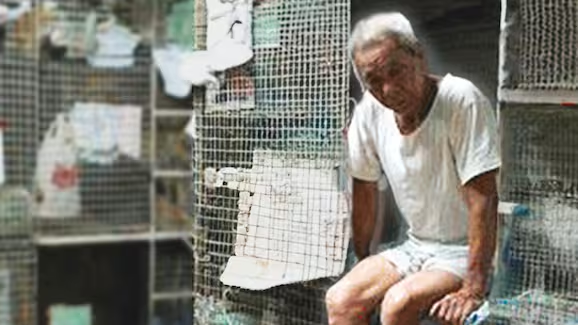
However, what is presented as a sustainable choice can hide a condition of necessity. The rhetoric of minimalism risks, in some cases, masking structural inequalities, transforming forced renunciation into a desirable lifestyle.
In this sense, tiny houses show a dual nature: on the one hand a symbol of freedom and sustainability, on the other a possible consequence of an increasingly less accessible real estate market.
Environmental impact and sustainability: a promise to be contextualized
The tiny house they are often associated with a more sustainable lifestyle, and in fact have features that can significantly reduce environmental impact.
The small size implies lower energy consumption for heating and cooling, a reduction in materials used in construction and greater efficiency in resource management. Many projects integrate technologies such as solar panels, composting systems and rainwater harvesting, reinforcing the idea of self-sufficiency.
However, this sustainability must be analyzed critically. The overall impact depends on many variables: the quality of the materials, the duration of the home, its geographical location and the mobility habits of the inhabitants.
The tiny house and the caravan lifestyle in Italy
A community has been created around this new way of living that has a strong affinity with the world of caravans, campers and residential vehicles, with which they share not only technical characteristics but also cultural imaginaries.
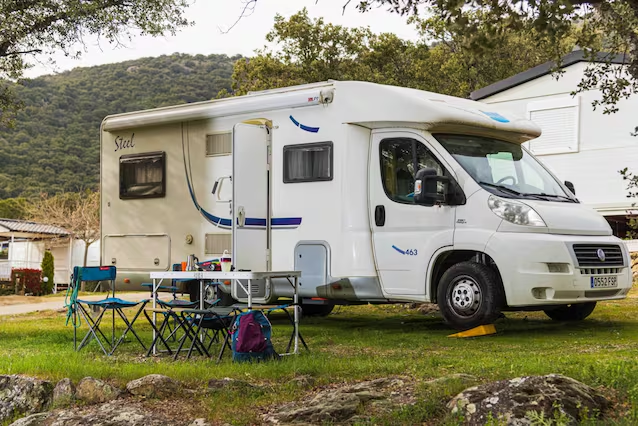
The tiny house on wheels, in fact, they represent a sort of hybrid between home and means of transport: more stable, isolated and customizable than a traditional camper, but at the same time mobile and free from a permanent anchoring to the ground.
This assimilation recalls a long tradition of living on the move, from caravans to nomadic communities, to contemporary “van life” culture.
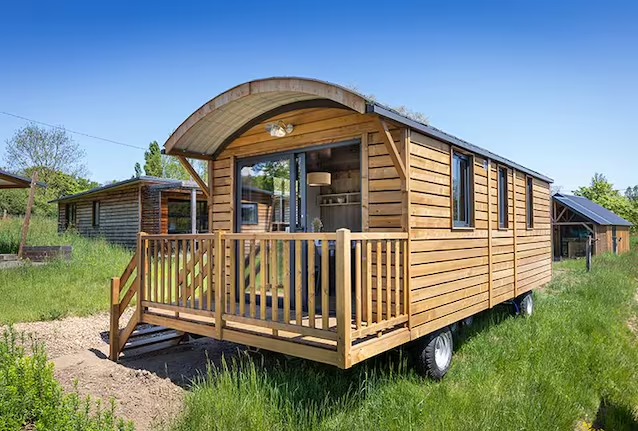
However, while the camper is historically associated with temporary travel and leisure, the tiny house it increasingly presents itself as a main residence, redefining the boundary between mobility and domesticity. In this sense, it is not just a formal similarity, but a deeper transformation: the idea that the house can be both a stable refuge and a mobile space, adapting to flexible and often precarious lifestyles.