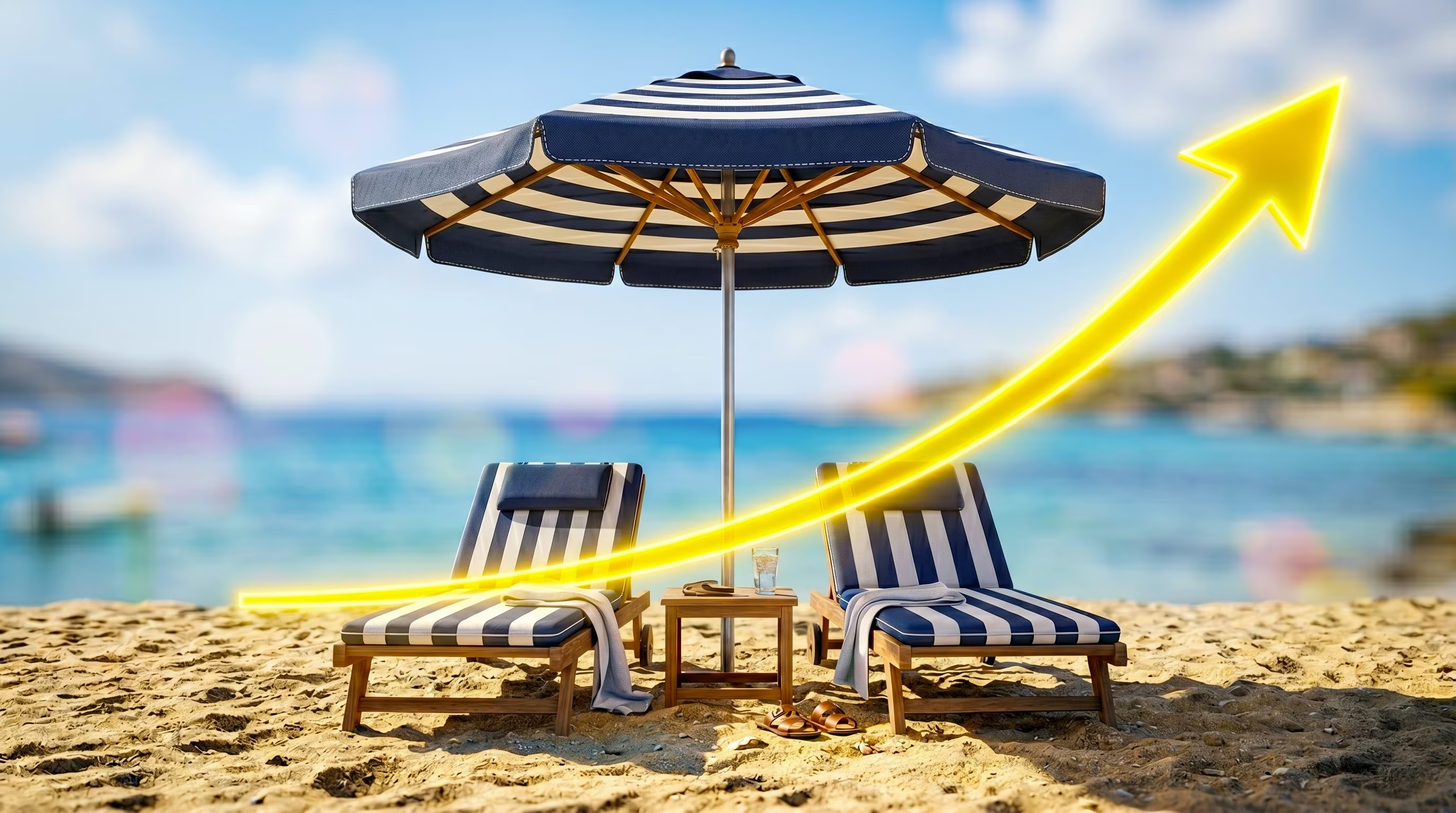
Umbrella, two sunbeds, first row. How much does a week at the seaside in Italy cost in summer 2026? It depends on the destination, but almost everywhere the answer is: more than last year. And much more than five years ago.
This was revealed by the annual survey by Altroconsumo, the largest independent consumer organization in Italy, which every year anonymously calls hundreds of beach establishments to ask for simple information: how much does a week with an umbrella and two sunbeds cost during the first week of August, i.e. from 2 to 8 August?
This year, 222 beaches distributed in 10 locations (Lignano, Alassio, Rimini, Gallipoli, Alghero, Palinuro, Viareggio, Senigallia, Taormina and Giardini Naxos, Anzio) were contacted, choosing a sample that represents at least 20% of the establishments present in each location. What Altroconsumo has recorded is an average increase of 6% compared to 2025, which rises to +24% if we look at the last five years. In 2021, in fact, the average rate was 182 euros; in 2026 it reached 225 euros.
Where factories pay the most in 2026: the ranking and the map
Not all beaches are the same, and the differences are notable. The locations with the strongest price increases this year are Taormina and Giardini Naxos in the province of Messina, Sicily (+16% compared to 2025), followed by Alghero in Sardinia (+14%) and Gallipoli in the province of Lecce, Puglia (+10%). In the other destinations the increases were more limited, between 2 and 7%.
This is the complete list with the average fares of the 4 rows compared, from the most to the least expensive:
- Alassio (30 factories monitored): 340 euros (0% variation)
- Gallipoli (14 factories): 324 euros (+10%)
- Alghero (10 factories): 274 euros (+14%)
- Taormina and Giardini Naxos (13 establishments): 237 euros (+16%)
- Viareggio (35 factories): 232 euros (+7%)
- Palinuro (14 factories): 188 euros (+0.5%)
- Anzio (19 factories): 179 euros (+2%)
- Senigallia (18 factories): 159 euros (+0.6%)
- Rimini (50 factories): 158 euros (+5%)
- Lignano (19 factories): 157 euros (+2%)
The average cost of umbrellas, deckchairs and sunbeds: rates on the rise
The absolute record of the most expensive beach in Italy is confirmed by Alassio, in the province of Savona, Liguria: a week in the front row with an umbrella and two sunbeds costs on average 368 euros, with an average rate for the first four rows of 340 euros. It is worth noting that Alassio in 2026 did not increase prices compared to last year (0% change), they were already the highest. In Alassio the first row costs 368 euros, the second 346, the third 330 and from the fourth onwards 314.
At the other extreme there is Lignano Sabbiadoro, in the province of Udine, Friuli-Venezia Giulia, where the same week in the front row costs 164 euros, practically half as much. The second drops to 159, the third to 154, and from the fourth onwards to 141.
Choosing one location over another can save you almost 200 euros and even the row you sit in makes a difference: the first costs on average 238 euros per week, the second 229, the third 219, while from the fourth onwards it drops to 210 euros.
The question of free beaches, increasingly rare
With ever-increasing prices, the free beach remains the only economically sustainable alternative for many families – preferred by 35% of people. The problem is that free space is decreasing every year.
A virtuous exception comes from Spotorno, in the province of Savona, Liguria, where the mayor Mattia Fiorini has increased the quota of free beaches while still guaranteeing essential services (cleaning, lifesaving, showers, bathrooms) without additional costs for citizens. As? Concession kiosks on public beaches generate enough revenue to cover those costs. A model that, for now, has not found imitators among other Italian municipalities.
What Italians prefer
Altroconsumo also surveyed consumer preferences via an online questionnaire administered to a sample of 1,058 people between 18 and 74 years old, weighted by gender, age, geographical area and educational qualifications to be representative of the Italian population.
37% prefer the equipped establishment (or the paid free beach with services), 35% choose the free beach, and just over one in four declare themselves open to both solutions depending on the case.
Those who pay do so above all for services and equipment (80% of responses); those who choose the free beach do so because it is free (79%) and because it gives them the freedom to change places every day (63%).
On the topic of concessions, among those who know the issue, 63% believe that a reform should lead to a reduction in prices, and one in two asks for a periodic and transparent change in the management of the beaches.