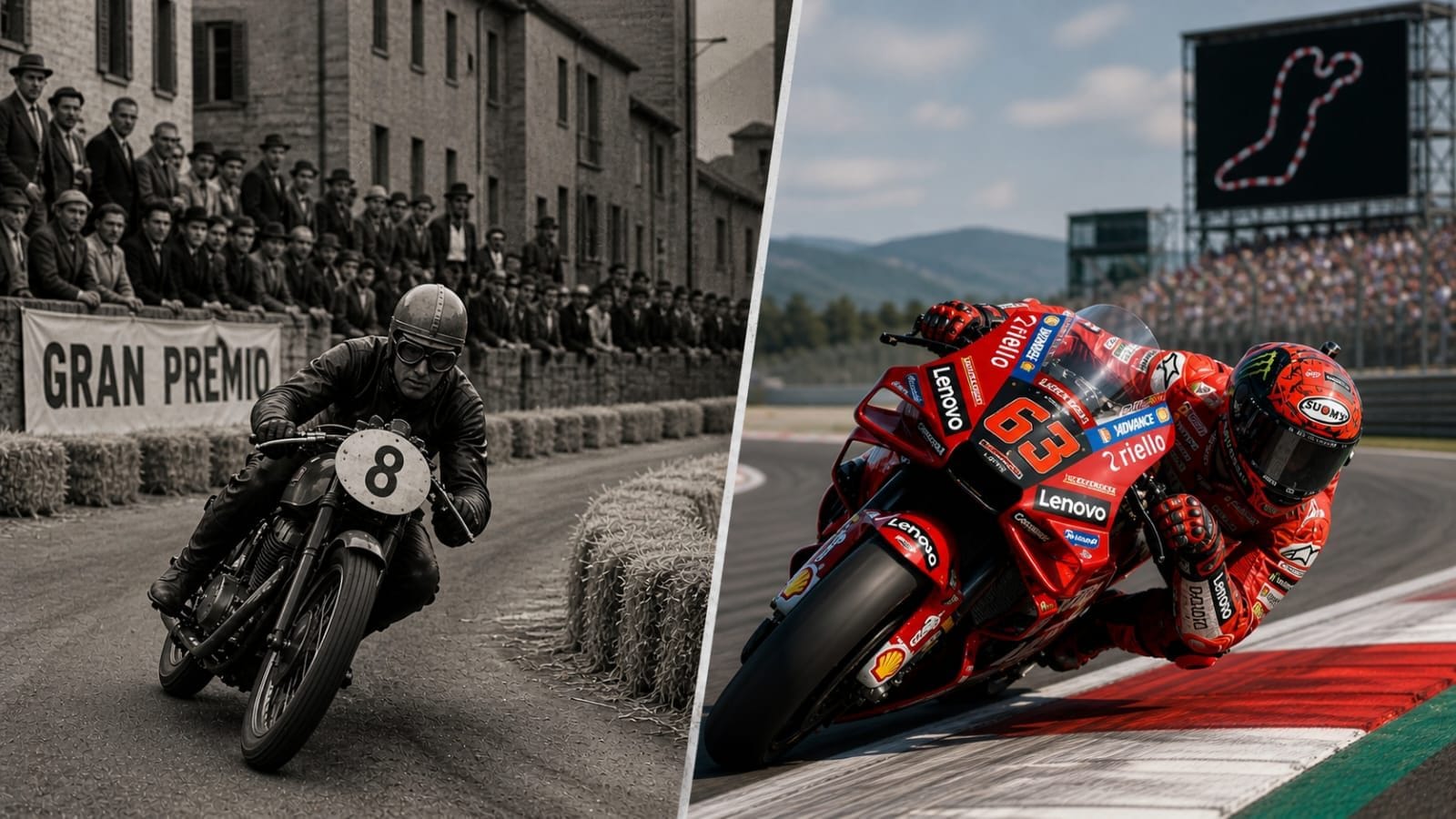
What would a rider of the 1950s have thought when he saw a Ducati Desmosedici speeding at over 360 km/h on the Mugello straight? The Motorcycle World Championship has existed, in its form, since 1949. In over seventy years, this sport has transformed radically: motorbikes have become 300 horsepower technological prototypes, circuits have evolved to protect riders and even suits have become high-tech devices. Let’s see together the comparison between today’s MotoGP and that of the early days.
Closed roads and straw bales: the origins in 1949
The World Motorcycle Championship was born in 1949, with an initial calendar made up of six European races, including the legendary Isle of Man Tourist Trophy. The races took place on city tracks created from ordinary roads closed to traffic, while the permanent circuits as we know them today were very rare exceptions. The safety conditions were, by our standards, unthinkable: the pilots wore leather suits and helmets that provided limited protection and the circuits were often cordoned off by straw bales, unable to prevent serious injuries in the event of high-speed impacts. A champion like Giacomo Agostini raced in an era in which safety was an optional and the tracks were roads bordered by trees and walls.
Over time, circuits have transformed profoundly. The top class tracks have been redesigned with large run-off zones, gravel areas and protective barriers. Hay bales have given way to advanced engineering structures: modern Air-fence barriers are composed of pressure-controlled inflatable modules, designed to absorb impact energy and drastically reduce decelerations. An emblematic case of change is the Assen circuit – the only one to have hosted a Grand Prix every year since the birth of the Motorcycle World Championship in 1949 – which has undergone various changes over time to meet modern safety needs.
The technological revolution of motorcycles: from 55 to 300 horsepower
The comparison between the bikes of yesterday and those of today is almost surreal. The first world champion motorcycle was Leslie Graham’s AJS Porcupine E90 which in 1949 developed 55 horsepower. Today a Ducati Desmosedici GP reaches around 300 horsepower, an estimated value since the manufacturers do not release complete official data for reasons of industrial secrecy. Modern motorcycles are also equipped with electronic systems — traction control, anti-wheelie, launch control — and aerodynamic winglets that provide downforce, improving the bike’s stability at high speeds. Telemetry data transmitted in real time during each race provides a continuous stream of parameters, allowing engineers in the pits to monitor and optimize every aspect of the bike while the rider is still on the track.
The early motorcycles were instead extremely minimal: without electronics, with essential technical solutions, and control of the vehicle entrusted almost entirely to the rider. Furthermore, reliability was limited, with failures and recalls much more frequent than today. To give a further measure of evolution, the current Moto3s develop around 60 horsepower: more than the 1949 world champion bike did, demonstrating how much the overall performance level of the MotoGP has grown. At the same time, the role of the rider has also changed, today a true elite athlete, subjected to extremely rigorous physical and mental preparation to handle increasingly faster and more demanding motorbikes.
Speed record, 366 km/h
The top speed record in MotoGP was set at Mugello, where Brad Binder reached 366.1 km/h. To understand what this means in practice: MotoGP riders maintain an average lap speed between 160 and 185 km/h on the entire track, taking into account both the straights and the technical and slow areas. All this is also made possible by the low weight. The regulation sets the minimum weight at 157 kg without a driver and without fuel, which leads to a weight-to-power ratio of more than one available horsepower per kilo — a figure that no road vehicle could come close to.
In the early days of the MotoGP, however, the speeds were much lower and rarely exceeded 180-200 km/h; the bikes were generally heavier in relation to the power, with less efficient engines, less refined chassis, less effective drum brakes and tires with limited grip, elements that made both acceleration and braking much less efficient compared to modern standards.
The technological evolution of suits
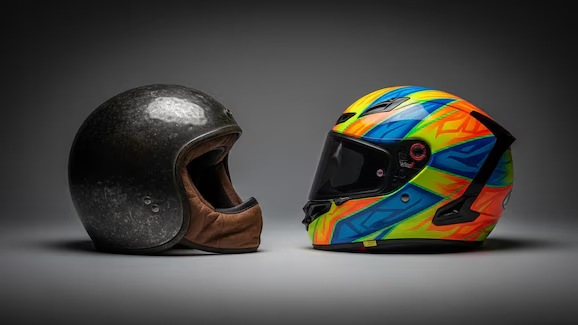
Perhaps no area better illustrates the distance between past and present than the clothing of the pilots. From the simple leather suits of the 1950s we have arrived at high-tech devices. The airbag in MotoGP suits has been mandatory since 2018. The system is regulated by sensors that constantly monitor the rider’s movements: in the event of a fall, it activates in a few tens of milliseconds, protecting the neck, spine, ribs and shoulders. The result of all this progress is concrete: accidents that in the past would have been fatal are now less impactful, thanks to safer suits, helmets and slopes.