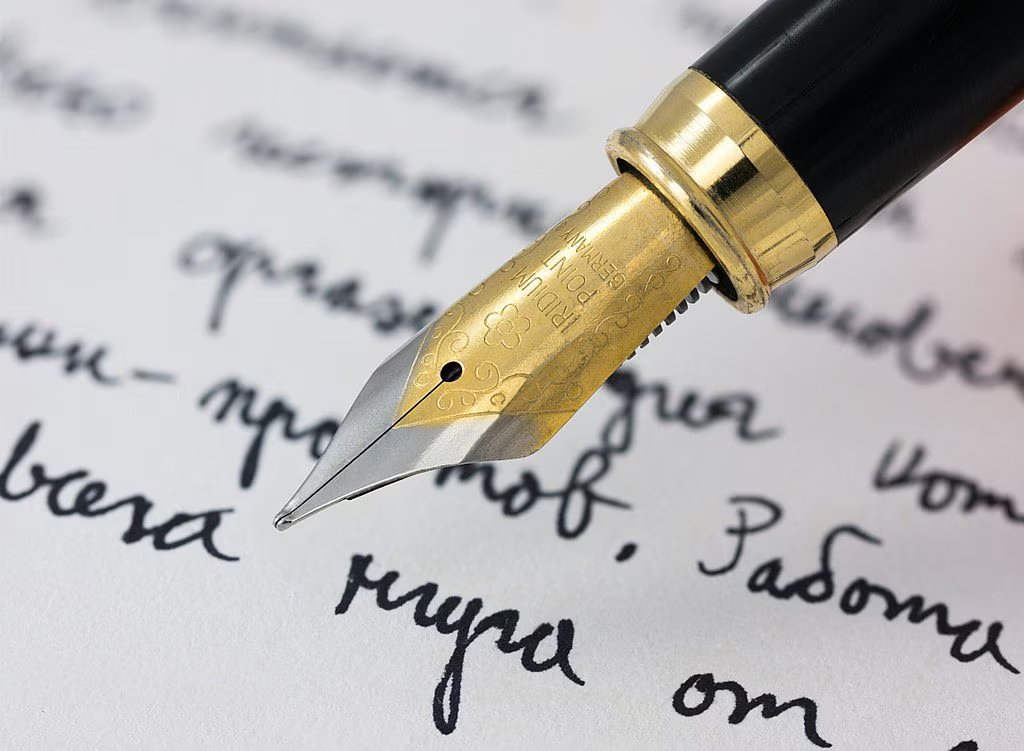
Cursive writing is one of those skills that risk disappearing in the coming decades due to the technological changes that have occurred over the last seventy years and the increasingly frequent replacement of the pen with keyboards and touch screens. But how is it possible that a tool considered fundamental for schooling and education in past centuries is now at risk of extinction?
In paleography (the discipline that studies the history of handwriting) cursive is not specific font but it simply indicates fast writing, which precisely because of the speed of execution links the individual letters together, deforms them and tends to slant them. Going into specifics, it is a continuous and linked graphic system that is distinct from block letters. However, the term italic or italic in English it can also refer to the so-called typographical cursive, i.e. the character introduced by the typographer and engraver Francesco Griffo, known as Francesco da Bologna, almost in conjunction with the advent of printing, in the mid-15th century, inspired by the first pocket book in history. Although it was born out of a practical need for fast writing, due to the prestige obtained by typographical italics, over the centuries a calligraphic standard (literally of beautiful writing) was born also for italics and therefore for private and documentary writings.
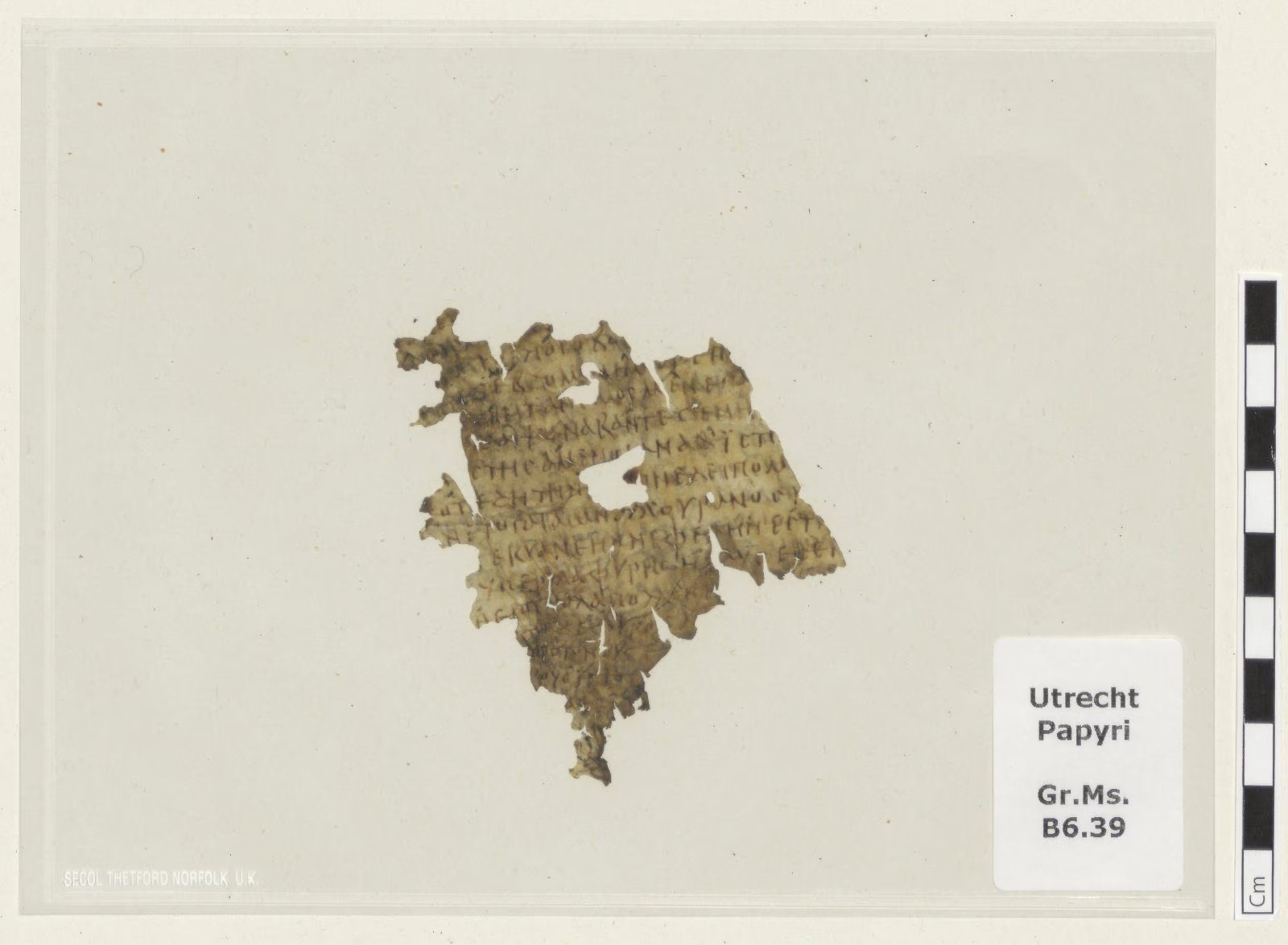
Italics has in fact always existed but, before Griffo, it was relegated to everyday writing without having a precise model. In book production, more elegant, decorative and staid writing was preferred (in paleography, staid is the opposite of cursive and indicates slow, unbound writing). In the Middle Ages, for example, it was unthinkable to write in cursive a Bible or a literary text considered important and prestigious.
Its diffusion also extended to the educational system: in the Modern Age, learning to write in cursive represented a fundamental step in the student’s growth and a sign of linguistic mastery. Consider that in the sixteenth century very short manuals began to be published which practically explain which writing styles exist (including cursive) and how to master them correctly. The teaching of cursive became consolidated in schools in the following centuries: continuing to practice handwriting was considered fundamental not only for efficiency and practice, but also for character formation.
However, starting from the second half of the twentieth century, various social transformations began to erode this practice. The massive introduction of typewriters first and then computers has progressively shifted attention from the pen to the keyboard. More and more people began to type texts first and then on digital media, preferring to type rather than use handwriting. Such a technological change has therefore had a profound impact on the presence of cursive in education and private life: cursive was born because it is fast, but no handwriting will ever be as fast as typing.
The spread of digital devices in daily life has led to a redefinition of the skills considered essential, because where once great importance was given to the fluency of manual writing, today the ability to type quickly and accurately is considered more useful.
This change has also been reflected in educational policies and research. In the United States, for example, the 2010 federal standards of Common Core State Standards Initiative they did not include the teaching of cursive among the mandatory objectives of primary school, marking a symbolic turning point in the way of conceiving basic literacy. In Rome, a study on the legibility of writing in children conducted by the Sapienza University and the Umberto I Polyclinic revealed that 1 Roman child in 5 is not at ease in cursive writing, also highlighting that the phenomenon may be linked to other specific problems, with 5% suffering from disorders related to motor coordination, while learning disorders range from 5% to 15%. Furthermore, lowercase print is more immediate and easier to learn, while italics are less easily readable.
However, there is no shortage of academic debates on the value of italics. Some pedagogical experts argue that the act of writing in cursive, as distinguished from block writing, promotes cognitive development in children, as it integrates complex motor movements with language learning. Others believe that literacy needs to adapt to the times, placing more emphasis on digital skills without sacrificing manual writing altogether. There are neuroscientific studies, such as the one conducted by Karin James and Laura Engelhardt (2012), which highlight how the experience of manual writing in preschool children activates brain areas linked to letter recognition and linguistic processing in a more extensive way than simple typing or passive observation, integrating perception, memory and language into a single process.
Finally, another cultural reason for the disappearance of cursive concerns the way we perceive handwriting. In the past, the calligraphy was often associated with treatmentto theelegance and to thepersonal identity. Signing one’s signature in cursive characterized individuals, almost as much as one’s fingerprint. Today, however, we have the digital signaturei quick bureaucratic logins and authentication via facial biometricswhich have completely replaced calligraphy as identifying element. In this sense, what was once a shared cultural skill is now one specialized expertise of very fewwho for particular reasons practice cursive with frequency and attention.
Ultimately, we no longer write in cursive for a combination of technological, cultural and above all educational reasons, as schools and institutions have adapted to a world in which digital writing has become necessary to communicate, work and participate in social life.
However, it must be remembered that italics has not completely disappeared but has become “for a few”, becoming sectorial and specializing in specific areas of use. Think, for example, of the social success of lettering (study of forms of writing) as an art form. If once it was the fastest common tool for writing and communication, today in some artistic, historical or professional fields it is guarded with dignity, for aesthetic reasons or by tradition. Also for this reason, despite its progressive marginalization, italics is a precious piece of the past that continues to be part of the present.