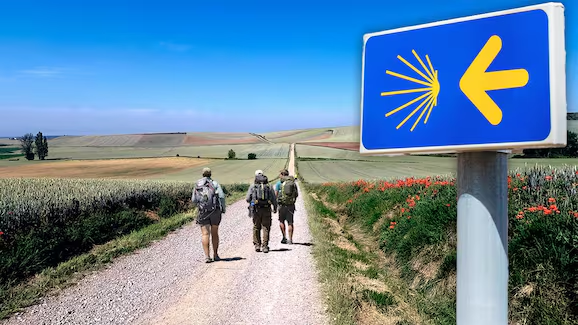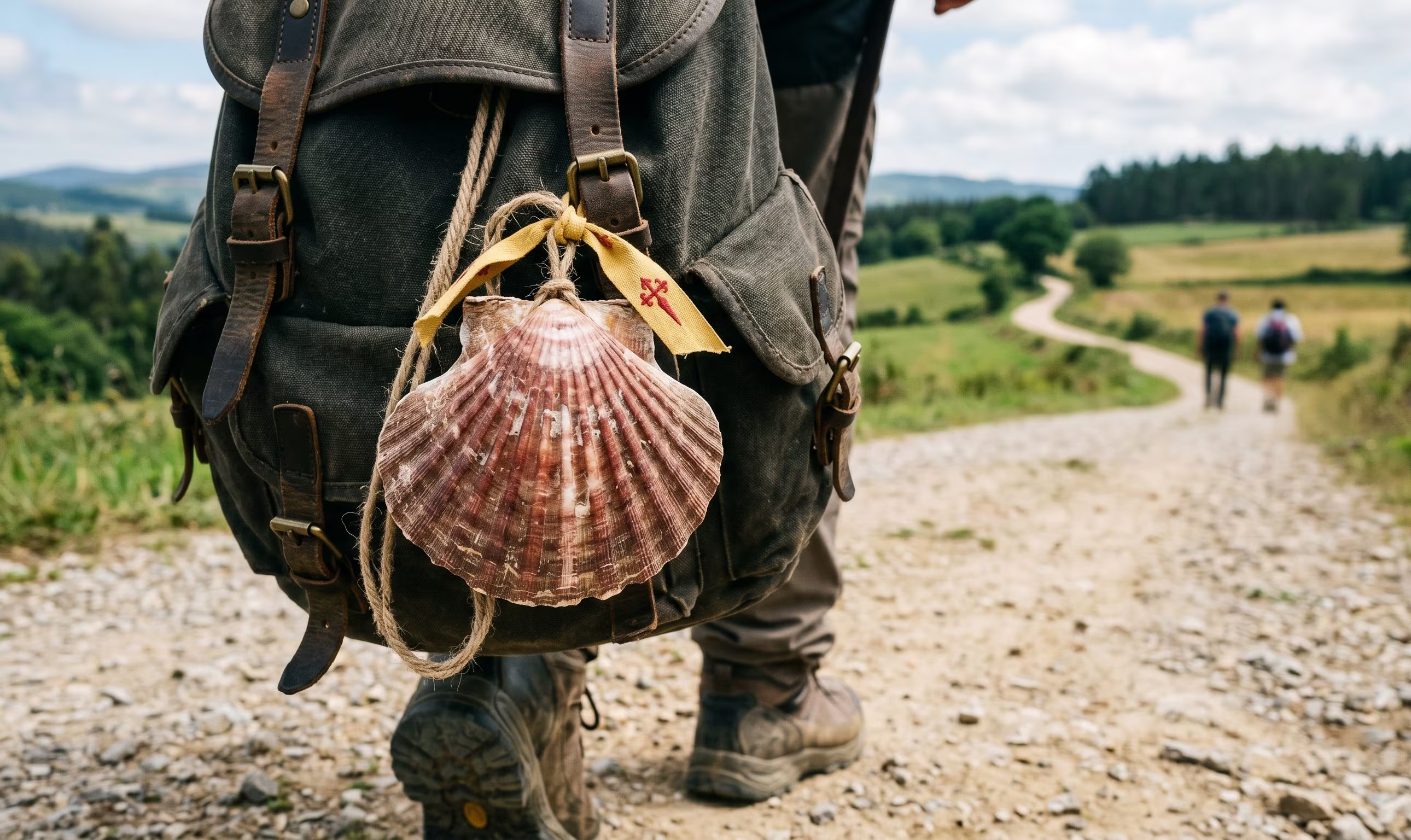
If you have ever met a pilgrim on the road, seen an image of the Camino de Santiago, which becomes increasingly popular every year, or watched Checco Zalone’s latest film, you will have noticed an unmistakable detail: a large shell hanging from the backpack of those who walk it, omnipresent in the route signs, of which it represents the official logo.
But have you ever wondered how a scallop became the emblem of one of the most important pilgrimages in history, which developed between the 9th and 12th centuries and headed to the Cathedral of Santiago de Compostela, in Spain, to pay homage to the relics of the apostle Saint James the Greater? Behind this symbol lies a mix of ancient legends, medieval marketing and practical needs.
The scallop as a symbol of the Camino de Santiago
The shell (concha in Spanish), with colors ranging from reddish-brown to whitish, is that of the scallop (Pecten maximus in the case of the oceanic one or Pecten jacobaeus in the case of the Mediterranean), bivalve mollusc of the pectinid family which abounds on the Atlantic coasts of Galicia, the north-western region of Spain. In the Galician language it is called vieira.
Today pilgrims heading to Santiago carry it with them as a sign of the journey underway, usually hanging from their backpack. In the Middle Ages, however, the pilgrimage was an extremely complex and dangerous round trip, and the shell was conquered and taken with it only on the return.
The Codex Calixtinusthe most famous medieval codex of the Jacobean pilgrimage created in the 12th century, contains in five books all the liturgical texts, traditions, miracles and memories of the journey. Among these pages, in the fifth book – which describes the Camino de Santiago in France and Spain as a sort of “tourist guide” of the time – it is reported that the pilgrims of the time, who arrived in Santiago, received a document and a shell attesting to the success of the undertaking. It is still released today Compostela, the paper certificate of the pilgrimage, which can be requested from the Pilgrim’s Office. In the Middle Ages the parchment was kept safe, while the shell was exposed in plain sight, sewn onto the hat or cloak. Many pilgrims from all over Europe were even buried with it, to be identified as such even in the afterlife and invoke the intercession of Saint James.
The local artisans immediately caught wind of the deal signum peregrinorum (emblem of the pilgrim), in particular those in the Azabachería area (Plaza de la Imaculada), on the side of the north façade of the Cathedral, final point of arrival for the pilgrims of the French, English and Northern Way: they did not limit themselves to selling real shells, but began to make reproductions in lead, bone, ivory, metal and jet (azabachea black gem typical of the region) to be sold to travelers so that they could sew them on their clothes or hang them around their necks, as still happens today. It became such a profitable business that the Church decided to regulate it by law, imposing taxes and restrictions on sales. To prevent them from being falsified or smuggled, a true commercial monopoly was established: selling the shells outside Santiago de Compostela was strictly prohibited, and anyone who violated the rule even risked excommunication.
The pilgrims who reached the Cathedral often decided to extend the journey for about three days to Finisterre, on the Atlantic Ocean, considered at the time the end of the known world (finis terrae, precisely), a place full of charm and linked to ancient pre-Christian itineraries of solar worship. Arriving on the cliff and then at Langosteira beach, they bathed in the ocean waters, burned their old clothes as a sign of purification and collected one of these shells to take home as irrefutable proof of the journey – and souvenir! This symbol had the same value as the palm leaves that the palmiers brought back from Jerusalem after the pilgrimage to the Holy Land and the cross of the Romei in Rome.
The shell also had a practical aspect: it could also be used as a small natural container or spoon to collect water and quench one’s thirst at rivers and springs during the long return journey.
The miraculous knight and other legends
The Way was born from the cult of James the Greater: according to tradition, after his beheading in Palestine in 44 AD, the disciples transported his body to Galicia, where the apostle had evangelized the local Celtic populations. His tomb, rediscovered in the 9th century by the hermit Pelagius in the “field of stars” (Compostela), began the famous pilgrimage.
The most famous legend links the shell to a maritime miracle. It is said that, while the boat guided by angels with the remains of the apostle was approaching the Galician coast (near Bouzas or Padrón), a noble wedding was being celebrated on the beach. The groom, on horseback, saw the boat in difficulty due to the waves or, according to another version, the horse became frightened by the brightness of the boat and threw itself into the sea. The rider and the animal were swallowed by the waters. Feeling lost, the man invoked the help of Heaven and, through the intercession of the Apostle, reemerged safe and sound. Both rider and horse reached shore completely covered with scallop shells. Faced with that sign, the groom and the witnesses immediately converted to Christianity and from that day, the image of Santiago remained forever linked to concha.
But that’s not the only miracle: the one already mentioned Codex Calixtinus reports another, of a thaumaturgical type. In fact, it is said of a knight who recovered from a very serious inflammation of the throat, which no doctor had been able to cure, simply by being touched with one of these shells, used as a blessed amulet. “… a gentleman in Puglia had an enormously swollen throat and since no doctor could help him, the poor man devoted to the Apostle Santiago asked to have one of the shells that the pilgrims brought from their journey to Santiago. Having received it, he touched his throat and it healed and subsequently as a sign of thanks the man set out to go to the tomb of the Apostle in Galicia”.
The hidden meanings in the shape of the shell and the official signage
The conformation of the vieira lends itself to profound symbolic and geometric interpretations. Its radial shape represents the convergence of the roads which, from different places, lead to a single summit. Likewise, the dozens of European routes and variants (the French Way, the Portuguese, the Primitive, the North) start from all over Europe to converge westward at a single center: the Cathedral of Santiago.
In modern signage, codified by the Council of Europe (which declared the Camino “First European Cultural Route” in 1987), the stylized yellow shell on a blue background is the official symbol of the route. According to the official guidelines of the Xunta de Galicia and the walking associations, the stylized shell serves to identify the route, but the direction of travel is strictly indicated by the yellow arrow. However, in historic centers or in areas declared Heritage of Cultural Interest, to reduce the visual impact and landscape pollution, vertical signs are replaced by bronze or stone shells set directly into the road pavement. In that case, the open part of the rays (or the convergence of the channels, depending on the local convention of the individual autonomous communities) can also indicate the way forward.
The shape of concha lends itself to different interpretations:
- Generosity: the grooves in fact recall the fingers of an open hand, ready to give, and symbolize the obligation of charity and good works that the pilgrim must carry out along the way;
- Spiritual rebirth: being historically linked to the classical iconography of the birth of Venus (think of Botticelli’s famous painting), the shell evokes the sea as the womb of new life. For the Christian, it represents the overcoming of the old man and selfishness to give birth to a purified “I”. The Castilian term venerate (synonym of vieira) derives from Latin venerialinked to the goddess of love;
- The initiatory paths: its stylized shape recalls the imprint of a goose’s paw. In the medieval esoteric tradition and in the builders’ guilds, the goose was a sacred animal linked to transition and wisdom; it is no coincidence that many historians see in the traditional “Game of the Goose” an encrypted map of the Camino de Santiago used by the Templars!
One of the oldest depictions of the shell explicitly associated with the figure of the pilgrim dates back to the 12th century and is carved on the portal of the church of the Monastery of Santa Marta de Tera, in Camarzana de Tera (Zamora, Spain), where Saint James is depicted wearing the wayfarer’s dress and the vieira.
Even before Christianity, the shell was a pagan amulet used to promote fertility and protect against illnesses and spells. The Catholic Church then inserted the archetype into its rites, from the sacrament of Baptism (the metal shell is still used by the priest to pour water on the head), definitively transforming it into the universal symbol of purification, rebirth and inner journey.