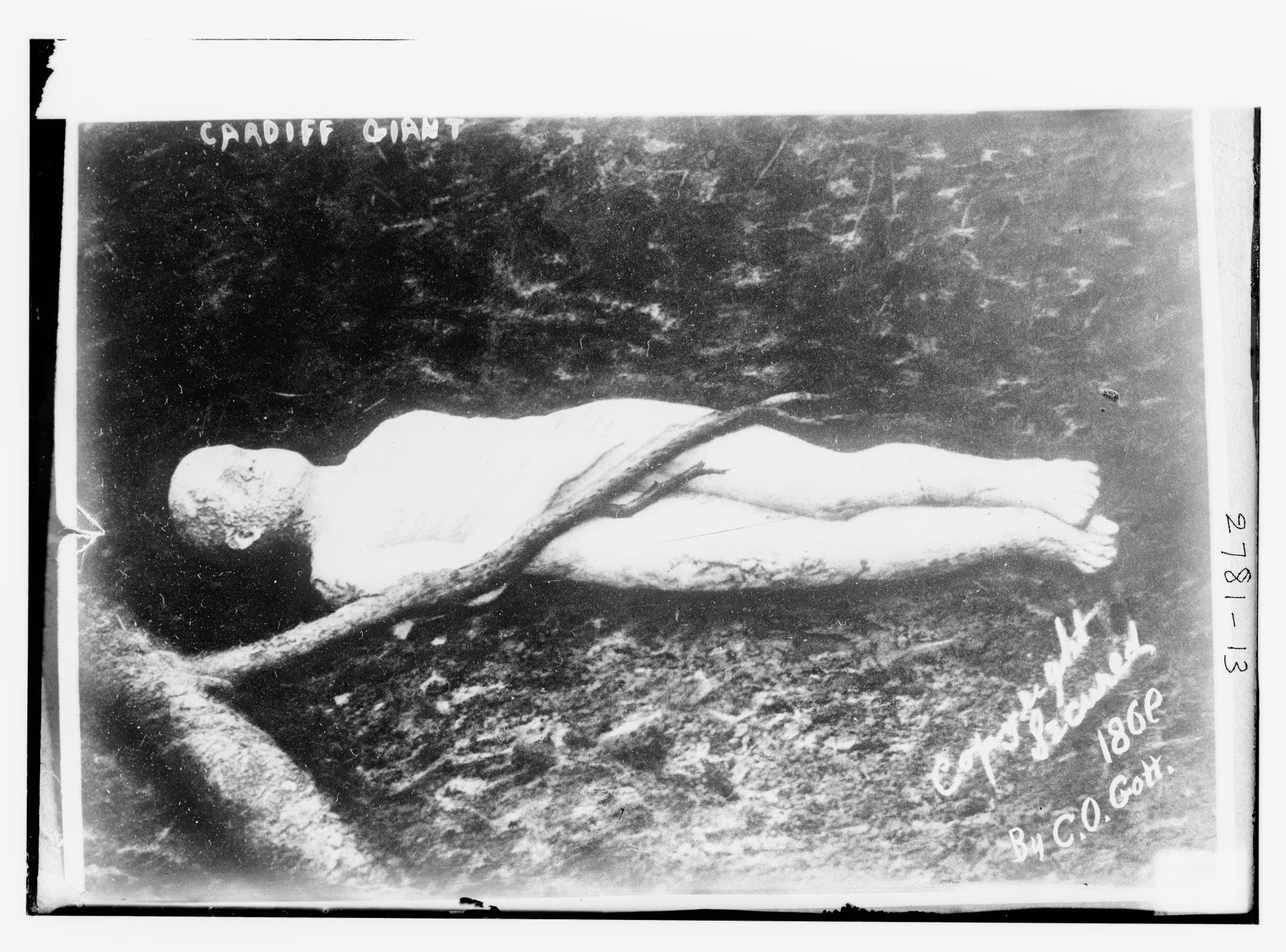
In 1869, near the city of Cardiff, New York state, USA, a buried giant was found: a huge plaster statue over three meters high, passed off as an ancient petrified man. It was a fake, created in plaster on the initiative of George Hull, an atheist man who wanted to make fun of Catholic fundamentalists, who believed in the existence of giants based on what was written in Genesis. The giant was exhibited as an attraction and many people believed it was real, even though authoritative voices of archaeologists and scholars had immediately guessed the deception. The entrepreneur PT Barnum tried to buy it to exhibit it during the circus shows he owned, but the deal was unsuccessful. He therefore decided to make a copy, declaring it to be the original giant. Subsequently, the scam was exposed: today both “giants” are exhibited in small museums in America. A similar scam was orchestrated in England, it is the Piltdown man.
The mastermind of the fake petrified giant scam
The idea of creating a fake giant came from George Hull, a tobacconist in New York, after having had a heated discussion on the existence of giants during a meeting in a Methodist church. The subject of the debate was a passage from the book of Genesis, which reads:
There were giants on earth in those times – and even after – when the sons of God united with the daughters of men and the latter bore them children: these are the heroes of antiquity, famous men. (Genesis – chapter 6, verse 4)
George Hull was an atheist and could not stand fundamentalism and those who took the Holy Scriptures literally. So he decided to make fun of them: inspired by an article published in 1858 in a Californian newspaper which spoke of a man petrified after drinking a liquid from inside a geode, Hull thought of artificially creating a giant.
How he created the 3 meter plaster statue
George Hull contacted some workers in Iowa and asked them to provide him with a block of plaster more than three meters high, saying that it would be used to make a statue of Lincoln in New York. He then had the block shipped to Chicago, where he instead entrusted Edward Burghardt, a craftsman of German origin, with the task of sculpting the image of an enormous man. Hull swore Burghardt to secrecy: the craftsman used acid to give the statue an ancient and ruined appearance, and struck the exposed “skin” numerous times to simulate skin pores to make it more believable.
Hull then had the giant transported to his cousin William Newell’s farm in Syracuse County in Cardiff, where he was buried. Newell became Hull’s accomplice: he in turn hired two workers, saying he wanted to build a well, and had them dig right where the giant was buried.
It was the workers commissioned by Newell to dig the well who found the statue, a fact which obviously caused great outcry.
The discovery and the exhibition
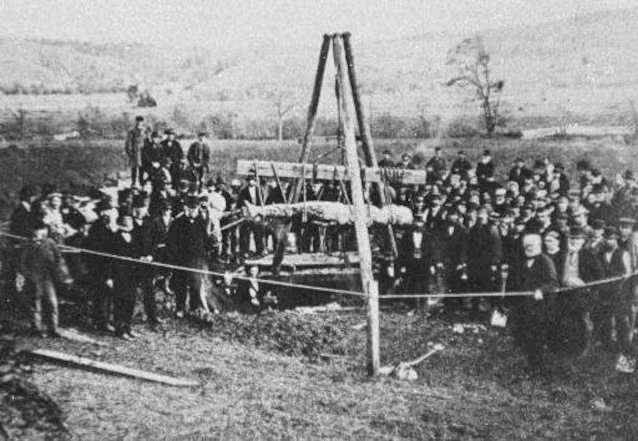
Based on the article that inspired George Hull, the rumor spread that the giant was petrified as had happened to the man who drank the liquid from the geode.
William Newell had a tent set up to exhibit the giant, charging each visitor 25 cents: people flocked by the dozens, convinced that it was a real giant. Day by day, Newell increased the price of the ticket, which only increased interest in the giant: obviously archaeologists also flocked there, who immediately declared that it was a fake. Particularly relevant among these was the voice of Othniel C. Marsh, Yale professor and expert in anatomy, mineralogy, geology and paleontology who defined it without any doubt as a “big hoax”.
The controversies and the creation of the “second” giant
The detractors were also joined by some geologists who noted that the point where Newell had asked to dig a well was not suitable for that purpose: the Catholic fundamentalists, however, were convinced that the giant was real and that it was finally a confirmation of what was written in Genesis.
Hoax or reality, the giant had in the meantime acquired great value: George Hull, in agreement with his cousin, sold it to David Hannum, a banker and horse trader who had understood its potential. Hannum had the statue moved to Syracuse, where it was put on display again, and received a very high purchase offer from entertainment impresario Phineas Taylor Barnum, but Hannum refused.
So it was that Barnum had the shape of the giant modeled in wax and created a copy which he put on display in New York, declaring that his was the real giant, the one displayed in Syracuse by David Hannum was a fake.
George Hull’s confession: the giant is fake!
The newspapers, obviously, went crazy: when Hannum realized that Barnum was trying to “cheat” him in turn, he declared that the giant had always been a fake and that he had managed to deceive hundreds of people since he had exhibited him for a fee.
Hannum took up a legal case, and the judge wanted the giant himself to be brought into the courtroom: George Hull, the initial creator of the whole scheme, was then called to testify. Hull declared that the giant was a fake and told his entire project: at the end of 1870 both giants were officially declared fake.
The giant’s celebrity then began to wane: for a few years “the original giant”, that of George Hull, was abandoned and then in 1901 it was exhibited at the Pan American Exposition, without arousing particular interest. It was then purchased by a private individual who sold it to the Farmers’ Museum in Cooperstown in 1947 where it is still on display today.
The second copy, however, that of Barnum, is at Marvin’s Marvelous Mechanical Museum in Farmington Hills, Michigan.