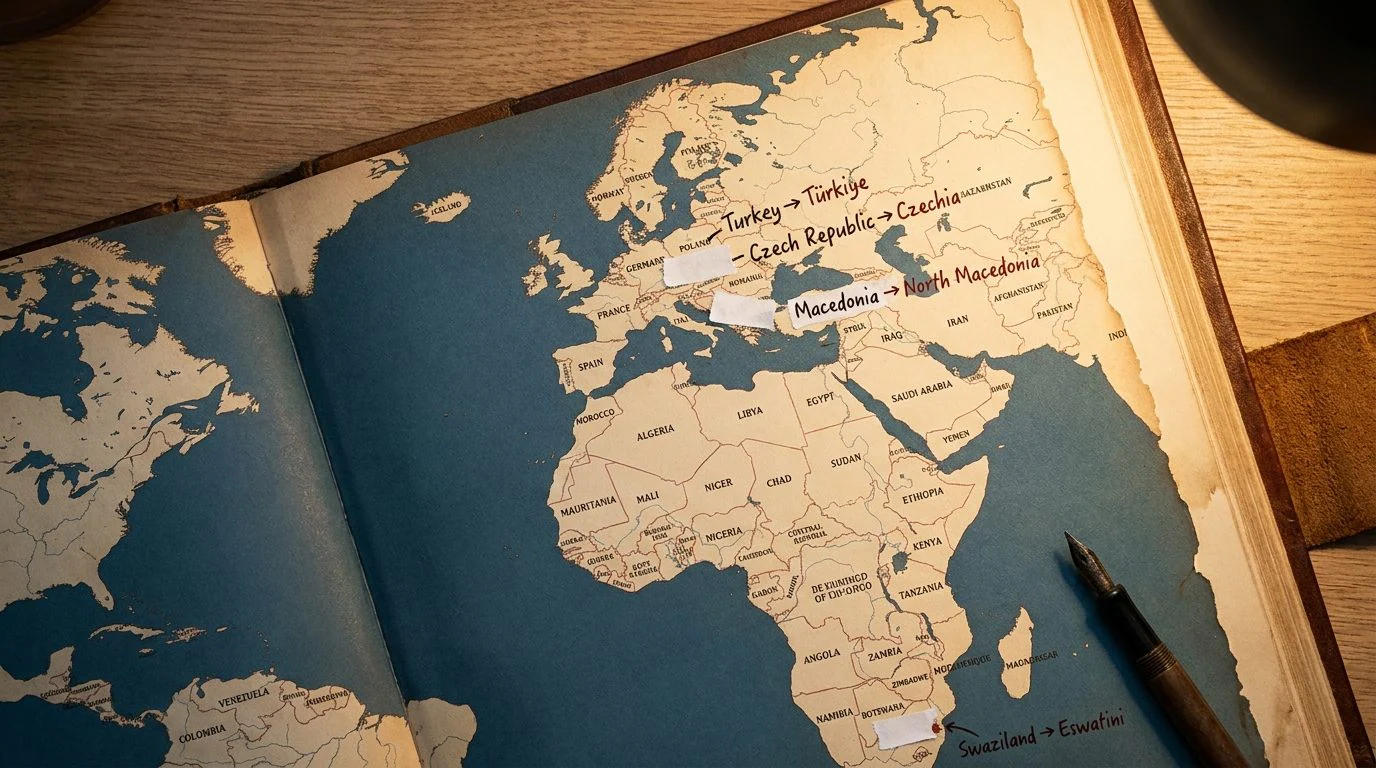
In the last ten years the Czech Republic has become Czechia, Turkey has asked the world to call it Türkiye, Swaziland has transformed into Eswatini and Macedonia into North Macedonia. And even today India is debating whether to officially become “Bharat”. They are neither the first nor the last countries to have changed their names for the most varied reasons. The name of a State is never just a name and behind apparently bureaucratic choices national identities, old colonial wounds, diplomatic tensions and even marketing strategies are actually hidden.
The Czechia of 2016, the divisive name for the Czech Republic
In 2016 that changed international standardization of the English version “Czechia”: Replaced Česko, which had been the official short name for the Czech Republic since 1993, set by the national mapping body. Today “Czechia” (the Italianized form we use is “Czechia”) coexists alongside the political name “Czech Republic”.
In fact, almost all states have two names: one politicallong and formal, and one geographicalshort and for daily use. Let’s take Italy: its official name is “Italian Republic”, but in everyday life none of us would call it that. Likewise we say “France” and not “French Republic”, “Germany” and not “Federal Republic of Germany”. The long name is used in documents, treaties and passports, while the shorter one is the one we normally use, even on maps.
The problem of the Czech Republic arises precisely from this: for over twenty years, from its birth in 1993, it did not have a short name recognized internationally. While its Slovak sister had immediately adopted “Slovensko” (short form of “Slovenská Republika”), i.e. Slovakia, the Czech Republic remained trapped in its political name. Incidentally, the 1993 “velvet divorce” that peacefully separated the Czechs and Slovaks was preceded by the so-called “hyphen war”: There was a long discussion about whether to write the name of the common state “Czechoslovakia” or “Czecho-Slovakia”. The first proposal won.
Almost ten years later, the English form “Czechia” continues to divide, for three reasons. The first is the fear of confusion: former prime minister Andrej Babiš opposed it, fearing that it would be mistaken for Chechnya, Chechnya. Indeed, in 2013, after the Boston Marathon bombing (carried out by two Chechen brothers), some international media confused “Chechens” and “Czechs”, to the point that the Czech embassy had to intervene publicly to clarify the misunderstanding. The second is regionalism: in Czech the root of the word (Chech) historically refers to Bohemia, the Prague region. This generates discontent among the inhabitants of the other historical regions (Moravia and Silesia) who read in the name an exclusion of their identity in favor of the centralism of the capital.
Finally, there is an aesthetic reason: to many the word Česko sounds bad. Former president Václav Havel went so far as to say that he got “slugs on his skin”, that is, shivers, every time he read or heard it. The result is that, even today, a good part of citizens and many documents prefer the old “Czech Republic”.
Türkiye, Eswatini and cases related to identity, post-colonialism or marketing
Czechia is not an isolated case. In recent years the phenomenon has multiplied, again for three main reasons. The first is the desire to reclaim one’s identity, erasing the colonial past or the exonym (i.e. name given in a specific language to a place located outside the area where that language is spoken, which is different from the local name). This includes the case of Türkiye, which in 2022 asked the world to call it Turkiyethe Turkish spelling of his name. The official reasons of the Erdoğan government were to enhance national culture and, not least, to distance itself from the English word turkey, which also means “turkey”. The UN accepted the request within a few weeks.
It too Swazilanda country in Africa, has returned to its pre-colonial name Eswatini (“land of the Swazi”) in 2018, at the behest of King Mswati III on the occasion of 50 years of independence. Cabo Verde he asked as early as 2013 to no longer see his name translated into “Cape Verde”, but used in the Portuguese form. Same choice made by Ivory Coast (Côte d’Ivoire) since 1986. And then the great classics of decolonization: the Burma become Myanmar in 1989 (a choice imposed by the military regime and still contested), Ceylon since 1972 Sri Lankathe Persia who asked to be called in 1935 Iran and the Siam which it has become since 1939 Thailand.
In other cases, there is a need to resolve a diplomatic conflict, as for the North Macedonia. For nearly three decades, Athens opposed the name “Republic of Macedonia”, arguing that it implied territorial claims to the Greek region of the same name. With the 2018 Prespa Agreement, which came into force in 2019, the country added “Northern” to its name. This unlocked its entry into NATO (2020) and the race towards the European Union (membership negotiations began in 2022 and are still ongoing).
Finally, there are “marketing” reasons, as in the case of Netherlands who in 2020 decided to progressively abandon the nickname “Holland” in official and tourist communications. In fact, “Holland” actually indicates only two of the twelve provinces of the country, and the government wanted to move tourist flows beyond Amsterdam, enhancing the entire territory.
A choice still open: India or Bharat?
The warmest front in recent years and still being defined is undoubtedly the Indian one. During the G20 summit in New Delhi in September 2023, the official invitations to the gala dinner were signed with the wording “President of Bharat” instead of the usual “President of India”. A detail that triggered a real political earthquake. Not that the name was invented: the Indian Constitution, in article 1, already states “India, that is Bharat”, sanctioning the official coexistence of the two terms.
Bharat is the Sanskrit and Hindi form, of ancient origins. Emphasizing “Bharat” to the detriment of “India”, however, had an obvious strategic significance, which exploded in view of the 2024 general elections. When the opposition united in a maxi-coalition choosing the provocative acronym INDIA, the nationalist government of Narendra Modi accelerated the use of “Bharat” to boycott its opponents and, at the same time, present itself as the liberator from the colonial legacy: the name “India” is in fact linked to British use. After the elections, the government returned to the dual track: India remains the reference name for international law and foreign diplomacy, while Bharat is spent on domestic politics and large state programs, such as the national strategic plan Viksit Bharat (“Developed India”).
All the other states that have changed their names
The official name of Mexico is “United Mexican States”, that of Greece “Hellenic Republic” (the Greeks call their country Elláda). Uruguay is called in full “Eastern Republic of Uruguay” (because east of the Uruguay River); Switzerland is called the “Swiss Confederation”; Australia”Commonwealth of Australia”. Bolivia”Plurinational State of Bolivia“, by the constitution promulgated on February 7, 2009 under Evo Morales, the first indigenous president, to recognize the 36 indigenous nations of the country. Venezuela is the “Bolivarian Republic of Venezuela“, since 1999 by will of Hugo Chávez (in honor of Simón Bolívar). The real name of Gambia is “The Gambia”: the article serves to distinguish it from the river Gambia. In 2015 the dictator Yahya Jammeh renamed it “Islamic Republic of The Gambia”, but his successor Adama Barrow revoked the decision in 2017 and today it is “Republic of The Gambia”.
With the Act of Union of 1801 the “United Kingdom of Great Britain and Ireland” was born (the latter, in fact, was entirely British). After Irish independence and the creation of the Irish Free State in 1922, only six northern counties remained in the Kingdom. So the Royal and Parliamentary Titles Actwhich came into force on 12 April 1927, officially renamed the state the “United Kingdom of Great Britain and Northern Ireland”. Today it is sometimes abbreviated to “United Kingdom”, sometimes to “Great Britain”, which however is only the largest island. The ISO code of the United Kingdom is GB (Great Britain), but the internet domain is .uk (United Kingdom), one of the very few exceptions in the world where the domain does not coincide with the official ISO code.
The two Congos offer us an opportunity for geographical confusion par excellence: in fact, they exist there Republic of Congo (with capital Brazzaville) and the Democratic Republic of the Congo (with capital Kinshasa), two neighboring and distinct states. The second, under Mobutu’s dictatorship, was called Zaire from 1971 to 1997, and then returned to the “Democratic Republic of Congo” after the fall of the regime. Burkina Faso was previously called Upper Volta: in 1984 the revolutionary president Thomas Sankara renamed the former French colony, abandoning the colonial name linked to the Volta river, choosing a name that means “land of upright/honest men”, and combines two local languages (More and Dioula).
The record for name changes is held by Cambodia, which in the twentieth century went through a tormented series of historical transitions: it passed from the original Kingdom of Cambodia (1953-1970) to the Khmer Republic (1970-1975), and then became the infamous Democratic Kampuchea under the dictatorship of the Khmer Rouge (1975-1979). It was subsequently renamed the People’s Republic of Kampuchea (1979-1989), then the State of Cambodia (1989-1993) and finally, with the restoration of the monarchy in 1993, it became the Kingdom of Cambodia again.
The length record was instead held by Libya under Gaddafi’s regime from 1977 to 2011: since 2013 “State of Libya”, for years it was called “Great Socialist People’s Libyan Arab Jamahiriya”.