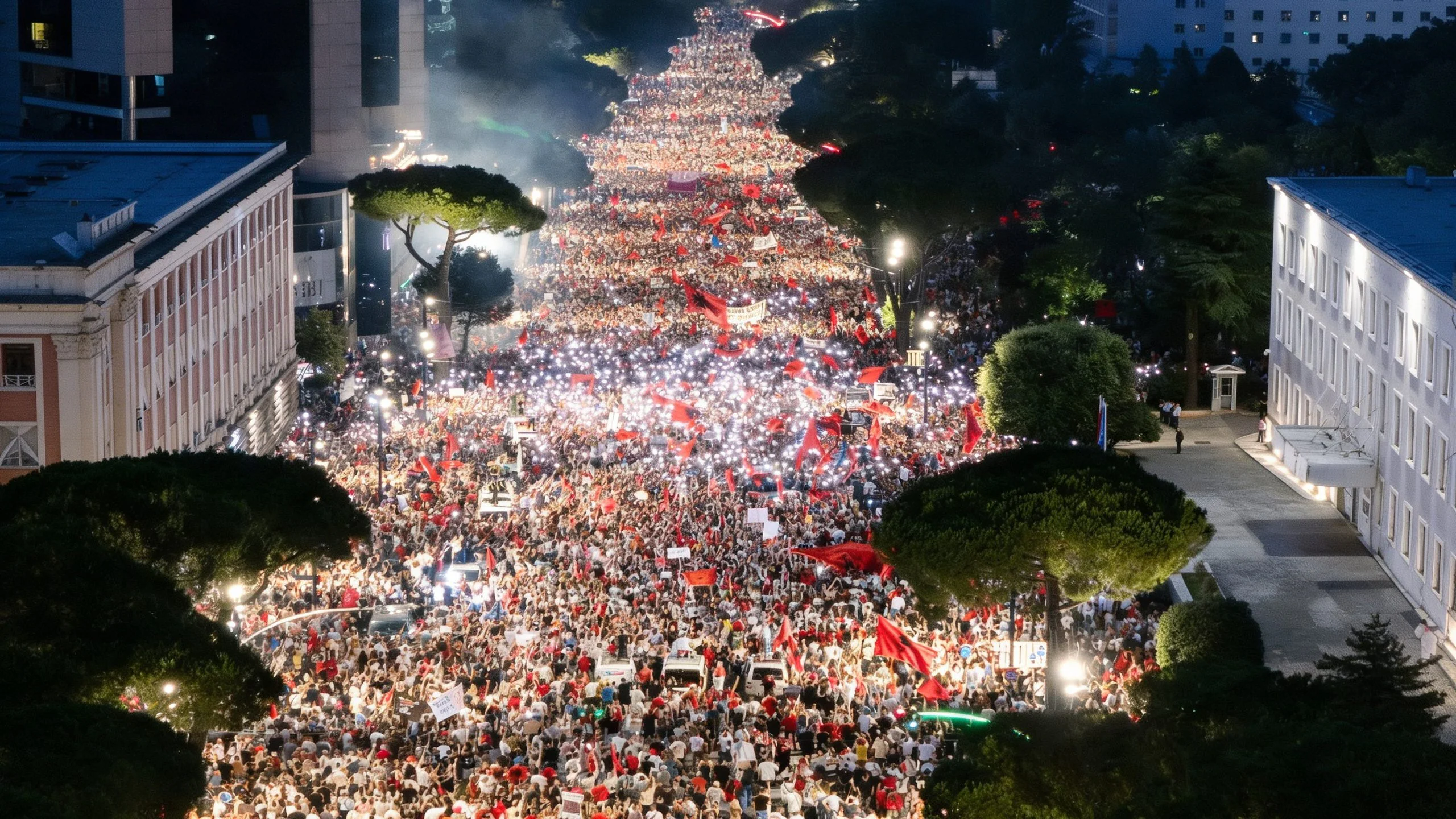
For 22 days, Albania has been experiencing one of the largest civic mobilisations in recent years, which began in the form of local protests against the construction of a tourist resort in a protected environmental area, a project behind which the company Affinity Partners, owned by Donald Trump’s daughter and son-in-law, Jared Kushner, is hidden.
Over the weeks, the mobilization – now renamed “the flamingo revolution” – has gradually spread throughout the country, with the population now calling for the resignation of the socialist prime minister Edi Rama: thousands of people have taken to the streets to demonstrate in Tirana, Vlora and other cities against the entire old political class, which would have given the green light to the tourist resort, destined to be built along the southern coast of the country, between the island of Sazan and the area of Vlorë (Vlorë in Albanian).
The project has been described as a local story linked to luxury tourism and environmental conflicts, but in reality it is part of one of the most strategic spaces in the entire Mediterranean: the Otranto Canal, the strait that connects the Adriatic and Ionian Seas and which represents one of the main “energy gates” to Europe. In fact, maritime traffic, strategic infrastructures and interests involving the European Union and NATO allies are concentrated here, making any coastal transformation much more than environmental or construction speculation.
Albania between environmental and political protests against Edi Rama
At first glance it might seem like a contrast between environmentalists and builders of luxury resorts, but the numerous protests that are crossing Albania are calling into question the development model chosen by the government of Prime Minister Edi Rama, based on the attraction of large foreign capital to accelerate economic growth and transform Albania into a new tourist destination in the Mediterranean.
According to the government, this approach has contributed to increasing employment, infrastructure and tourist flows, which have reached record levels in recent years. But the issue has become even more delicate because the country is officially a candidate for entry into the European Union and must demonstrate that it respects increasingly rigorous standards in terms of administrative transparency and environmental protection. The protesters are calling for the resignation not only of Prime Minister Rama, but also of all those who approved the project, including opposition leader and veteran of post-communist Albanian politics, Sali Berisha.
Sazan Island which could become the resort of Kushner, Trump’s son-in-law
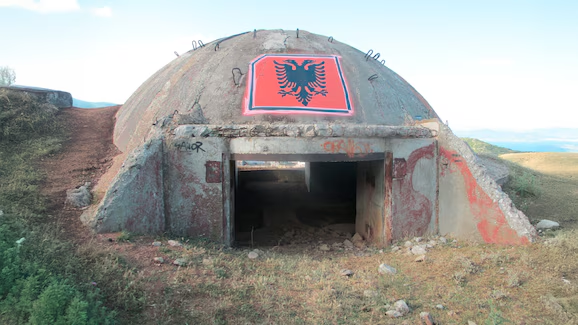
The island of Sazan is located at the entrance to the bay of Vlora, representing the meeting point between the Adriatic Sea and the Ionian Sea. For decades it remained practically inaccessible because it was used as a strategic military base: during the twentieth century it came under Italian control, then Soviet control and finally the communist regime of the former Albanian prime minister and dictator Enver Hoxha. Even today, there are bunkers, underground tunnels and military infrastructures on the island which testify to the climate of isolation that characterized Albania during the Cold War.
In recent years, however, the government has decided to open Sazan to private investments: the most discussed project involves the construction of a large luxury tourist complex, with investments estimated at over one billion euros which according to the Albanian government would allow the recovery of an abandoned area, create employment and attract visitors with high spending power. But from an environmental point of view, Sazan hosts still uncontaminated coastal habitats and is part of the ecological system of the Karaburun-Sazan Marine Park, one of the most important marine areas in Albania. The concern is that we could permanently alter an ecosystem that has been preserved thanks to its long isolation.
Because Sazan is a strategic point in the Mediterranean
Added to all this is the military dimension. Albania has been a member of NATO since 2009 and the coast of Vlore represents one of the Alliance’s access points to the Western Balkans. In recent years, NATO has increased its attention towards the eastern Mediterranean and the Adriatic area, considered crucial for the monitoring of maritime routes and for the safety of underwater infrastructures, such as gas pipelines and telecommunications cables.
This does not mean that there is necessarily a hidden geopolitical purpose behind the tourism project, but Sazan is not just any locality: its position places it at the center of a network of interests involving energy, maritime security and stability of the Mediterranean. For this reason, discussions on the island go far beyond the construction of a resort: they concern a geographical space that for over a century has been considered strategic by the great powers bordering the Adriatic.
Vjosa-Narta and its ecological importance in the Balkans
Vjosa-Narta is a vast protected area that includes the Narta lagoon, wetlands, salt marshes, coastal dunes and the final stretch of the Vjosa river, considered one of the last large European rivers still relatively uncontaminated. It is located along the Adriatic migratory route and every year thousands of migratory birds use this area as a resting, feeding and nesting point.
Among the best-known species are pink flamingos, which have become the symbol of the events. But the biological importance of the area goes far beyond the presence of these animals: wetlands like Vjosa-Narta perform essential functions for the ecosystem. They naturally filter water, reduce coastal erosion, absorb large amounts of carbon and help mitigate the effects of extreme weather events. From a scientific point of view, these environments are considered among the most important ecosystems in the Balkans and, despite occupying a relatively small surface area, host extraordinary biodiversity.
The TAP and the energy corridor that crosses the Balkans
A few kilometers from the area affected by the project passes the Trans Adriatic Pipeline (TAP)the final stretch of the Southern Gas Corridor, the pipeline that transports natural gas from the Shah Deniz field in Azerbaijan, crossing Greece and Albania before arriving in Italy, where it connects to the European energy network.
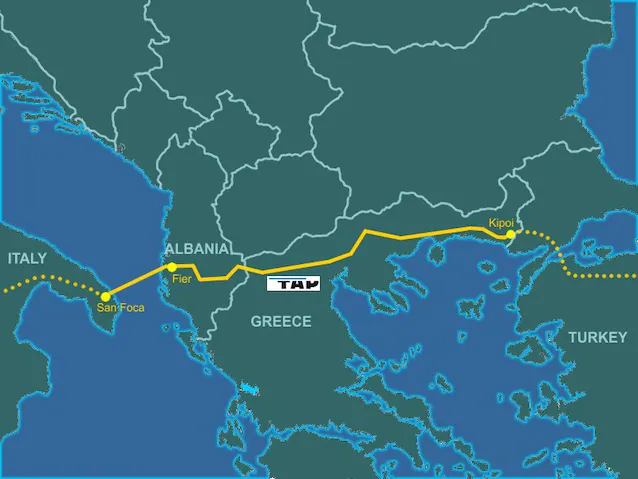
The Southern Gas Corridor, among the most relevant from an energy point of view for Europe, has the objective of reducing Europe’s dependence on energy supplies from Russia, making this strip of territory a crucial and strategic part of a larger continental energy network, designed to diversify European energy supplies and strengthen it safety.
In this context, therefore, Albania represents a crucial energy hub and every coastal transformation represents a reorganization of the infrastructural space of the Mediterranean. The system is also designed with an important feature: the reverse flow capacityi.e. the possibility of temporarily reversing the flow of gas in the event of a crisis or need for redistribution.
How does this story fit into the European framework?
The protests have now gone beyond the local dimension: Albanian citizens have also taken to the streets in the capital and the criticisms mainly concern the transparency of procedures, the management of concessions and the relationship between public interest and large private investments.
For this reason, the so-called Flamingo Revolution is not just an environmentalist mobilization, but has become the expression of a deeper malaise involving issues such as corruption, the distribution of wealth, democratic participation, the future development model of the country and its European dimension. Albania is in fact a candidate for entry into the European Union and, during the accession negotiations, is called upon to demonstrate concrete progress in environmental protection, in the rule of law and in administrative transparency. For this reason, what is happening in the country is also carefully observed outside national borders, to understand the country’s real ability to reconcile economic development, territorial protection and the standards required by European integration.