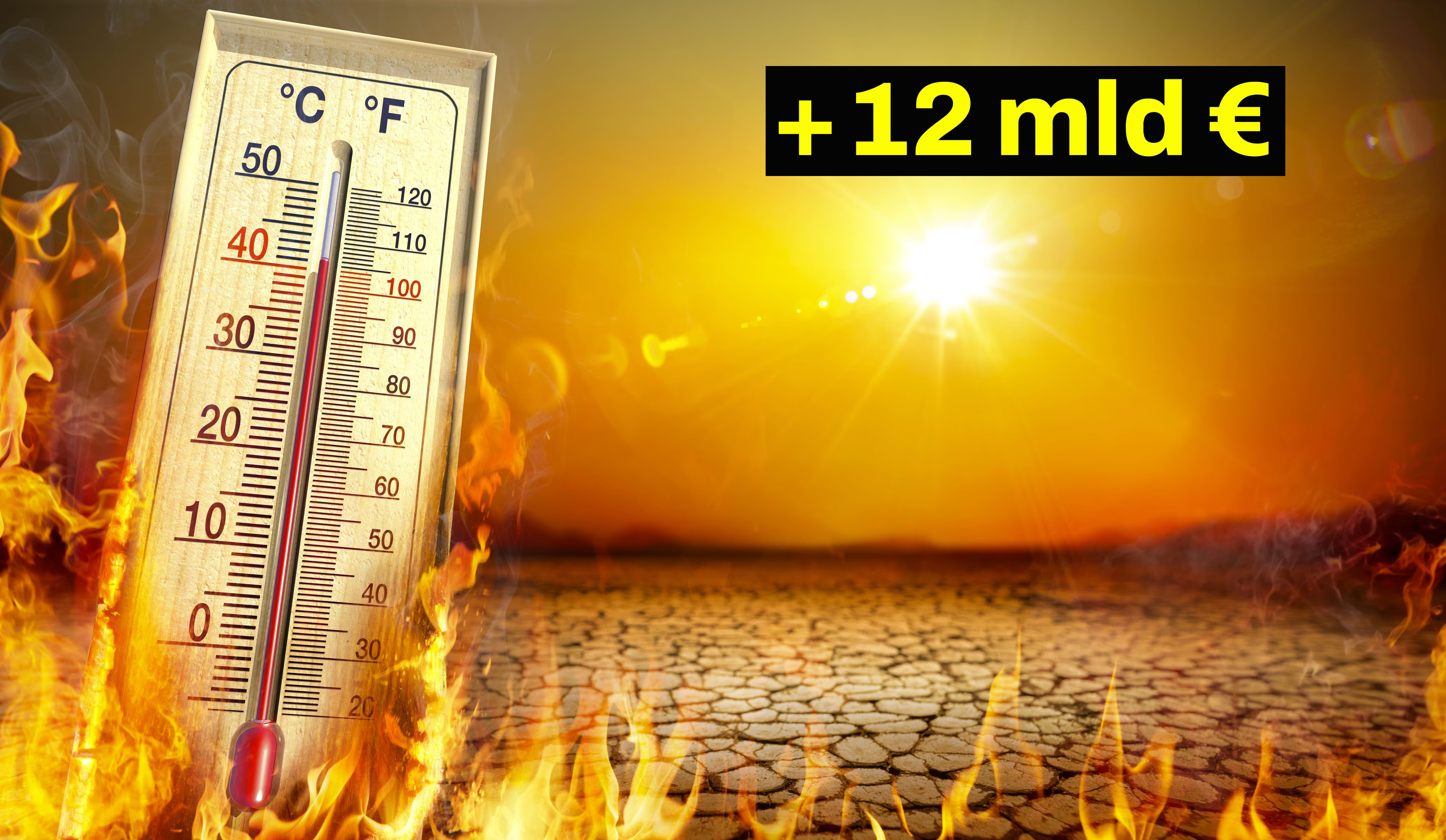
Between 6 and 12 billion euros a year. This is the bill that extreme heat presents to the Italian economy according to the Economic Office of Confesercenti, which on 18 July released an analysis on the impact of high temperatures: living with 30/60 days of intense heat every year can have an impact of between 0.2 and 0.4% of GDP, including higher energy costs, lower productivity, forced investments and lost turnover in the most exposed sectors.
The estimate comes at the height of an anomalous summer: according to the Copernicus Climate Change Service, June 2026 was the warmest June on record in Western Europe and the second warmest globally.
When the heat costs in Italy: the four economic items
The estimate is made up of four items. The heaviest is that of the now obligatory investments – more efficient air conditioning systems, photovoltaics, shielding, energy requalification of properties – valued between 2 and 4 billion.
This is followed by higher energy costs, between 2 and 3 billion, linked to the need to cool for longer, and the drop in work productivity on days of intense heat, estimated between 1.5 and 3 billion. Added to this are 1-2 billion in lost turnover in the most exposed sectors, from construction to agriculture to logistics and street trading.
It must be clearly stated what these numbers are: an estimate developed by a trade association, not an official statistical survey. Independent confirmation, however, exists at least on the energy item. Terna’s provisional data indicate that on 15 July 2026, between 3pm and 4pm, the national electricity demand reached 57,985 megawatts: the highest hourly peak of the year, 4.6% higher than the peak in 2025, when the maximum demand stopped at 55,450 megawatts.
The historical maximum remains that of July 2015, with 60.5 gigawatts. A peak in demand driven by air conditioning is, in practice, the same thing seen from the grid side: energy that someone pays for.
Why above 35 degrees productivity collapses and how consumption changes
Above stable 35 degrees, work performance drops: errors and absences due to illness increase, the capacity for physical effort decreases. The most exposed sectors are construction, agriculture, logistics, street trading and maintenance, together with small businesses and outdoor tourism.
It is the point on which the international literature is most solid. In the Working on a Warmer Planet report, the ILO (International Labor Organization) estimates that in 2030, 2.2% of hours worked worldwide will be lost due to high temperatures: the equivalent of 80 million full-time jobs and 2,400 billion dollars. Agriculture and construction alone are worth 60% and 19% of lost hours respectively, and it is a conservative projection, because it assumes that we work in the shade and that global warming stops at 1.5 degrees.
In Italy the account is already visible in the fields. Cia-Agricoltori Italiani estimates that the 2026 heat wave could cost the primary sector over 1.5 billion euros in damage to crops and lost working hours, with critical issues for corn, soya, fruit and vegetables and livestock; Coldiretti estimates the damage to Italian agriculture in the last four years between droughts and floods at more than 20 billion.
But the heat doesn’t just take away hours of work: it also shifts consumption. In the central hours of the day the high temperatures empty the streets, and the winners are the large air-conditioned spaces and online platforms, while the losers are the markets, the shops in the historic centers and the neighborhood businesses, which find themselves a further factor of pressure after that of e-commerce. In catering, the heat paradoxically discourages the use of dehors, reducing the potential capacity of public establishments; in tourism the flows tend to move towards June and September and redistribute towards the mountain areas, penalizing the cities of art in the hottest weeks.
Why Confesercenti’s estimate is conservative: what European studies say
0.2-0.4% of GDP may seem like a low figure when compared with the scientific literature. The study by David García-León and colleagues published in Nature Communications, carried out with the Joint Research Center of the European Commission, measured European economic losses due to the decline in productivity from heat.
The historical average for the period 1981-2010 stands at 0.21% of GDP – practically the lower limit of the range indicated today by Confesercenti – but is destined to rise to 0.77% in 2035-2045, to 0.96% in 2045-2055 and over 1.14% in the 1960s. For Italy, the projection to 2060 is for losses equal to 2.17% of GDP, with strong territorial differences: in regions such as Sicily and Lombardy the regional product losses could approach 3%, in Tuscany they could exceed 4%.
In other words: the account that today weighs a few tenths of a point is that of a climate that has already changed, not of what will come. Over the course of a generation, with legislation and adaptation unchanged, the same voice is worth ten times as much.
From regional ordinances to urban regeneration: what can be done
Some of the tools already exist, but act downstream. Regional ordinances prohibit outdoor work between 12.30 pm and 4.00 pm on days and in areas where Inail’s Worklimate platform indicates a “high” risk, while for the purposes of redundancy payments the INPS considers the threshold of 35 degrees, real or perceived (message no. 2130 of 2025).
On 22 June 2026, the Council of Ministers also approved a decree-law that reintroduces access in derogation to social safety nets for exceptional heat waves in the construction and related sectors, for suspensions between 1 July and 31 December 2026. These are measures that absorb the blow but which do not systematise the heat problem.
The long-term solution, claims Nico Gronchi (President of Confesercenti), involves the deep thermal redevelopment of buildings and commercial structures and adaptive urban regeneration: without immediate investments in the resilience of cities, climate change will continue to act as an accelerator of the economic crisis, emptying public space and weakening the competitiveness of the country system.
In terms of incentives, the main instrument is the Conto Termico 3.0 managed by the GSE, a direct contribution that can cover up to 65% of the eligible expenditure depending on the intervention and the requesting party. On the urban front, some cities are equipping themselves with climate shelters: Milan has mapped over 600 of them, Bologna has developed an app that reports in real time which spaces are open and air-conditioned.