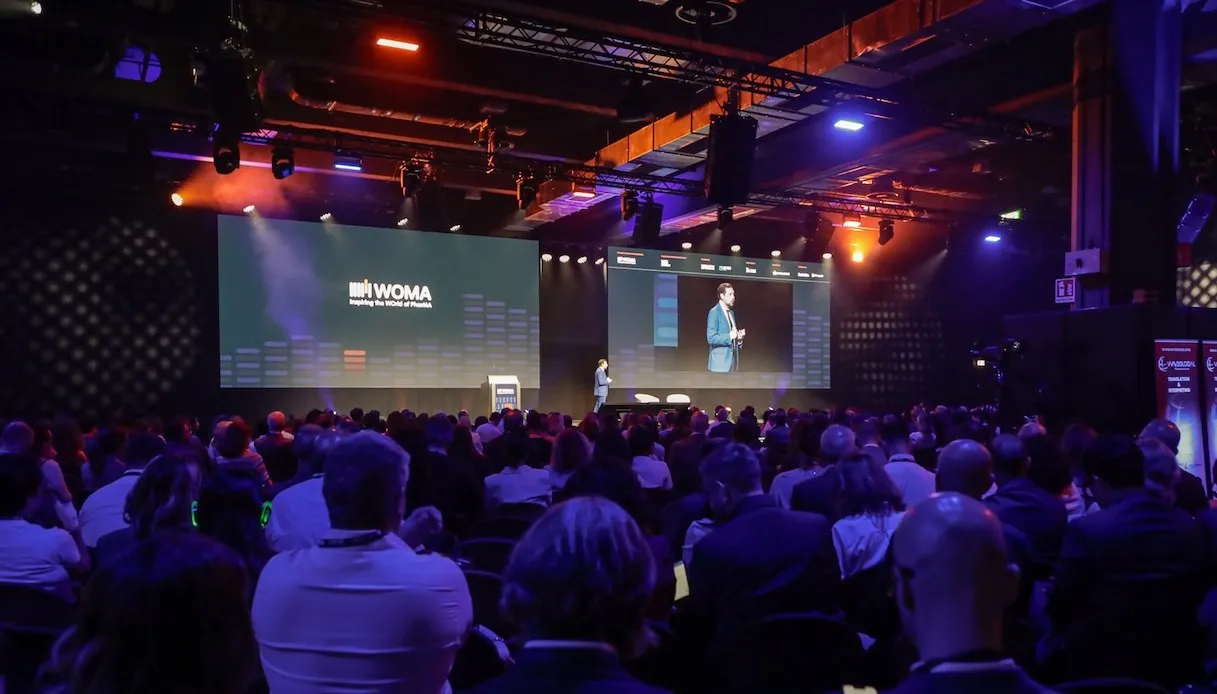
Almost a thousand professionals, over sixty partners and sponsors, a Nobel Prize winner, a former president of the European Commission and one of the most authoritative voices in the world on artificial intelligence: the first edition of the Woma Forum – Inspiring the WOrld of pharMA, held on 25 and 26 June, left its mark on the panorama of events dedicated to pharma, medtech, healthcare and life sciences.
Two intense days at the Allianz MiCo in Milan transformed an idea into an event which, right from the first edition, brought together industry, research, institutions and academia to discuss how to build the future of health.
Milan as a European innovation ecosystem
Milan thus confirms itself as a strategic hub for life sciences at a continental level, thanks to a combination that is difficult to replicate: excellent universities, research infrastructures, industrial capacity and a dynamic entrepreneurial fabric. This was underlined by Emmanuel Conte, Budget Councilor of the Municipality of Milan, recalling that:
life sciences are today a strategic challenge that is not only scientific, but social and political: they concern access to care, the sustainability of health systems and the reduction of inequalities. Woma strengthens the ecosystem of relationships and skills that makes Milan a European innovation hub. The real challenge remains to transform research and technology into health, development and shared opportunities.
Barroso’s words
The main guest of the first day was José Manuel Barroso, former president of the European Commission and former Board Chair of Gavi, the Vaccine Alliance. For Barroso, international cooperation is going through a profound crisis, but there are ways to recover. For example by changing the model, as Gavi’s experience demonstrates:
by uniting governments, industry, foundations and civil society around a common mission, in twenty-five years we have halved infant mortality in 78 countries. Mission-driven public-private partnerships are the most realistic way to address the great challenges of our time, from global health to health security to equitable access to artificial intelligence.
What we talked about on the second day
The second day of the Woma Forum focused on some of the key themes for the future of life sciences, starting from the role of scientific research. Among the most anticipated speeches, that of Jennifer Doudna, Nobel Prize winner for Chemistry 2020 and co-discoverer of Crispr-Cas9. The scientist retraced the evolution of gene editing, explaining how the study of the immune system of bacteria has opened up new perspectives for modern medicine, with repercussions destined to transform diagnoses and therapies.
In the afternoon, Bertalan Meskó of the Medical Futurist Institute proposed a provocative reflection on the future of healthcare: rethinking the entire system “as if it had to be rebuilt from scratch, for example on Mars”. A useful exercise, according to Meskó, because, as he explained in his speech:
the future of medicine must be designed starting from the patient’s experience. AI, digital health and advanced technologies only matter if they enhance that experience: technology doesn’t replace the doctor, it amplifies him.
Zack Kass: “AI, a new Renaissance”
There is also ample space for artificial intelligence with the intervention of Zack Kass, former manager of OpenAI. His vision overturns the most widespread narrative: AI is not a threat, but a “Renaissance” to be governed. In the pharma and medtech sector, he underlined:
the difference will not be made by those who adopt the most advanced technology, but by those who have the courage to lead the transformation instead of undergoing it.
The conclusions were entrusted to Michele Barletta, president of the Woma Scientific Committee and President of BioPharma Network:
The future of health is not something to be predicted, but something to be built together, through dialogue between science, industry, institutions, technology and society. The participation registered at Woma confirms that in the sector there is a strong need for an ecosystem and collaborative approach to the major transformations underway.