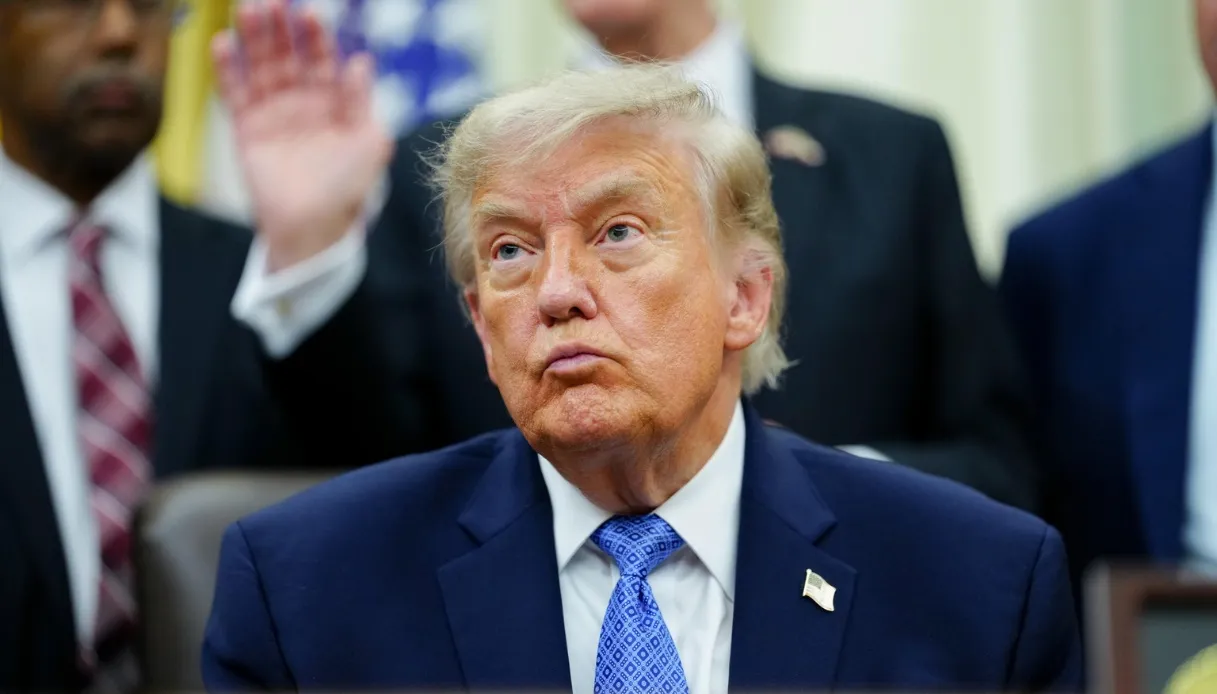
Donald Trump threatens the EU with 100% tariffs against countries that apply taxes to the digital services of American Big Tech.
A tension that does not arise today but is part of a commercial balance built with difficulty in recent weeks and which risks dissolving in a cloud of smoke.
An already fragile agreement between Brussels and Washington
The European Union and the United States had recently reached a broad agreement on trade relations, based on a political compromise rather than a full convergence of interests. The objective was to reduce uncertainty and contain the escalation of cross-tariffs that has characterized the transatlantic relationship in recent years.
Europe had accepted a greater opening of its market to certain American products, while Washington had maintained some tariff barriers on strategic sectors of European exports. A balance that, right from the start, was considered temporary rather than a definitive solution.
The new front: digital taxes
The real fracture has opened in the field of digital taxation. The so-called digital services taxalready introduced or discussed in several European countries, were created with the aim of taxing the revenues generated by large online platforms in national markets.
This is a tax fairness measure. The digital economy generates significant profits in individual countries, but often concentrates them in lower-tax jurisdictions. Digital taxes therefore try to rebalance this asymmetry.
Washington considers these taxes discriminatory treatment against American companies, given that the main groups involved are the US-based technology giants. Hence the decision to raise the level of conflict, to the point of threatening 100% general duties.
The political variable that changes the scenario
What makes the situation particularly delicate is the way in which this new threat fits into existing agreements. In fact, the American position is not limited to contesting individual fiscal measures, but introduces the possibility of reacting with duties even in the presence of trade agreements already signed, if the interests of Big Tech are affected.
This is the element that changes the perception of risk. This is no longer just a sectoral dispute, but a potential unilateral revision of the rules of the game, at least from a European point of view.
The European Union’s response
Brussels, for its part, firmly defends the legitimacy of its fiscal policies. The official position is that digital taxes are not targeted measures against American companies, but applied to all large platforms operating in the European market.
The European Commission reiterates the fiscal sovereignty of Member States as a non-negotiable principle. From this perspective, any trade retaliation by the United States would be interpreted as a disproportionate and potentially destabilizing measure for the entire transatlantic trading system.
Is the trade deal at risk?
This new stance by Trump seriously risks calling into question the agreement reached with difficulty a few days ago.
The agreement does not seem destined to fall apart automatically, but it is certainly being made more fragile. The reason is that it introduces an element of political conditionality on a topic, digital taxation, which until now had remained on the margins of traditional commercial negotiations.
In essence, the risk is not so much that of an immediate rupture, but of a progressive erosion of the agreement, especially if neither of the two parties were to take steps backwards in terms of their respective fiscal and commercial policies.
What are the possible scenarios in the coming months
If the European Union were to maintain or strengthen digital taxes, the United States could proceed with the imposition of very high duties, triggering a new phase of trade tension.
Brussels and Washington could agree on an implicit compromise: the EU would review the structure of digital taxes to avoid escalation and the other side would renounce extreme measures, thus preserving the backbone of the trade agreement.
The crisis could be an opportunity to reopen a broader negotiation, in which Big Tech becomes part of the diplomatic table.









