In ancient Greece and ancient Rome there was no concept of homosexuality understood as a sexual orientation like today. In classical Greco-Roman culture, homosexual (male) relationships were an integral part of the way of experiencing sexuality, but were seen differently depending on whether one was “active” or “passive”. This distinction had very strong repercussions on a social level. You could be sexually attracted to both sexes (from this point of view there was no exclusivity), so much so that for Greek and Roman men it would be more correct to talk about bisexuality. The real difference lay in the hierarchical relationship that was established between the people involved, however permeated by a very strong patriarchal and chauvinist connotation. The sphere of female homosexuality, however, is shrouded in “mystery”, due to the almost total absence of sources that talk about it.
Homosexuality in the Greek world
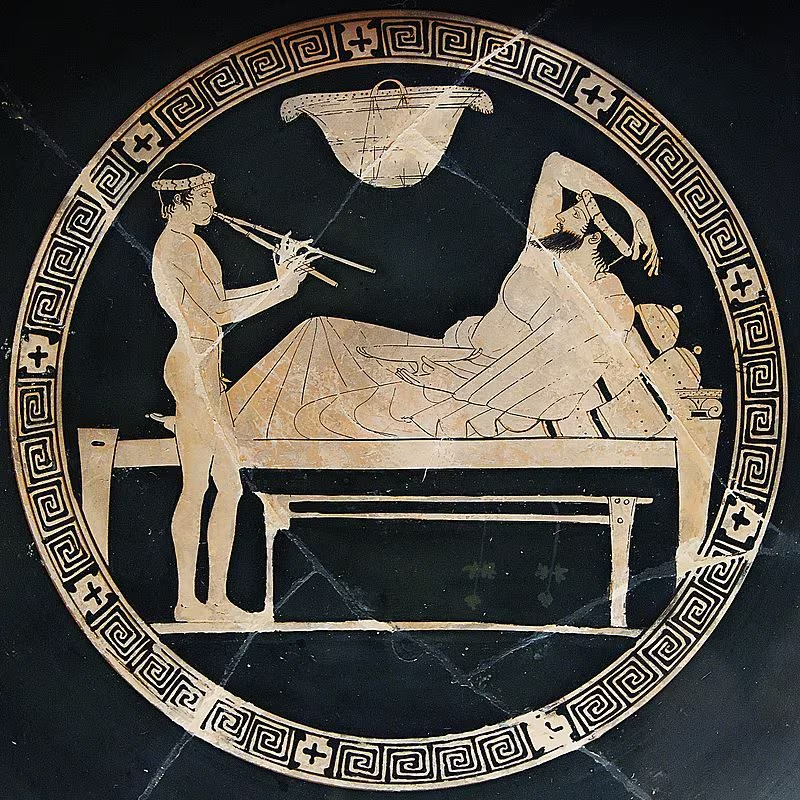
In classical Greece, homosexual practices between men were quite common. This is mainly due to the fact that our concept of “sexual orientation” did not exist in the Greek world. The distinction was purely social. In fact, the relationship between two men reflected the strongly patriarchal and chauvinistic mentality inherent in Greek culture: in sexual intercourse, those who were “active” were perceived as masculine, strong and dominant; those who held a “passive” role, on the other hand, found themselves in a lower position hierarchically, and were perceived as weak and feminine, like women themselves. What was despised was not homosexuality, but being in a passive or “feminine” position.
Homosexual relationships between men were also formalized. In particular, the institution of “pederasty” was perceived as an integral part of a young man’s growth path. It consisted of the relationship, both educational and romantic and sexual, between a mature man and a young man between twelve and seventeen. This relationship, which reflected the dominance of the elderly over the young, ended with the boy’s maturity, and was considered useful and necessary for the formation of a man.
However, we know very little about homosexual relationships between women, due to the poor representation that the female world of ancient Greece had in the sources in our possession. The only explicit references to relationships between women occur in the production of Sappho (c. 630–c. 570 BC), poetess of the island of Lesbos, hence the terms “sapphic” and “lesbianism”. Sappho was responsible for the education of the young noble women of her island, and it has been hypothesized that a relationship similar to male pederasty existed between her and her students. One of her well-known poems, fragment 31, describes the sensation felt by the poet at the idea of moving away from one of her students, who had reached marriageable age:
He, that man, appears to me to be equal to the gods
who sits in front of you and close by
listens to you: your voice sounds sweet
and your smileignites desire. And this is the heart
it makes my chest explode: if I look at you
for an instant, not a single one comes out
faint voice(Translation from Greek by G. Nuzzo)
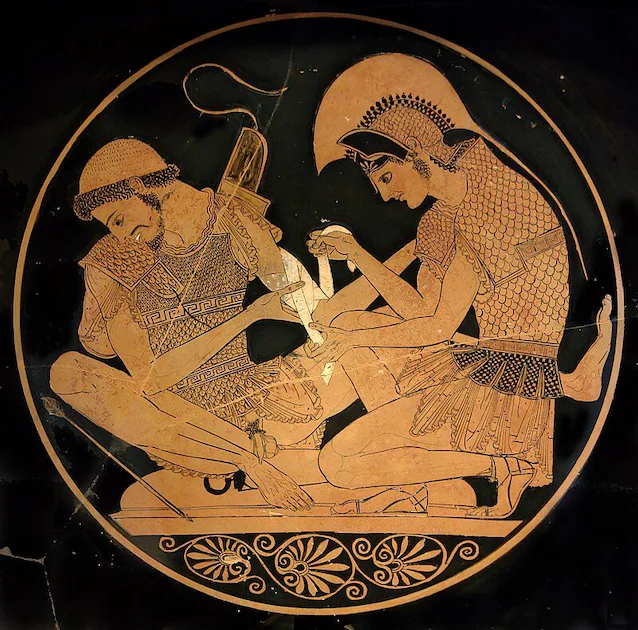
The sources, both mythological and historical, present numerous examples of homosexual relationships. Although Homer never talks about it explicitly, the relationship between Achilles and Patroclus in the Iliad is very reminiscent of pederasty, if not a real love relationship. Although scholars have doubts, a similar relationship seems to have existed between the Macedonian king Alexander the Great and his childhood friend Hephaestion.
Homosexuality in the Roman world
As far as Roman civilization is concerned, the perception of homosexuality radically differed between the period before and after contact with Greek culture, between the 3rd and 2nd centuries. to. C. Before Roman culture was heavily influenced by Hellenic culture, homosexuality was considered morally despicable, so much so that it was called the “Greek vice”. Later, however, when Rome absorbed the cornerstones of Greek thought and lifestyle, it also made its vision of relationships between people of the same sex. Even in ancient Rome, homosexuality was not defined as a sexual orientation, but was regulated by norms of power again – and did not see a loss of status for those who had an active role.
In a highly hierarchical society like the imperial Roman one, homosexual relationships as an instrument of social abuse were the norm. As in the Greek world, the discriminating factor was not the relationship itself, but the active or passive role assumed. For this reason, slaves or prostitutes, at the bottom of the social pyramid, usually filled the “passive” role. The sources also speak of some marriages between men, but always in a negative and derogatory way. Even in the case of the Roman world, the sources have reported almost nothing regarding relationships between women, some cases are reported in the literature, even if the Roman chauvinist mentality almost always treats them in a comical way or in any case assuming that female pleasure is possible only through penetration.
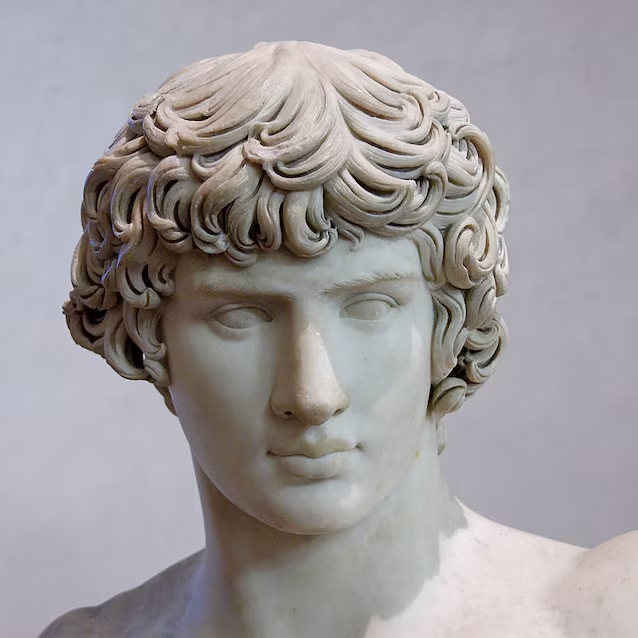
Homoerotic sexuality has found ample space both in art (just think of the numerous representations from Pompeii) and in Roman literature, but always following the recurring pattern of social abuse. In this general framework, many homosexual relationships are known from the Roman era, the best known of which even involved emperors. Hadrian (117-138 AD) loved a young man named Antinous very much and, after the boy’s death at just twenty years old, the emperor had him deified, identifying him with the Egyptian god Osiris.