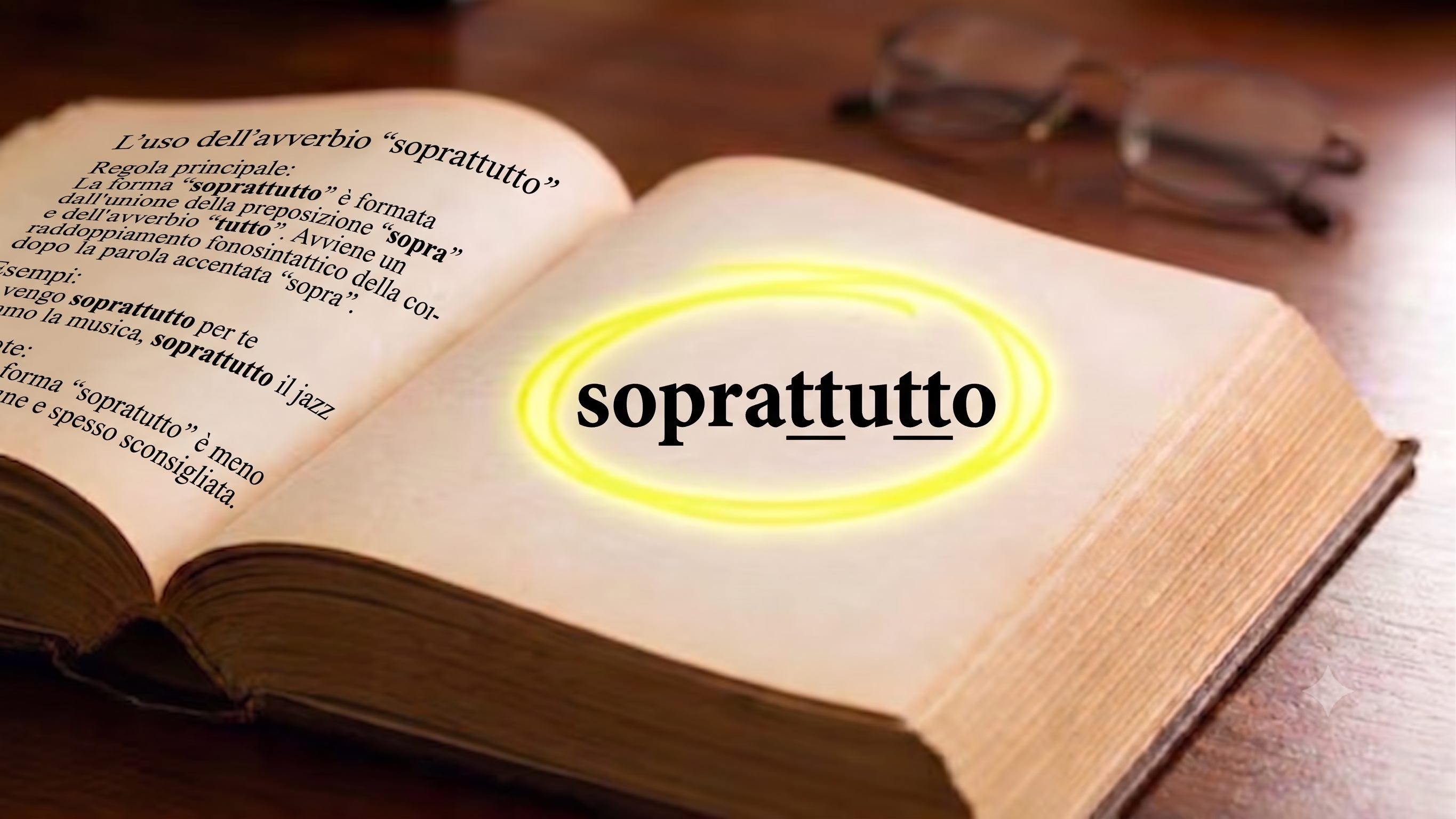
Do you write above all, above all or above all? It seems trivial, but the incorrect spelling of this adverb is more common than we think. The correct form is “above all”, with 4 t. It is not the only word that can leave us uncertain in the use of double consonants: errors, whether omissions or additions, also arise from regional inflections.
In the case of above all, the so-called syntactic doubling takes place, which occurs when the initial consonant of the following word is doubled in pronunciation (and, with univerbation, in spelling) in particular phonetic contexts. But let’s see better how it works and which are the words in which we most often mistake the use of double consonants – that is, the sequence of two repeated consonants.
Syntactic doubling and its origins
Above all, it is written with four t’s. This happens by virtue of phonosyntactic or syntactic doubling, a phenomenon specific to spoken Tuscan and central-southern Italian, where consonants are doubled in many contexts – unlike what generally happens in Italian spoken in northern regions, where disarray (i.e. the reduction of doubles) often occurs. Syntactic doubling occurs first and foremost in spoken language, as we can see for example. in the Tuscan forms that we could conventionally represent as “Dove vvai?” or “From home”, and so on.
How come this happens? Because in the transition from Latin to Italian many words lost the final consonant, as happened in the case of ad (became a), tres (became three). In syntactic doubling it is as if the loss had been recorded only on a graphic level, with the final consonant surviving in speech, joining the following word. In most cases doubling remains relegated to pronunciation. However, when univerbation occurs between two or more elements (linguistic phenomenon whereby two or more words, originally autonomous, merge and form a single term), the doubling is also reported in the spelling of the word, just as happens with above all.
The word is in fact formed by the prefix sopra-, which is used to form compound words, which requires the doubling of the consonant that follows it: this happens both in the case of sopra-, and, for example, of nickname or ornament. The same thing also happens in the union of other words, adverbs or prepositions, such as “so” (so-called), “nor” (not even, not even), “da” (first, everywhere, really), “to” (precisely, on purpose).
Why and which words do we get wrong?
As also reported by Enciclopedia Treccani, the form “soptutto”, quite widespread, is now considered obsolete and historically a minority, to be avoided, and is due to the influence of forms such as Dopotutto, Oltretutto etc.
Unlike other languages, Italian does not have a single universal rule for managing doubles: you need an ear, but this is clearly “shaped” depending on the environment in which we live and the inflections to which we are exposed. Often the ear deceives us instead of helping us, because what we pronounce and the correct spelling do not always coincide.
Among the most particular words of the Italian language there is “soqquadro”, famous for being (almost) the only Italian word written with the double q – in fact it also exists bisquare (variant of natural, a sign of musical notation), very rare today. The general rule is that the reinforcement of q is written cq (hence water and not aqqua). The Accademia della Crusca explains that soqquadro escapes the norm due to a pure historical coincidence: it arises from the univerbization of sotto andquadro (referring to walls not at right angles), in a technical jargon of bricklayers and craftsmen, and was established by analogy with other “direct” doublings such as riot or soppiatto. Curiosity within curiosity: until the fifteenth century the handwriting was oscillating, and for a while it was even written… socquadro. That form, today, is simply wrong.
Above all, it is not the only word whose spelling challenges us, in terms of doubles. Among the most common mistakes we make are:
- Speed up (do not accelerate): the correct form has only one l because the verb derives from the adjective celere, from the Latin celer (“fast”), which does not have a double l. Where does the error come from? According to Treccani we write accelerate by analogy with words which in the transition from Latin to Italian have doubled the consonant, such as anger (from Latin choleram) or machine (from machinam). The double l is also an error in all derivatives: acceleration, accelerator, decelerate.
- Exceptional (not great). In this case it is enough to follow the golden rule, whereby the group -zion rejects the doubling of the z preceding it. The letter z you don’t normally double even in front of groups -i, -ia, -ie, like at the station, patience, thanks, Egyptian, vice, police. The most well-known and cited exceptions by the Crusca Academy are two words of non-Latin origin: madness and razzia. Another exception are words like upholsterer or cuirassier, but only because they derive from the words “upholstery” and “cuirass”.
- Grate (grate): here the deception is entirely phonetic, often of regional origin: in speech we are inclined to lengthen the consonant, but the spelling imposes the silly form.
Tricks to never make double mistakes again
As mentioned, the ear can help us, but it can also deceive us. Certainly repeating words out loud can give us an indication of how we should write a word. To avoid making mistakes, therefore, let’s try to repeat the word we have doubts about out loud, both with and without doubling, so as to hear the difference clearly and understand whether the double consonant is needed or not; we can also try to divide it into syllables, always pronouncing it out loud. In case of uncertainty, however, there is always the good old (online) dictionary!