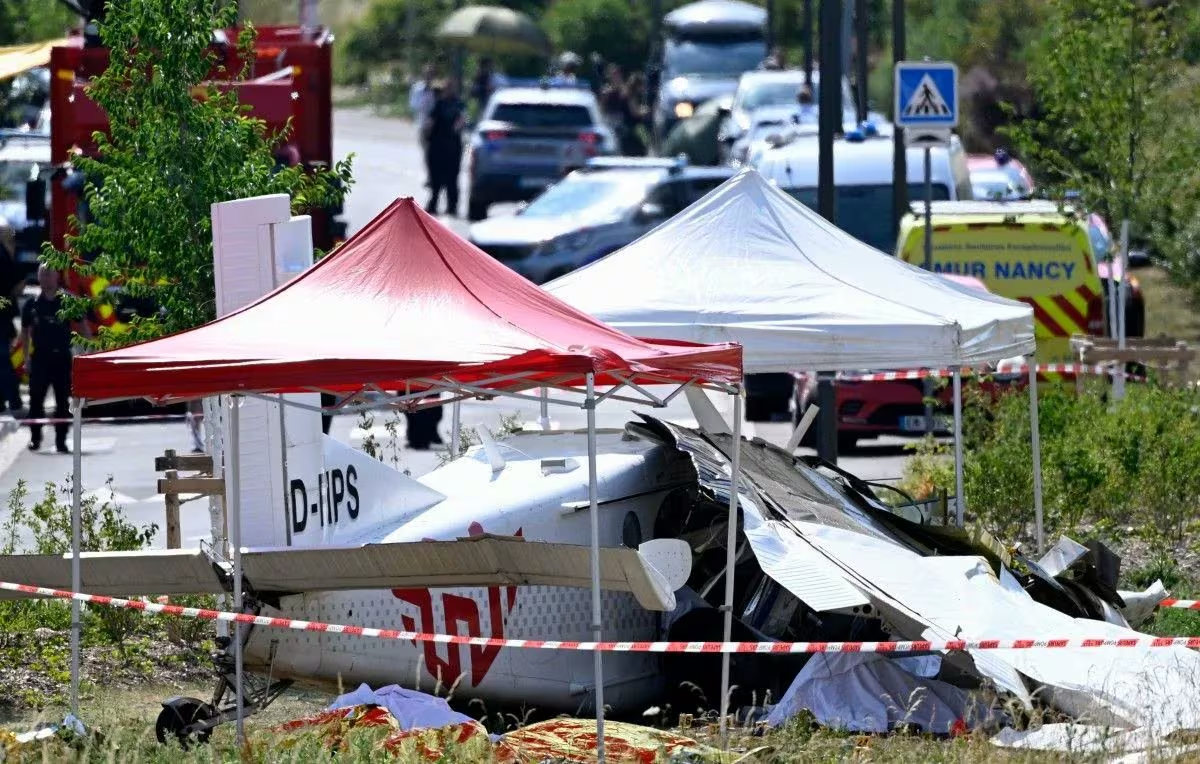
A civil parachuting plane crashed in Tomblaine, a municipality in eastern France near Nancy, shortly after taking off from the Nancy-Essey aerodrome. On board the aircraft, on the morning of Sunday 28 June, there were eleven people: a pilot, five instructors and five students who were about to carry out a tandem jump. Unfortunately, all passengers lost their lives.
The causes of the accident have not yet been made official: the prefect of Meurthe-et-Moselle, Yves Séguy, spoke of a failure that would have caused the aircraft to fall almost vertically a few hundred meters from the runway. The Bureau d’enquêtes et d’analyses (the French government body responsible for investigating aeronautical accidents) called the accident the most serious in French history in civil aviation outside of commercial and military transport.
The dynamics of the crash
At 11 am the Pilatus PC-6/B2-H4 aircraft took off from Nancy-Essey aerodrome with eleven people on board. According to available information, less than two minutes later, the aircraft crashed in rue Salvador Allende in Tomblaine, on a grassy strip about 250 meters from the end of the runway, between a supermarket and a residential area.
Prefect Séguy declared that the accident was caused by a failure: the aircraft fell vertically, without any trajectory attributable to an attempted emergency landing. 50 firefighters with twenty-five vehicles responded to the scene. Interior Minister Laurent Nunez confirmed that all eleven victims had already died before help arrived. Among the students there was a group of freelance nurses from the region.
The pôle accidents collectifs of the Paris court (the specialized section that deals with large catastrophes with multiple victims) has opened an investigation, entrusted to the air transport gendarmerie.
The Pilatus PC-6 Turbo Porter: history and features
The aircraft involved was a Pilatus PC-6/B2-H4 Turbo Porter registered D-FIPS, built in 1991 and operated by the German company KIAS Airlines, specialized in parachuting flights. The PC-6 is a single-engine, high-wing turboprop with STOL – Short Take-Off and Landing – capability designed to take off and land on short runways even in difficult conditions. With a maximum cruising speed of 232 km/h, a range of over 900 km and an operational ceiling of 7,620 metres, the PC-6 is capable of taking off and landing in very short spaces: just 440 meters with a 15 meter obstacle in front, and 315 upon landing.
The large sliding door on the side facilitates the exit of parachutists in flight, a feature that over time has made it one of the most used aircraft by jump clubs throughout the world. Production of the PC-6 ended in 2022, after 63 years and 604 examples delivered. The Pilatus is not equipped with a black box: the investigation will have to rely on the physical examination of the wreck and any videos recorded by passengers with their own devices.