Ferrari Hypersail, the 100 foot (30 meter) flying monohull born to challenge the oceans, has unveiled the concept of its energy management system: the technological heart that makes it the first monohull in offshore competitions that is completely self-sufficient from an energy point of view, without combustion engines or external sources, exploiting only sun, wind and the physical effort of the crew. Developed by the Tech Team Hypersail in Maranello, the system transfers for the first time to the world of offshore sailing solutions born on Formula 1 and road models of the Prancing Horse, such as the new Ferrari Luce, to manage two very different needs on board: the adjustments of the sails above deck, entrusted by regulation to the strength of the crew, and the active control of flight on the foils (the appendages that lift the hull above the surface reducing friction) below deck, which instead requires power continuous hydraulics and electronics during long voyages in the open sea. The solution identified by the engineers is a unified electrical system that converts every form of energy, whatever its origin, into electrical current managed by high voltage batteries and redistributed in real time where it is needed.
The project, born in 2024, aims to bring to sailing the same development philosophy that made the Ferrari 499P successful in the World Endurance Championship and at Le Mans: more than a simple racing vessel, Hypersail is a true floating laboratory, where the advanced electrification already explored by Ferrari on the road is put to the test in the most extreme possible context, the open ocean, without any possibility of refueling or resorting to external energy sources.
The “Winch by Wire” turns the crew’s fatigue into electricity
Perhaps the most surprising part of the system concerns the way in which the muscular strength of the sailors is exploited. On traditional racing boats, the crew members (the so-called grinder) manually operate cranks mechanically or hydraulically connected to the winches, the winches that regulate the tension of the sails. It is an enormous physical effort and, above all, inefficient: the more you get tired, the more your movements slow down.
Hypersail overturns this scheme with Winch by Wire: the power generated by pedestal (the stations where the crew pedals or turns the cranks) no longer moves mechanical gears, but is instantly converted into electrical energy. This current flows into a centralized network which dynamically redistributes it to all the users on the sail plan, rotating the winches or activating the on-board hydraulic pumps depending on the need of the moment.
To understand the scope of this innovation, just think about the gear shift of a bicycle. Tackling a steep climb with a bike without gears soon becomes impossible and the more the slope increases, the more the cyclist is forced to slow down, struggling more and more. By introducing electronics, Ferrari virtually provided sailors with a gearbox with infinite gears.
The practical advantage is twofold. On the one hand, the crew can maintain a constant rotation rate, always working at the point of maximum efficiency both for the electromechanical system and for its own metabolism, without the classic drop in performance due to fatigue. On the other hand, this approach allows a single crew member to handle large loads of up to 9 tons, a threshold much higher than what traditional mechanical or hydraulic architectures allow.
The electric motors used in the pedestals are the same ones that equip the active suspensions of the Ferrari Purosangue and Ferrari F80, a direct example of how the brand’s road know-how has been transferred to the sea. Even the “by wire” philosophy is not an absolute novelty for Ferrari: the same approach, which transforms a mechanical gesture into an electronic signal while maintaining the “feeling” of analogue driving, has already been introduced on the Ferrari 12Cilindri Manual.
The energy that makes the boat “fly” on the foils
This separation between “slow” and “fast” systems guarantees maximum performance, the best energy efficiency and above all the levels of redundancy necessary when you are in the middle of the ocean, far from any assistance.
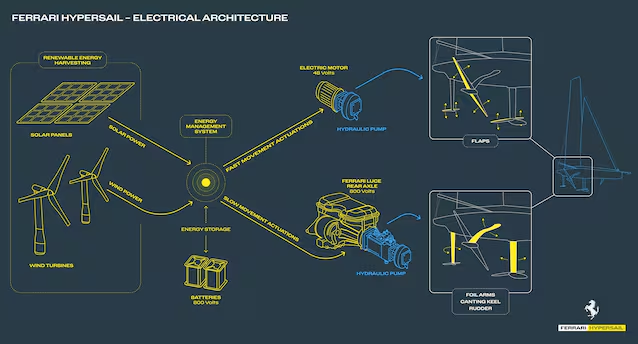
If human strength commands above deck, the technological “brain” of the boat is hidden below deck, responsible for managing the stability and height of flight on the foils. This system uses a platform of electronic control units (ECU) and sensors that work on four different voltage levels, between 12 and 800 Volts. To move the appendages, engineers developed a system called Active Flight Controller, which regulates hydraulic flow by dividing the action into two precise movement categories.
On the one hand there are the Slow Movements (slow movements), i.e. the macro-adjustments of the foil arms and the canting keel which, requiring enormous force, exploit the 800 Volt power of the rear electric axle derived from Ferrari Luce, the brand’s first electric car. On the other side we find i Fast Movements (fast movements), i.e. the small rapid and continuous adjustments of the control flaps, the flaps, entrusted to two smaller pumps driven by 48 Volt motors. This clear separation between slow and fast controls allows for performance with the lowest possible energy consumption, while also guaranteeing the backup and safety systems necessary when sailing in the middle of the open ocean.
Sun and wind: how Hypersail produces energy without emissions
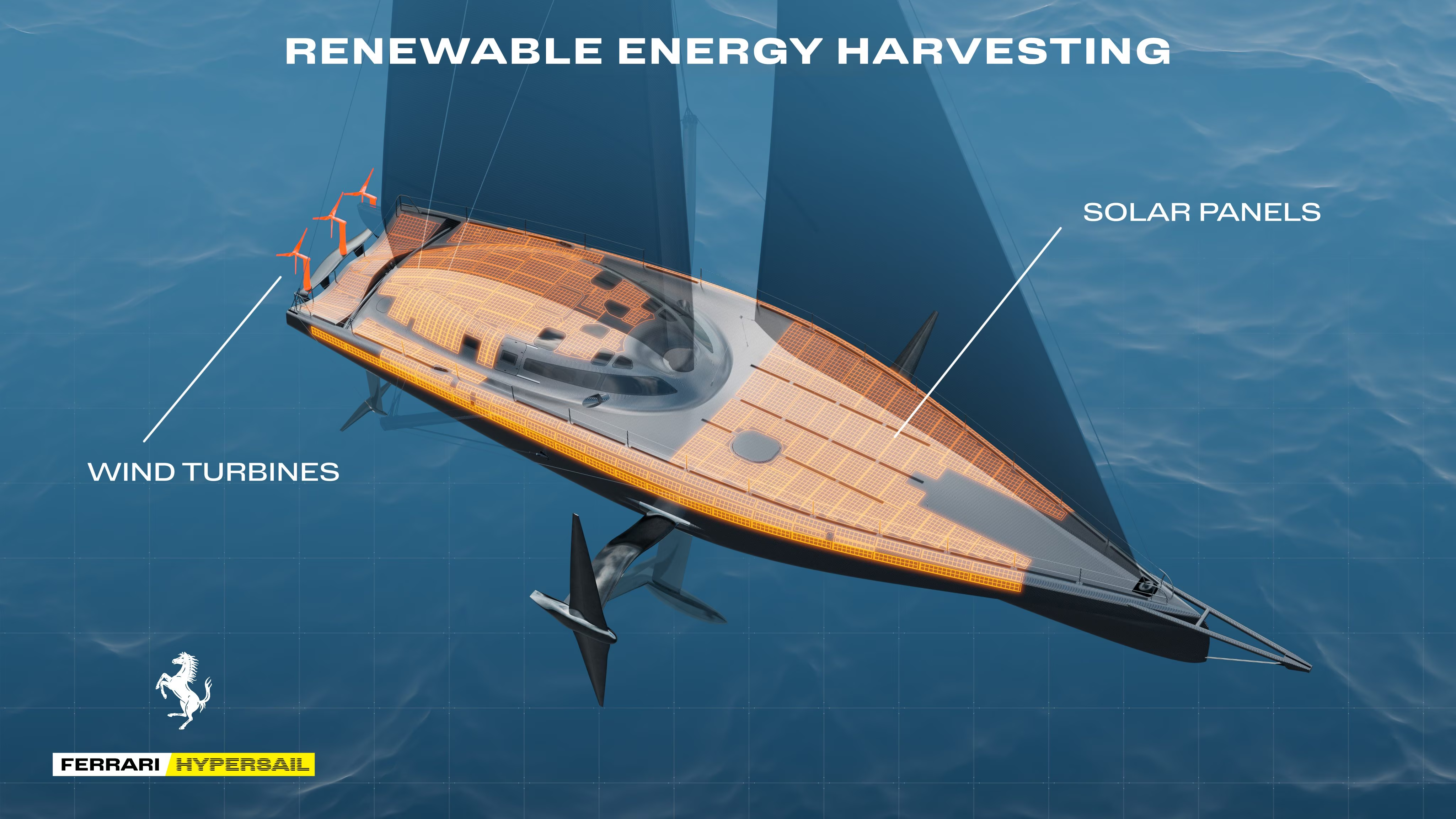
The entire electronic and hydraulic ecosystem below deck is powered exclusively by renewable sources, thanks to a solar and wind energy recovery system described by the engineers themselves as “unprecedented” in offshore sailing. Excess energy is stored in two identical 800V batteries, which manage the dynamics of energy flows on board.
As for solar, the boat integrates 100 square meters of walkable solar panels, equipped with a specific grip so as not to hinder the crew’s movements, positioned on the deck and on the sides. Their arrangement is the result of complex simulations that mapped solar exposure at different latitudes and along potential ocean routes, identifying only the areas with maximum energy yield. This made it possible to avoid installing “useless” panels, reducing added weight to a minimum and optimizing the weight/power ratio, a crucial factor for a vessel aiming for speed records.
At the stern there are removable and configurable wind turbines, which can be mounted or dismantled depending on sailing conditions. Here too, the most delicate engineering work concerned the study of the wind intake angle: the objective was to find the balance point between the maximum electrical generation yield and the minimum aerodynamic resistance at high speeds, preventing the turbines themselves from becoming a brake on the boat’s performance.