The expression “alla carlona” is a pillar of everyday speech, which indicates carrying out an activity in an approximate and coarse, or hasty way. It is used throughout Italy and, in particular, in Lombardy. Behind this apparently simple expression lies a thousand-year history that intertwines the figure of the emperor Charlemagne, passed down as clumsy and a little rough, the satirical literature of the sixteenth century and many popular curiosities.
The origins of the saying: Emperor Charlemagne
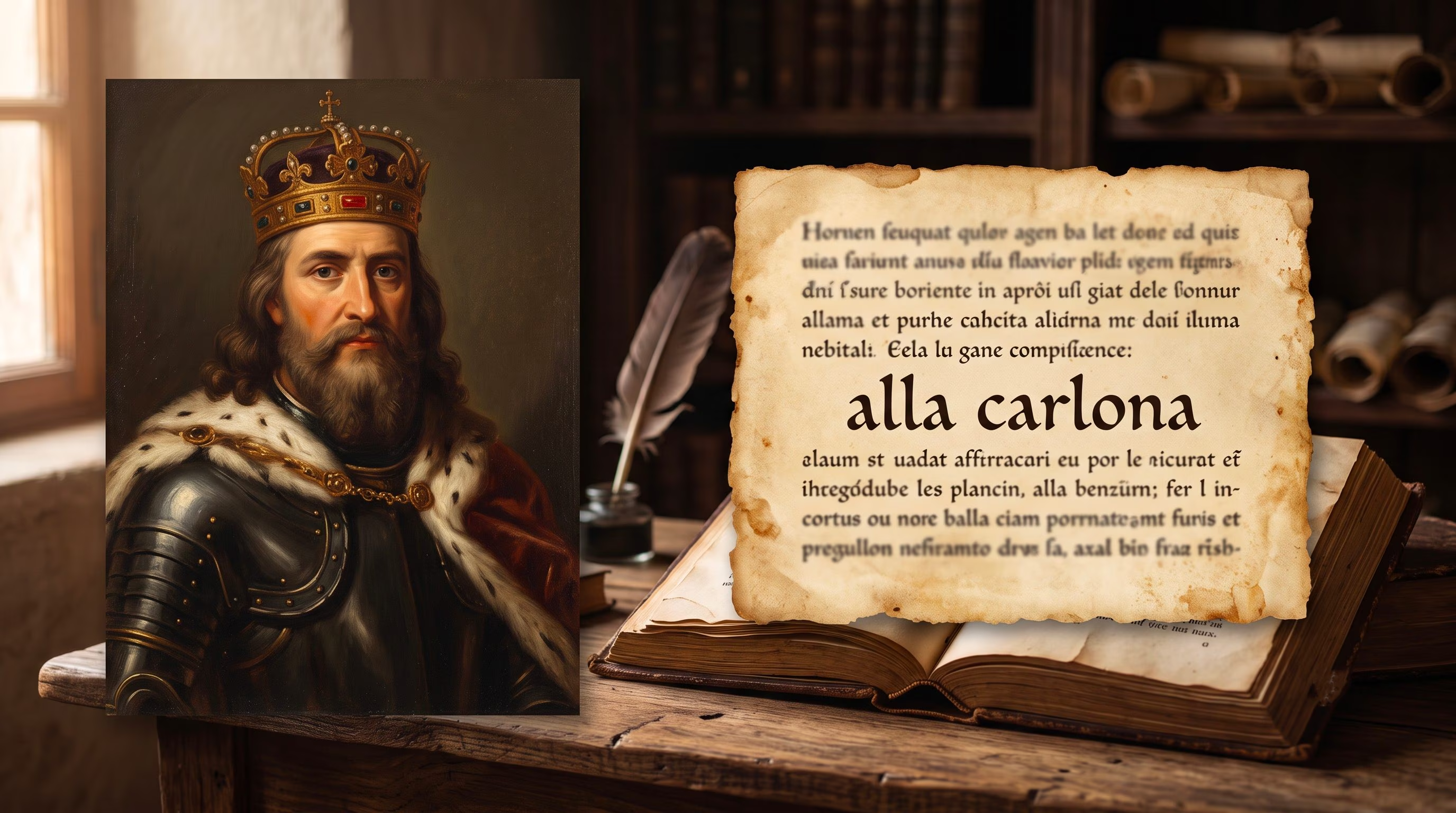
When we say that we have done a “bad job”, we are unknowingly quoting a ruler who was pivotal in the history of the Middle Ages: Charlemagnewhich it was Holy Roman Emperor in the 8th century. The etymology of this word, in fact, takes us back to ancient French and its grammar. At the time, in oil tongue the names were declined in two cases: the straight case for the subject (in the case of the emperor it was Charles) and the oblique case for all the other logical functions of the sentence, such as complements, which took the form of Charlon. From this linguistic basis the word “Carlone” has come down to us.
But how is it possible that the founder of the Holy Roman Empire, a brilliant and powerful leader, came to symbolize sloppiness and approximation? The fault of this semantic transition, if we can speak of fault, is to be attributed to literature. In later epic-chivalric poems and songs of deeds, the historical figure of the emperor was caricaturized and underwent a popular transformation: King Carlone became a good-natured, simple, frugal and at times even naive and clumsy character, who blindly relied on his paladins to make decisions.
This literary image is accompanied by a curious anecdote handed down by tradition, when one day Charlemagne invited the French nobility to court for a hunting trip. While the guests presented themselves lavishly dressed by great tailors, the emperor welcomed them dressed in coarse clothes, similar to those of a peasant. From that episode, “dressing in a formal way” began to indicate a way of acting devoid of care and elegance.
The saying through the fifteenth and sixteenth centuries
In the fifteenth century the expression began to circulate in written texts to indicate something done “in abundance” in a careless and careless manner, with reference to the proverbial and legendary carelessness of King Carlone.
But the moment in which this expression went from a simple popular way of saying to a real entry in the linguistic register occurred around the middle of the sixteenth century, thanks to Pietro Nelli, a Sienese author. Hidden behind the pseudonym of Andrea da Bergamo, Nelli published a work in 1546 entitled “The Satires in style”.
We find ourselves in the midst of satirical-burlesque poetry, a genre that opposed the rigid, artificial and repetitive perfection of Petrarchan poetry (the so-called “Petrarchism”) that dominated the courts of the time. In this literary context, writing “Carlona style” became a precise stylistic choice of those who adopted a “low style”, humble, simple and close to the spoken word. Pietro Nelli in his lyrics defined himself as a “big man” (a man simple) and described his verses as “ramshackle verses”. Naturally, this crudeness was a very refined literary fiction, where pretending to write “in the simple way” was a way of proposing an apparently spontaneous and vital poem, free from the prison of formal grammar.
What does “doing things the Carlona way” mean today
As the centuries passed, the expression progressively detached itself from the historical and literary figure of Charlemagne, losing its ancient connection with the emperor to take on a more general meaning. Nowadays, “doing things the hard way” universally indicates an action carried out hastily, without method, in a superficial and disorderly manner.
But it is not the only popular expression that can be used to enrich a speech given that the Italian language offers a large range of synonyms depending on the nuances we want to give to our sentence. Just a few examples: we can say “at random” when we do something with the means available, but with little accuracy, or even “at random” with sometimes positive connotations. In more refined terms, you can use “in bulk” to underline the chaos, or even “at random”, to highlight the absence of logical criteria.
In the fast-paced modern landscape that is obsessed with impeccable efficiency, doing things “the way it is” probably gets more value and reminds us of the human nature of imperfect beings, even if you are the great emperor of Europe.