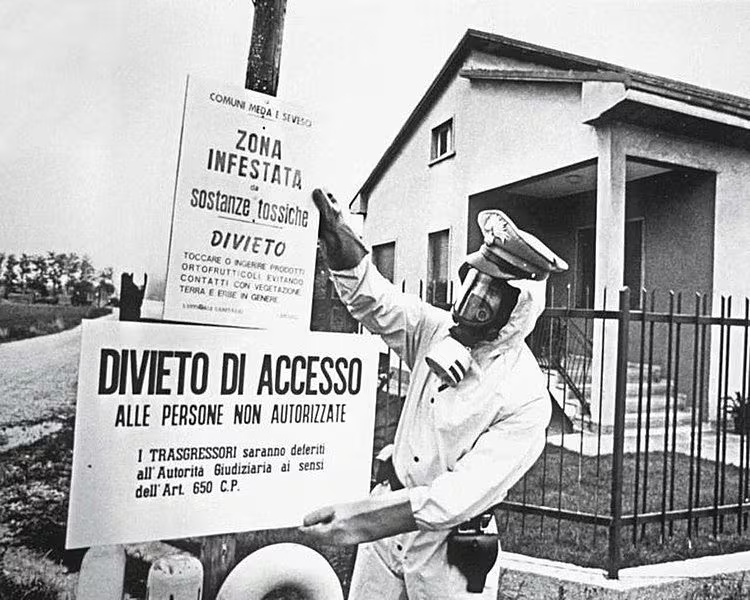
On Saturday 10 July 1976, a cloud of dioxin, an extremely toxic and carcinogenic substance, emerged from the ICMESA chemical company in Meda (now the province of Monza and Brianza), owned by the Swiss company Givaudan-La Roche. At 12.37 the rupture disk of the A101 reactor gave way, and the cloud of dioxin TCDD spread to the surrounding areas of lower Brianza, in Lombardy, densely urbanized, among fields, farms and houses, forcing the evacuation of hundreds of people and also contaminating the territory of Seveso, Cesano Maderno and Desio.
The substance caused skin damage, tumors and the death of 80,000 livestock. To date, 50 years later, it is still recognized as the most significant disaster in Italy and among the worst in Europe, both for the persistence of the damage and for the effects on Italian and European industrial and environmental legislation. We tell you what caused the release of dioxin and what the dynamics of the disaster were: from causes to consequences.
What happened in the Seveso disaster: causes and history
The ICMESA (Industrie Chimiche Meda Società Azionaria) factory in Meda, part of the Givaudan-La Roche group, was active in the production of substances for the cosmetics industry. One of the lines was dedicated to 2-4-6 trichlorophenol, a product used as an antiseptic and with disinfectant, fungicidal, antimicrobial and herbicide properties, like many other chlorinated aromatic compounds.
A failure in the temperature control system caused the A101 reactor, which was not active at the time because it was a Saturday, to overheat: when even the pressure containment systems failed, at 12.37 on 10 July 1976, several tons of material escaped in a cloud of smoke, which over the course of the day spread towards the towns of Seveso, Cesano Maderno and Desio.
Although the explosion of the reactor had been avoided with the controlled release from the valves, the increase in temperature caused a secondary reaction capable of producing a substance that was little known at the time: it was 2,3,7,8-tetrachlorodibenzo-p-dioxin (also called TCDD, among the most toxic forms of dioxin), released in quantities that would later be estimated at between 15 and 18 kg, commonly called dioxin.
The dioxin cloud and short-term effects
Despite the small quantities compared to the total products released, it was precisely this dioxin that caused the heaviest effects on the population and the surrounding environment: from the first hours the inhabitants complained of eye irritation, breathing difficulties and the appearance of cysts (a phenomenon called chloracne) especially in the children’s segment of the population, while the plants began to wither with evident damage to the leaves.
Although the cloud was clearly visible and the effects were increasingly evident, the institutions were notified late and with initially reassuring press releases, and only following the analyzes conducted 8 days later by the Province did the company’s leaders admit that they were aware of the spread and danger of dioxin.
The map of the areas affected by TCDD dioxin and health concerns
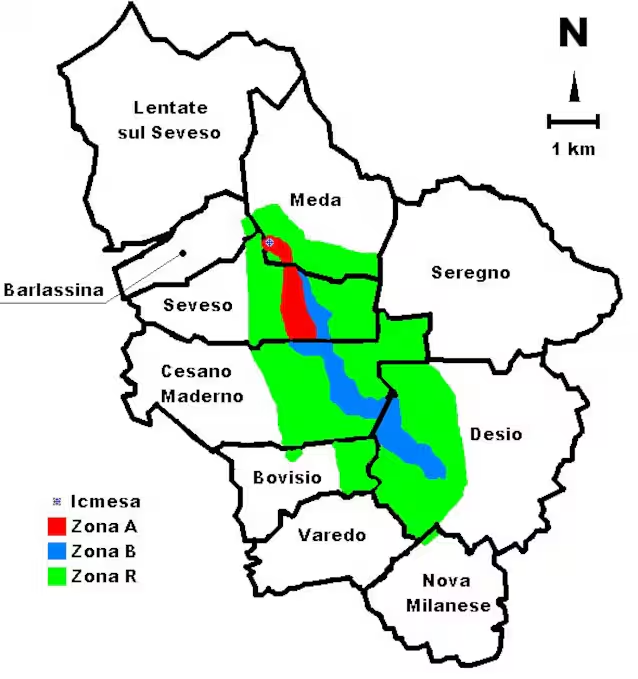
Once the severity of the event was understood, the affected area was divided into zones according to the degree of pollution (the most affected area was A, B and the R most distant from the fallout of the toxic cloud) and militarized to stem movements: only on 26 July, after more than two weeks of exposure to dioxin, was it decided to evacuate the inhabitants in the most affected areas.
The interventions of international experts also guided the choices of the authorities: the famous one was that of the Vietnamese professor Ton That Thut, who had unfortunately had the opportunity to observe in the field the effects of the dioxins contained in the Agent Orange mixture, used massively as a herbicide by the US army during twenty years of conflict.
Following the alarms on the teratogenic effects, i.e. on the possibility of malformations on fetuses (also sadly known to the Vietnamese population), the practice of abortion was also authorized for pregnant women in the area: a decision that was not to be taken for granted given that at the time, in Italy, any type of termination of pregnancy constituted a criminal offence, at least until the approval of law 194 of 1978.
Suspicions of the carcinogenicity of TCDD and its ability to accumulate in the soil led, following the evacuation of civilians, to start the first land reclamation works: studies confirmed that the dioxin was concentrated in the first 25 – 30 cm of soil, which were therefore removed together with the most contaminated structures.
Waste disposal, reconstruction and the situation after 50 years
The last controversy concerned the disposal of the waste, which initially seemed destined for incineration: the population, opposed to this solution, instead demanded to bury it in watertight and anti-seismic tanks located in zone A. Once the tanks were closed, a reforestation intervention covered the area with uncontaminated land, coming from other Lombardy provinces, to create in 1983 the Bosco delle Querce Natural Park, a city green lung dedicated to the memory of the events of 1976.
In the same years the agreements with Givaudan were also concluded for the compensation to the Region and the State of more than 103 billion lire to cover the clean-up costs, as well as 200 billion lire in compensation for the affected citizens. However, the legal aftermath has continued to the present day, with worrying twists such as in the case of the company’s appeal to the Supreme Court and the subsequent ruling in 1997: a reversal of previous decisions which saw some citizens, affected by chloracne, forced to return the sums obtained as compensation decades earlier.
In February 2026, the Bosco delle Querce Natural Park was awarded the European Heritage Label, the first site in Lombardy to obtain the recognition – and sixth in Italy. It is here that today, with the presence of President Sergio Mattarella, the commemoration for the 50th anniversary of the disaster will be celebrated.
This is the motivation of the European Commission:
“The Seveso disaster marked a turning point in the European approach to industrial risk and environmental protection. It directly contributed to the development of the Seveso Directive, the cornerstone of European legislation on industrial safety and major accident prevention. The Bosco delle Querce therefore represents the translation of the tragedy into a model of shared environmental learning, regulation and awareness at a European level. As a regenerated landscape, the park embodies Europe’s ability to collectively respond to crises through science, politics and civic engagement. It represents a tangible reminder that environmental protection, public health and sustainability are fundamental to the common responsibility and future of Europe.”
From a health point of view, although no victims were recorded in the first days following the accident, the monitoring plans organized over the last 25 years have indicated an increase in cases of lymphomas in subjects exposed in the long term, which adds to the greater mortality from circulatory diseases highlighted in the first years after the disaster. As reported by the Istituto Superiore di Sanità, various studies have been carried out: the first covers the years up to 1986, the second up to 1991, the third goes up to 1996 and the fourth, which is currently the most updated, up to 2001: it therefore covers a period of 25 years, and was conducted on the population exposed to dioxin (divided into zone A, zone B and zone R depending on the degree of contamination of the living area, as from the map in the previous paragraphs) and on a non-exposed reference population, involving approximately 280,000 people, of which almost 6,000 residents in the most affected areas. The research, they report, examined 99% of all those involved.
However, the seriousness of the matter also led to a positive aspect: at a European level, in 1982, Directive 82/501/EEC, also known as the Seveso Directive, was finally adopted which established common rules for the management of dangerous industrial activities. It was decreed that producers were obliged to identify the risks associated with the activity, draw up emergency plans and communicate them to local authorities to react promptly to any accidents. A conference will take place today at Palazzo Lombardia in Milan, “50 years since the Seveso accident: legacy and future prospects”, organized by the Region in which institutions and experts will meet to analyze the environmental recovery path following the contamination and future prospects.
The Seveso directive and its updates, influenced by other catastrophes such as the Bhopal accident in India, therefore represent the hope that we have learned something from the terrible lessons of our past, so that similar tragedies never have to happen again.