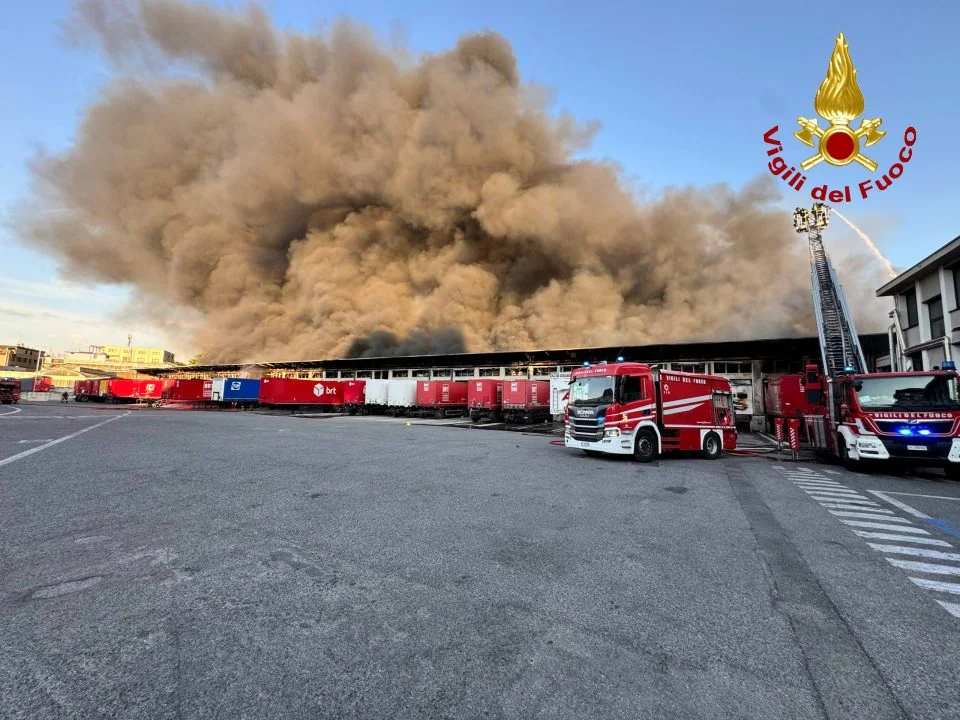
A large fire broke out inside the Milano Bovisa depot of the BRT shipping company (known by its previous name Bartolini), located in via Don Giovanni Minzoni 10. The flames, which broke out just before 7.30pm yesterday, Wednesday 8 July, involved a warehouse used for sorting parcels of around 8,000 square meters (a football field, so to speak, is around 7,000 square metres), involving also some administrative offices and several means of transport parked in the front courtyard. The cloud of smoke created was clearly visible from the entire city of Milan: fortunately, no one was injured.
Today, Thursday 9 July, the flames have been 95% put out, although firefighters are carrying out cooling operations as two containers loaded with electric bikes – with lithium ion batteries – are continuing to burn. In the meantime, ARPA Lombardy has confirmed that the typical combustion pollutants are present at the site of the fire, but the concentrations are not worrying, also thanks to the dispersion of the fumes into the atmosphere.
ARPA Lombardia’s findings on air quality
Already on Wednesday evening, the team from the Milan department of ARPA Lombardia reached the site of the fire to carry out the first measurements on air quality with the instruments supplied. The measurements carried out around the company perimeter did not highlight critical values for the pollutants that can be monitored directly on site: typical combustion pollutants were detected, the concentrations of which were not worrying, also thanks to the dispersion of the fumes into the atmosphere.
During the night, the Agency’s technicians installed a high-volume sampler in via Baldinucci, positioned in line with the forecast map of smoke fallout developed by the specialist atmospheric contamination group. The first sampler filter should be collected this afternoon, July 9th, and sent to the Milan laboratory to search for any micropollutants, in particular dioxins, furans and PAHs (polycyclic aromatic hydrocarbons).
In the meantime, the Municipality of Milan, given the new rapid findings by ARPA carried out during the morning, has provided specific indications for the population residing within a radius of 500 meters from Via Don Minzoni 10:
- Do not use public green spaces;
- Avoid outdoor physical activity;
- Do not use vegetables grown on the balcony or in the vegetable gardens;
- In schools and nurseries, avoid using outdoor spaces.
The possible dynamics of the fire and the intervention of the Fire Brigade
According to initial information, the fire could have started from a container probably covered in polyurethane, and then spread to one of the warehouses dedicated to parcel sorting, although this is a hypothesis yet to be confirmed with investigative investigations. At that point the flames would have spread rapidly, progressively involving the trailers of the trucks connected to the loading ramps. Meanwhile, the Milan Prosecutor’s Office has opened an investigation to reconstruct the causes of the fire.
An impressive rescue device was deployed on site: around 50 firefighters, coming from the commands of Milan and Monza, operated with 6 tank fire engines (APS), 4 pump trucks (ABP), 3 ladder trucks, an air truck, the SAPR (Remotely Piloted Aircraft Systems, i.e. drones) nucleus and a TRID vehicle (a basket for work at height). The operations were coordinated by the Provincial Commander of the Milan Fire Brigade.
One of the firefighters’ priority objectives was to prevent the flames from reaching the structures and fuel depots in the surrounding area. In fact, in the vicinity of the BRT depot there is another large freight forwarder, as well as the Bovisa campus of the Milan Polytechnic, a sports center and a restaurant business.
After firefighters worked continuously throughout the night, the fire was considered out, with 95% of the fire extinguished. However, two containers loaded with electric bikes with lithium ion batteries are continuing to burn: the batteries inside them pose a risk for possible new explosions, with the Fire Brigade therefore conducting a cooling operation.
Fires caused by electric batteries, in fact, are particularly difficult to put out, since a damaged lithium battery does not need an external flame to continue burning: when one of the internal cells becomes damaged or heats up too much, internal chemical reactions are triggered which generate further heat and flames, spreading in a chain to neighboring cells.