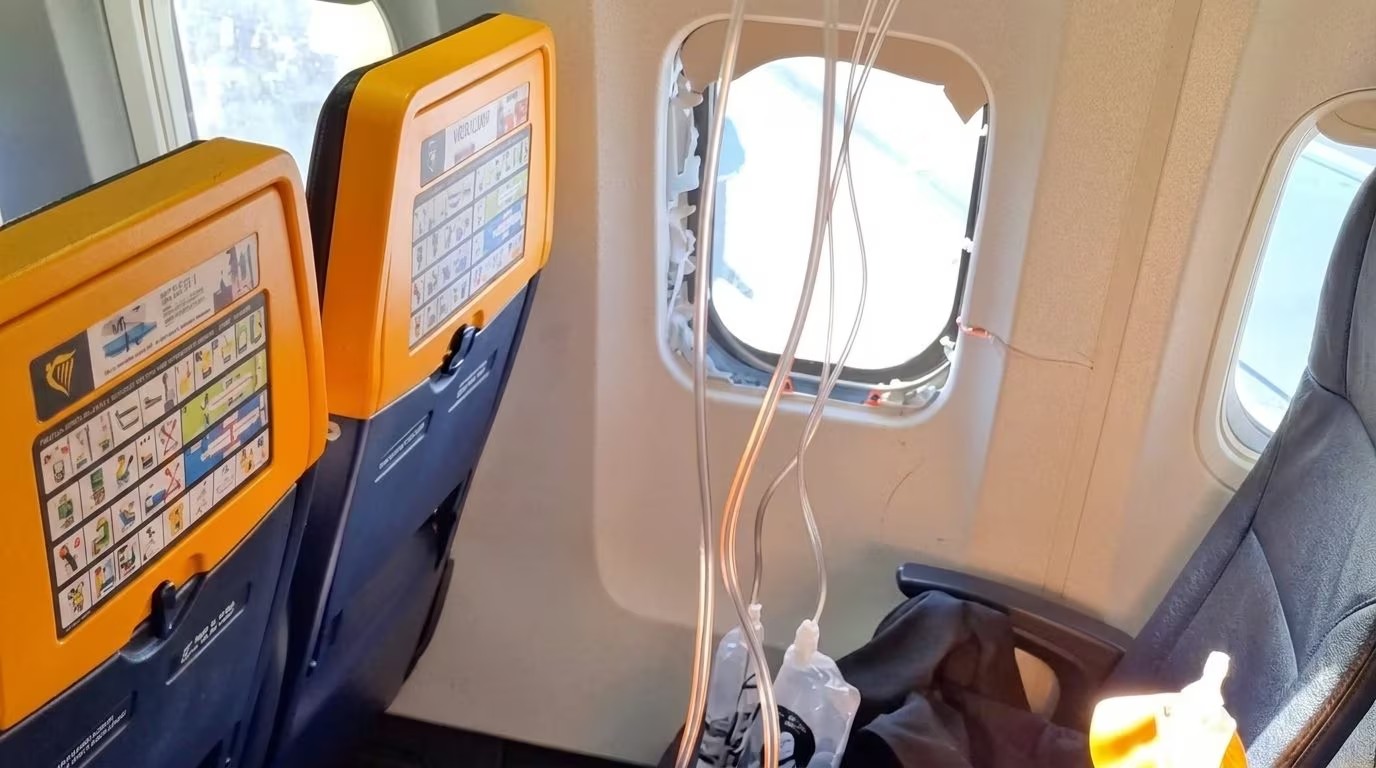
A Ryanair Boeing 737, operating flight FR1879 from Thessaloniki (Greece) to Memmingen (Germany), was forced to make an emergency landing after a cabin window broke in flight – as seen in the video below – causing rapid depressurization and injuring a 61-year-old Serbian passenger.
The man was partially sucked outwards, managing to save himself thanks to the seat belts and the intervention of his wife and at least one other passenger, who held him down forcefully. The plane landed safely in Thessaloniki and the 61-year-old was transferred to hospital, along with 3 other passengers taken as a precaution. Meanwhile, the Greek aviation authorities have launched a technical investigation into the engine to ascertain the causes of the failure.
The causes have not yet been clarified: according to the first information reported by the Greek media, a fragment of the engine would have been released in flight, ending up breaking the cabin window.
The possible dynamics of the accident
Flight FR1879 took off from Thessaloniki airport at 6.12am (local time, 05.12am in Italy) today 10 July. About 8 minutes later, during the climb, several passengers heard a loud noise coming from the right engine of the aircraft. According to the first reconstructions released by the Greek media, a fragment of the engine would have been released in flight – at almost 600 km/h of speed – ending up impacting the fuselage and shattering one of the cabin windows on the same side.
The breaking of the window generated an immediate and violent depressurization, with the oxygen masks being activated automatically.
The passenger sitting next to the damaged window, a 61-year-old Serbian citizen, was fully hit by the difference in pressure between the inside of the cabin and the outside: according to the statements of some passengers, his head and shoulders would have been sucked towards the opening, with the man managing to stay inside the plane thanks to the intervention of his wife, helped by at least one other traveller, managing to hold him until landing.
A detail that probably proved decisive is that the man was still wearing his seat belt, which was mandatory during take-off: without it, the consequences could have been worse.
After the window broke, the commander reacted immediately, starting a rapid descent from around 5,000 to 1,800 meters above sea level and reversing course to return towards Thessaloniki. The plane touched the runway at 7.09am, where it was joined by firefighters, ambulances and police.
In total, four passengers were transported to hospital: three were discharged after precautionary checks, while the 61-year-old Serbian remained hospitalized with neck injuries and friction burns, in a state of shock but not in danger of life.
In a note reported by Euronews, Ryanair confirmed that
A Ryanair flight from Thessaloniki to Memmingen, which departed on Friday morning (10 July), returned to Thessaloniki shortly after take-off after a passenger window broke off during the flight. The plane landed safely and the passengers returned to the terminal. A passenger requested and received medical assistance on the ground in Thessaloniki. To minimize the delay, a replacement plane was arranged to transport passengers to Memmingen, taking off from Thessaloniki at 9.53 local time this morning.
The precedent of 2018: what had happened
Among other things, the same plane involved in today’s accident had already been forced to return yesterday evening, during another connection due to technical problems.
The episode is very reminiscent of the accident that occurred on April 17, 2018 in the United States, again on board a Southwest Airlines Boeing 737. On that occasion, Flight 1380, which departed from LaGuardia in New York and was headed to Dallas, suffered a left engine failure while it was at approximately 32,000 feet (almost 10,000 meters) above sea level, approximately 30 minutes after takeoff. As confirmed by the NTSB, an engine fan blade broke due to a cyclic fatigue crack and struck the fan casing, generating loads that caused several portions of the engine cowling (i.e., skin) to separate in flight.
One of these fragments impacted the fuselage near a cabin window, causing it to completely detach. The rapid depressurization that followed partially sucked the passenger sitting next to the window, Jennifer Riordan, outward. The flight attendants and other passengers tried to pull her in with all their strength, but the woman, despite resuscitation attempts, lost her life.
The pilots at the time, Commander Tammie Jo Shults and First Officer Darren Ellisor, managed to land the plane in Philadelphia without any other fatal consequences: there were 144 passengers and 5 crew members on board.
In short, the dynamics present clear analogies with the Greek accident: engine failure, fragments hitting the structure of the plane, breaking of a window, violent depressurization and the passenger being partially sucked outwards.