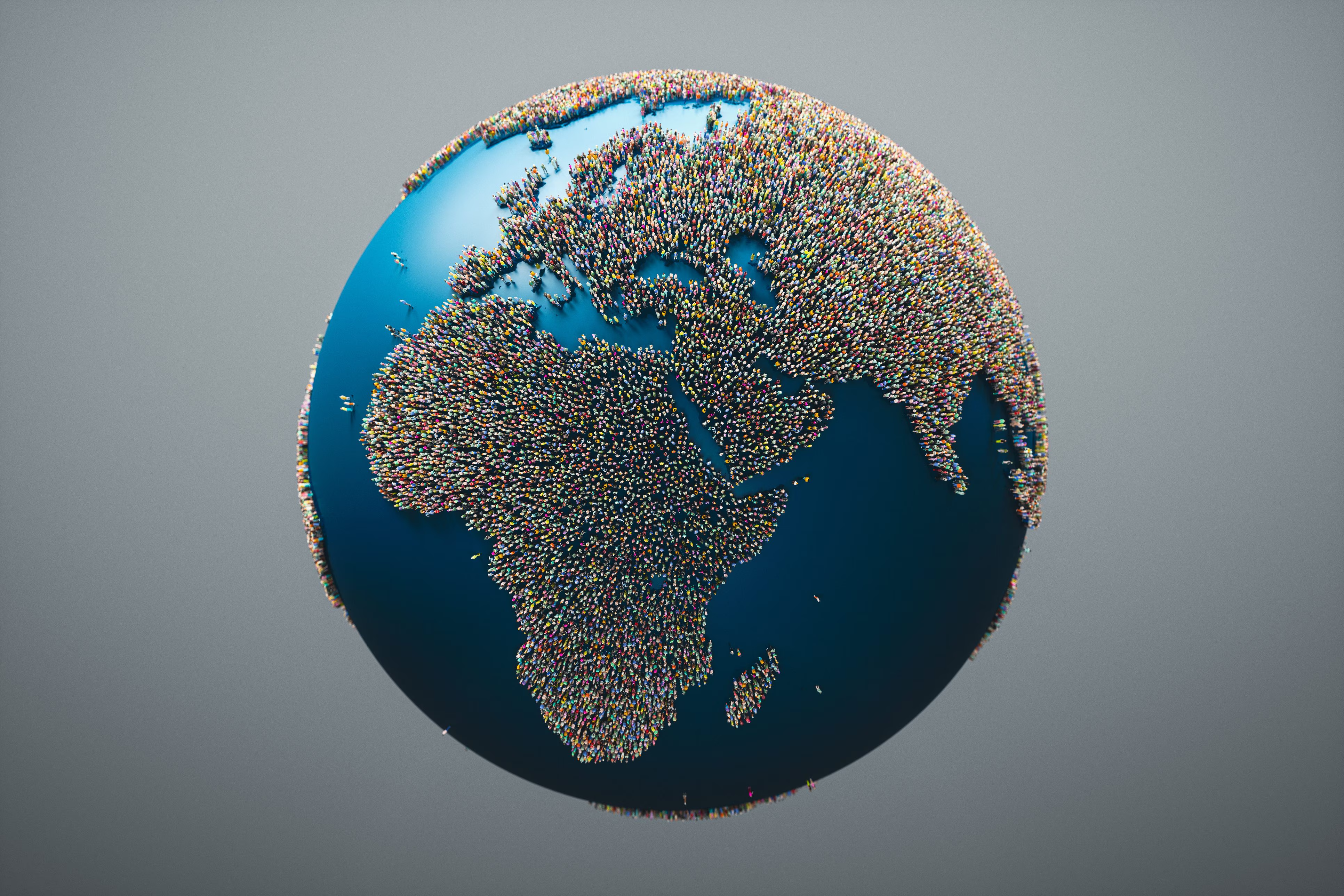
There are currently 8.3 billion people living on Earth. The world population, however, is distributed very unevenly: more than half of the inhabitants live in Asia, while less than 1 in 10 in Europe. According to the most recent United Nations estimates, population growth will continue in the coming decades, albeit at a slower pace, reaching 10 billion in 2061.
To draw attention to the importance of demographic dynamics, World Population Day is celebrated every year on 11 July, established in 1989 by the United Nations Development Program (UNDP). The date was established based on the so-called “Five Billion Day”, i.e. the symbolic day in which, according to estimates at the time, the world population reached 5 billion inhabitants, on 11 July 1987. The objective of the day is to raise awareness among governments and citizens on the issues of population growth, reproductive health, gender equality, migration and sustainable development.
How many of us are there in the world
According to the most recent United Nations estimates, as of 1 July 2026 the world population exceeded 8.3 billion people for the first time in history. This is an increase of almost 140 million compared to 2024, when the Earth’s inhabitants numbered less than 8.2 billion.
Global population growth, however, is very different from that observed in the second half of the twentieth century. In the 1960s the population growth rate exceeded 2% per year, the highest value ever recorded. Today, however, the annual growth rate of the world population is less than 1% and continues to slow.
The main reason is the progressive decline in fertility. In over half of the countries in the world, the average number of children per woman is in fact less than 2.1 children, the level considered necessary to guarantee generational turnover in the absence of immigration. Despite the decline in births, the world population is continuing to increase thanks to the increase in life expectancy.
According to the intermediate fertility scenario estimated from 2024 to 2100, the United Nations predicts that the population will continue to grow for several more decades, reaching a peak of around 10.3 billion inhabitants around 2084, and then starting a slight decrease towards the end of the century, although still remaining above 10 billion.
How the population is distributed on Earth: the map of the continents
The world population is distributed very unevenly across the continents. Asia is by far the most populous continent: with more than 4.86 billion inhabitants, it is home to approximately 58.6% of the world’s population, that is, almost six out of ten people. Much of this population is concentrated in India and China, which alone are home to more than a third of the entire planet’s inhabitants (almost 2.9 billion people).
In second place we find Africa, with 1.58 billion inhabitants, equal to approximately 19% of the world population. It is the continent that is growing fastest from a demographic point of view: the median age is less than 20 years and the birth rate is close to 4 children per woman. According to projections, Africa itself will be responsible for most of the increase in the world’s population in the coming decades.
Europe has approximately 743 million inhabitants, or 9% of the world population. Despite being one of the most densely urbanized continents, it is in fact already recording a decline in population due to an average number of children per woman of around 1.4: a value much lower than the threshold necessary to achieve generational turnover.
Latin America and the Caribbean are home to approximately 672 million people, or 8.1% of the global total. The region has completed much of its demographic transition and today has fertility rates around 1.7 children per woman.
North America includes just under 390 million inhabitants, i.e. 4.7% of the global population. Growth is relatively moderate and is supported to a significant extent by international migratory flows.
Finally, Oceania, despite covering a very large territory between Australia, New Zealand and the Pacific archipelagos, is home to just 47 million people, less than 1% of the world population and less than the Italian population alone.
Even within individual continents the distribution is far from uniform: enormous metropolises concentrate tens of millions of inhabitants, while vast rural areas or extreme environments have very low densities. Being aware of where the world’s population lives is therefore essential not only to describe today’s planet, but also to interpret future challenges related to urbanization, work, population aging, migration and resource sustainability.