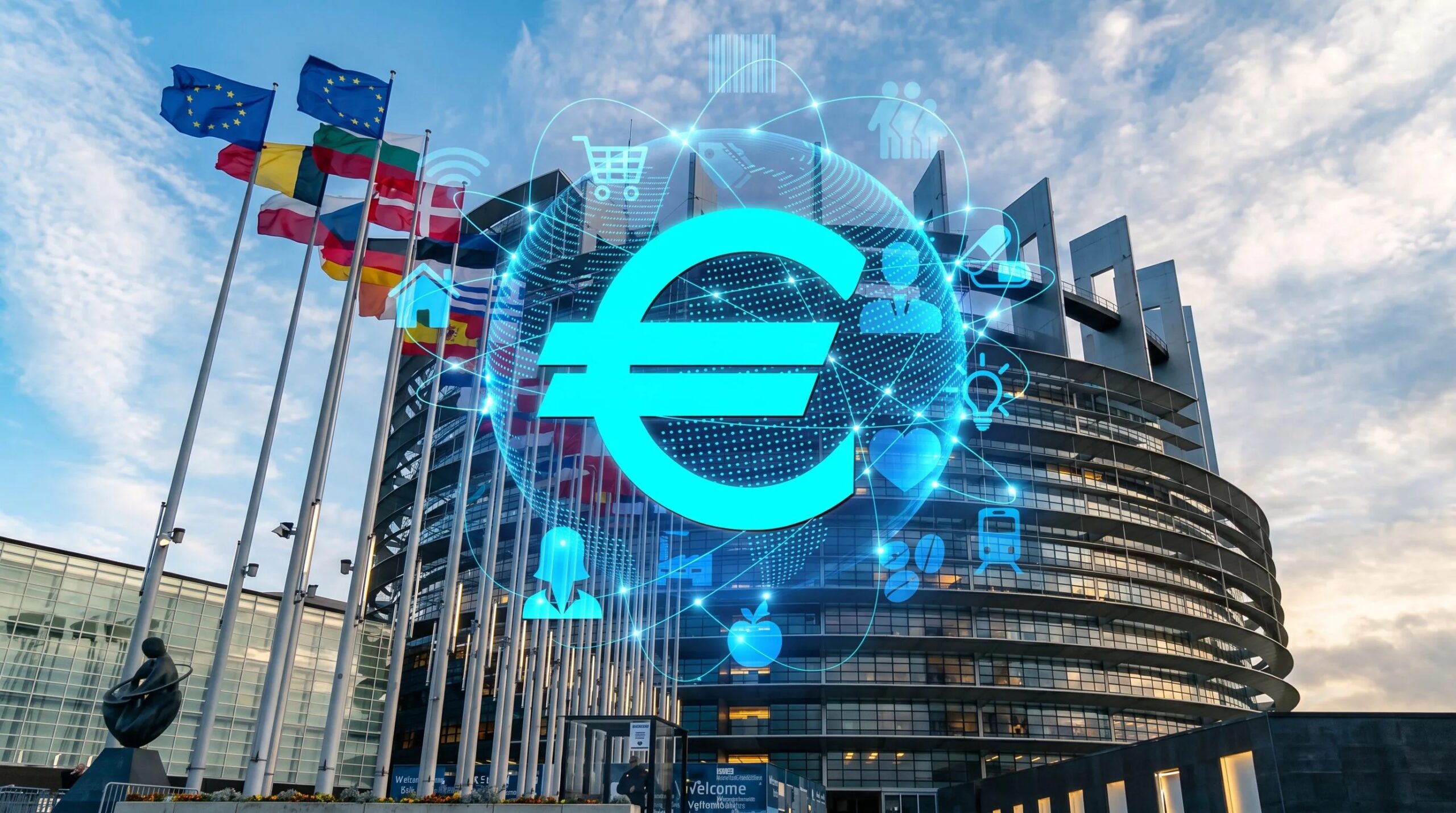
With 416 votes in favour, 169 against and 22 abstentions, the European Parliament gave the green light to the opening of negotiations between EU institutions to introduce the digital euro, with the aim of reaching a shared agreement by 2026. In concrete terms, the Parliament’s vote confirmed the decision taken on 23 June by the Committee on Economic and Monetary Affairs (ECON), rejecting the objections presented by the conservative (ECR), sovereignist (PfE) groups and ESN, who opposed the start of negotiations.
The first discussions with the Council of the EU and the European Commission will begin as early as 13 July: the process to reach a final agreement will therefore begin immediately, with representatives of the three institutions focusing on three pieces of legislation: the digital euro, public procurement and non-EU suppliers.
In this way, the digital euro could become operational starting from 2029, without replacing cash: among the objectives of this new instrument there is also that of reducing dependence on non-EU payment circuits, mostly controlled by US companies.
What happens now: negotiations between institutions for an agreement begin
As anticipated, the first meeting between the three institutions, the so-called “trilogue”, will be held on 13 July: the Spanish Fernando Navarrete Rojas (PPE), rapporteur of the measure, will lead the European Parliament delegation and will have to negotiate with the Irish presidency of the Council of the EU, which will represent the interests of the Member States. As reported on the official website, the points on which the EU Parliament intends to negotiate are:
- The digital euro would be a new form of electronic money issued by the European Central Bank (ECB) and would work both online and offline;
- Privacy guarantees would be integrated into the digital euro. Transactions would be verified without exposing personal data, which would be processed only to the extent strictly necessary for the functioning of the system;
- Most companies would be required to accept the digital euro. Self-employed workers and small and micro businesses that do not accept other digital payment methods would be an exception;
- Basic services, such as opening an account, holding and managing funds, and access to at least one payment instrument, would be free;
- To protect the financial system, a limit would be imposed on the amount of digital euros any individual could hold;
- Banks and payment service providers (PSPs) from non-euro EU countries would be allowed to distribute the digital euro;
- Euro area countries would be obliged to keep cash accessible, businesses could not ban its use, and member states would have to regularly monitor the availability of cash, with particular attention to vulnerable groups, such as the elderly, people on low incomes and those without access to the traditional banking system.
The institutional objective is to complete the entire legislative process by the end of 2026, thus arriving at an agreement shared by the 3 institutions.
As also reported by the Bank of Italy, in parallel with the discussions between the European institutions, the Eurosystem will continue its planning and testing work. In this context, the Bank of Italy will be actively involved, together with the ECB and the other central banks of the euro area, in the technical preparation of the project.
What would change with the digital euro
The digital euro would be a new form of electronic money issued directly by the European Central Bank. To understand how it would work, the mechanism is simpler than you might think: in the same way that today you withdraw cash from an ATM (with the account balance decreasing and you receive paper banknotes), with the digital euro you would convert the money in your current account into digital currency, to be stored in a digital wallet (the so-called wallets).
This is not, however, a replacement for cash. The digital euro would complement existing means of payment, offering an additional option.
In everyday practice, the digital euro could be used for payments in shops, online and for person-to-person money transfers, both online and offline. It would be usable throughout the eurozone, without additional costs for cross-border payments.
This would mean a concrete advantage, for example, for those who travel to another euro area country and often have to rely on cash to avoid bank commissions. Among the additional features provided by the ECB there are also recurring payments (such as monthly rent) and conditional payments, in which the payment ends only when certain conditions are met (for example, the delivery of a product ordered online).
The introduction of the digital euro has been discussed for some time within the EU: among the objectives there is certainly that of allowing greater autonomy and reducing dependence on non-EU payment service providers. Today, in fact, the banking circuits we use to pay for our purchases with credit cards or debit cards can be traced back to US companies: with the introduction of the digital euro, the Union therefore aims to obtain greater autonomy by internalizing the system, exactly as is happening for search engines alternative to Google.
It must be said, however, that there are many skeptics of the digital euro, who fear that the tool could be used to trace all payments within the Union, effectively limiting the use of cash, while at the same time causing negative consequences for competition with banks and financial institutions.
It is no coincidence that one of the central points of the EU Parliament’s position concerns privacy: transactions would be verified without exposing users’ personal data, which would be processed only to the extent strictly necessary for the functioning of the system.
To protect financial stability and avoid excessive outflows of deposits from banks, a maximum limit would then be set on the amount of digital euros that can be held by each individual (although the exact amount is still to be negotiated). Finally, banks and payment service providers from EU countries outside the eurozone (such as Sweden, Poland and the Czech Republic) would also be allowed to deploy the digital euro, with the aim of creating a pan-European payment system and reducing dependence on non-EU circuits.