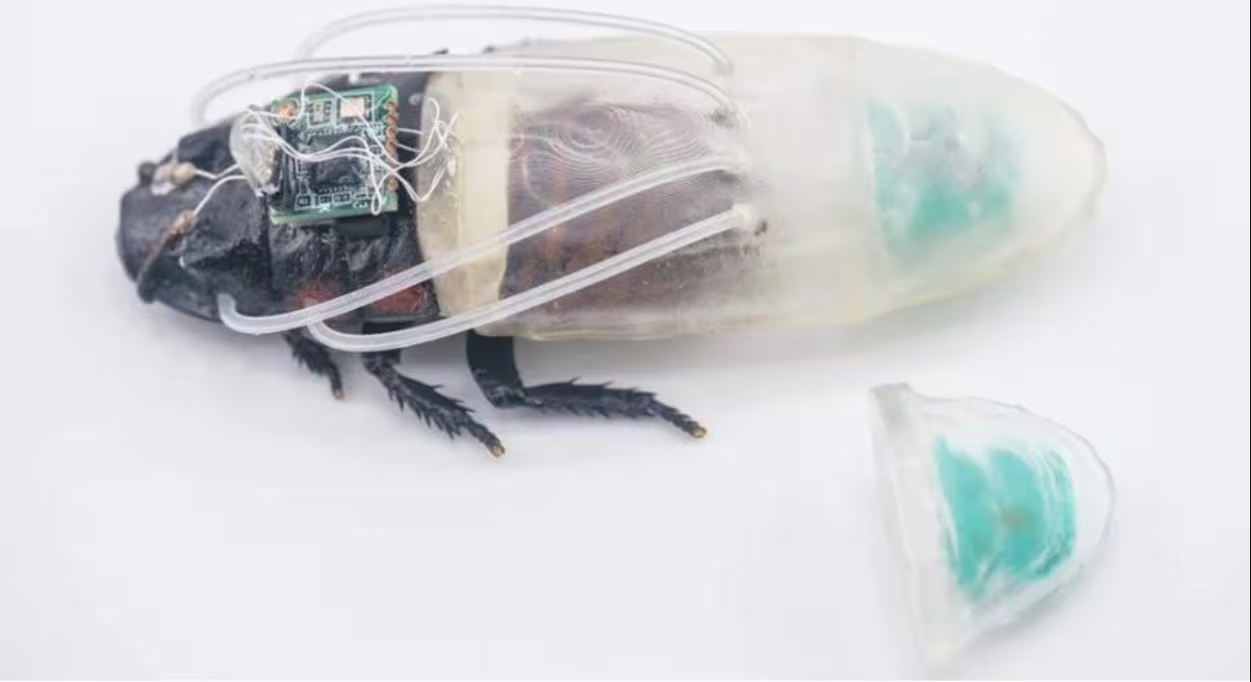
A group of researchers carried out a very particular experiment on a cockroach in a study published in Nature Communications. The research team of Fan and Sato, from Nanyang Technological University of Singapore have built and made the cockroach “wear” a small “wetsuit” that allows it to breathe even under water, transforming it into what the authors define as an amphibious cyborg insect. In this way the insect can remain in the water for up to three hours without any problem, cross flooded tunnels and slip into cracks just two centimeters high. The goal, however, is not to create an aquatic cockroach. The idea is much more practical and is to make these small systems capable of exploring even flooded environments. If the technology continues to develop, it could one day be used during rescue operations after an earthquake, flood or building collapse, entering spaces that are too narrow or too risky for rescuers and even for many robots designed for these types of interventions.
Why use a cockroach at all: resistant animals
If the goal is to enter the rubble or squeeze into a crack a few centimeters wide, it would be natural to think of a small robot. The problem is that when robots become very small, the technical difficulties also increase. Batteries, motors and circuits take up space and, by reducing the size, the autonomy is inevitably also reduced. For this reason some researchers have chosen a different path. Instead of building a robot from scratch, they exploit an animal that already has everything it needs to move: the cockroach walks thanks to its muscles and obtains energy from metabolism. The added electronic components do not move it forward, but only serve to guide its movements. In this way the energy consumption of the “robotic” system remains extremely low. Then there is another advantage: cockroaches are extremely resistant animals, they can squeeze into very narrow openings and move easily through debris, pipes and other complex environments where many small robots would have difficulty proceeding. In this study, the Madagascar hissing cockroach (Gromphadorhina portentosa), which is large and strong enough to support the weight of the intended device.
The water problem solved with a small underwater “wetsuit”.
To make the system work, however, the breathing problem had to be solved first. A cockroach, in fact, is not able to survive for long under water. It does not have lungs, but breathes through small holes distributed along the chest and abdomen, called spiracles, from where oxygen is transported inside the body by a network of tiny channels, the tracheae. When these holes are covered by water, the airflow is interrupted and the animal quickly suffers from asphyxiation.
To make it operational even underwater, the researchers therefore had to design a real miniature “diving suit”. The device is made up of three main elements:
- flexible waterproof shell that wraps around the cockroach’s abdomen preventing water from entering.
- a small oxygen generator.
- very thin tubes that transport oxygen directly to the spiracles of the insect.
Credit: Fan, et al. Nat comm (2026)
To verify how long the air reserve lasted, the researchers monitored the oxygen present inside the suit during the experiments. One milliliter of hydrogen peroxide was enough to produce approximately 6.2 milliliters of oxygen. In the first few minutes the level rose rapidly, reaching an average concentration of 47.4% after approximately eight minutes. Then it started to slowly decline.
Even after three hours, however, it was still equal to 14.8%, a quantity which, according to the authors, allows the cockroach to continue breathing without difficulty. When this value drops below 5%, insect activity drops dramatically and the risk of death increases. The authors also checked that the device had no negative effects on animals. Five cockroaches were observed for three days after the experiments, all of them survived and continued to behave normally. The generator temperature also remained stable, fluctuating between 23.6 and 24°C, without producing enough heat to disturb the insect.
Crossing spaces where nothing else can pass
Subsequently, the researchers also modified the system by eliminating the external backpack containing the electronics and placing these components inside the cockroach’s body. In this way the insect managed to pass through a submerged crack just 2 centimeters high, a dimension that represents an obstacle both for insects equipped with an external backpack and for many small amphibious robots. Furthermore, this configuration makes the system more stable and reduces the risk of some component getting stuck during exploration.
An immersion time of up to 2-3 hours
The most obvious result concerns immersion time. A normal cockroach, completely submerged, stops moving within about two minutes. With the underwater suit, however, the insects remained active and continued to respond to commands for two or three hours. Movement speed also remained quite high. On the ground the cockroach advanced on average at 87.5 millimeters per second, underwater the speed decreased slightly to 78.4 millimeters per second, a reduction of about 10%, mainly due to the greater resistance exerted by the water. As the hours passed, performance gradually decreased due to fatigue, but after three hours the insect still continued to move.
The test in the most difficult conditions
To test whether the system could be useful in situations similar to a real disaster, the researchers built a 1.7 meter long tunnel with two consecutive obstacles. The first section was filled with carbon dioxide. This gas, at high concentrations, can quickly cause a state of immobility in insects. Instead, the second section was completely submerged in water. The non-shedding cockroaches almost immediately stopped responding to stimuli in the carbon dioxide-rich zone or suffered asphyxiation within 45 seconds of being submerged. The animals were later recovered and made a full recovery after being returned to the open air. Those equipped with wetsuits, however, crossed both areas without problems while maintaining a normal ability to move. In all three tests carried out they managed to complete the route successfully!