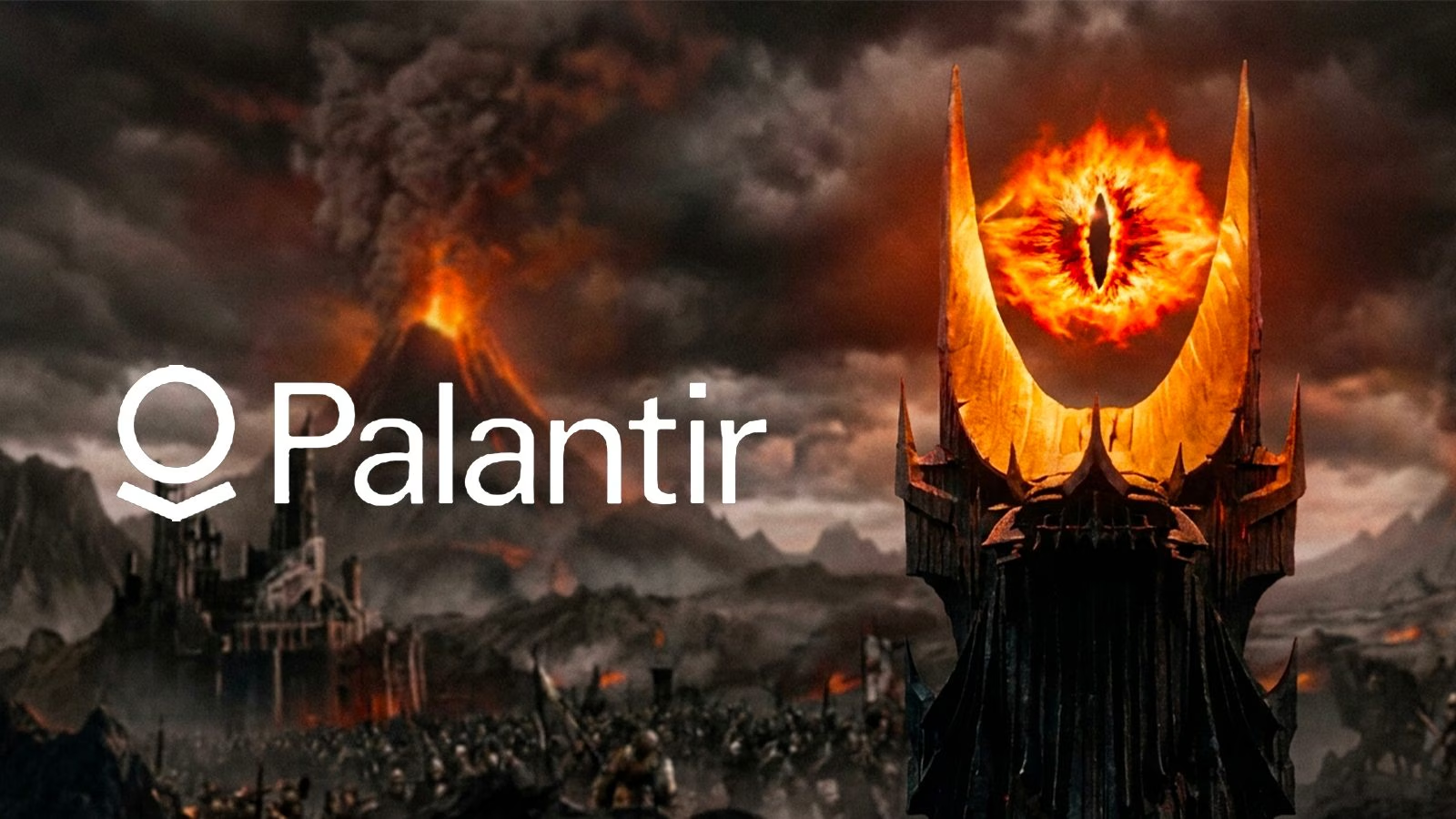
Palantir is one of the most influential, controversial and least-known technology companies in the world. It does not produce smartphones, does not manage social networks and does not sell services to individual citizens: it transforms data into information. Palantir’s main products are software capable of profiling and integrating enormous quantities of different data, transforming them into operational information useful to governments, armies, intelligence services and large companies.
Its systems are used to coordinate military operations, analyze criminal networks, manage healthcare infrastructures, monitor migratory flows and optimize industrial processes. Palantir describes itself as a company committed to defending the West through technological superiority, often using symbols and references taken from the universe of Tolkien and the Lord of the Rings.
For advocates, Palantir represents an essential tool in an era marked by geopolitical crises and growing complexity. Critics, however, ask who controls such powerful tools capable of leading to mass surveillance and posing problems for the privacy of individual citizens, what interests they reflect and what happens when crucial public functions are entrusted to a private entity. Let’s see how Palantir collaborates with Western governments, what the main ethical problems are and what Tolkien has to do with all this.
Collaboration with the USA, NATO and private companies
Founded in 2003 with the aim of helping the US government in the fight against terrorism, Palantir is able to connect large amounts of very different data, such as tax data, license plate records or criminal records, and transform them into useful tools for making informed decisions.
Over time the company has become a strategic supplier to the US government. Its clients include the Department of Defense, several federal agencies and ICE, the agency responsible for immigration enforcement. Software created by Palantir for ICE, such as ImmigrationOS and Elite, is used to track undocumented migrants, select who to deport, and generate maps of potential deportation targets.
On the military level, since 2017 Palantir has been the main company behind Project Maven, the Pentagon program that applies artificial intelligence to the analysis of satellite images, drone videos and data collected in the field to indicate, among other things, where a strategic target might be located. In 2025, this program was also adopted by NATO.
Also on the military front, Palantir has provided its software to the Ukrainian army since June 2022 and, presumably with the same purposes, signed a strategic partnership with the Israeli Ministry of Defense in 2024. According to a United Nations report, which Palantir denies, there are reasonable grounds to believe that Palantir provided the IDF, the armed forces of the state of Israel, with predictive tools and software infrastructure critical to attacks on the Gaza Strip.
As for the private sector, however, Palantir software is used by large companies such as Airbus or Hertz to optimize supply chains, predict operational critical issues and analyze financial and management data.
Ethical problems and internal oppositions
The strong use of Palantir systems in the security, immigration and defense sectors has fueled a growing number of criticisms over the years, both from international institutions and from within the company itself. The problem, for many, is not the existence of advanced data analysis tools, but that state activities are delegated to a private company through systems that are often opaque and difficult to evaluate from the outside.
One of the collaborations most criticized even by the company’s own employees is, for example, the one with the American immigration control agency (ICE). During the first Trump administration, Palantir software was used by ICE to track and deport undocumented immigrants, thus separating migrant children from their parents. In response, company employees wrote an internal letter of objection to company leaders, but it was never heard.
More recently, in early 2026, the internal debate was reignited following the killing of nurse Alex Pretti by ICE in Minneapolis and the US missile attack on an Iranian elementary school, which killed more than 100 children. According to an investigation by Wired US, following these tragedies, company employees asked for greater transparency on the use of company software, going so far as to declare:
We were supposed to be the ones to prevent these abuses. Now it looks like we’re enabling them.
The ideology of Palantir and the Tolkienian imagination
To fully understand Palantir’s behavior and its strategic choices, we need to understand its ideology, as described in the book “The Technological Republic”. The book, written in 2025 by Alex Karp, current CEO of Palantir, and his colleague Nicholas Zamiska, was recently summarized in 22 points and published on X, totaling tens of millions of views.
This summary, called the “Palantir manifesto” by the media for simplicity’s sake, explicitly contains all the central points for the company. According to Palantir, Silicon Valley, the area of California that is home to numerous start-ups and technology companies, has a moral debt to the United States and an obligation to participate in the nation’s defense. He also argues that dysfunctional and regressive “subcultures” exist and that the West must resist multiculturalism and what he calls “vacuous pluralism.”
This rhetoric of defense of the West and protection from an enemy that attacks it is also proposed in the language that the company uses to describe itself and promote itself. The name Palantir comes from the universe created by JRR Tolkien and indicates spheres capable of observing distant events and communicating remotely. In the story, some of these stones end up in the wrong hands and are used to manipulate the world. According to the company itself, this name was chosen as a warning: to always remember not to let surveillance tools fall into the wrong hands.
The rhetoric and use of Tolkien’s imagery does not stop there: the company’s employees are often called Hobbits and Palantir’s mission, that of “defending the West”, is described as “saving the Shire”, that is, the “homeland” of the Hobbits.
The use of this imagery is not accidental. It transforms technical themes, such as surveillance, intelligence and technological supremacy, into an epic story of defending civilization against external threats. It is a narrative strategy used for a long time by the most extremist sections of the right. In Italy, for example, as early as the 1970s, Tolkien-themed neo-fascist youth festivals were organized, in which the Lord of the Rings was read and exploited to justify one’s vision of the world.
Palantir, therefore, does not present itself only as a technology company. He describes himself as a subject called to defend a civilization and, in doing so, seems to want to place his mission above the law and normal democratic limits.