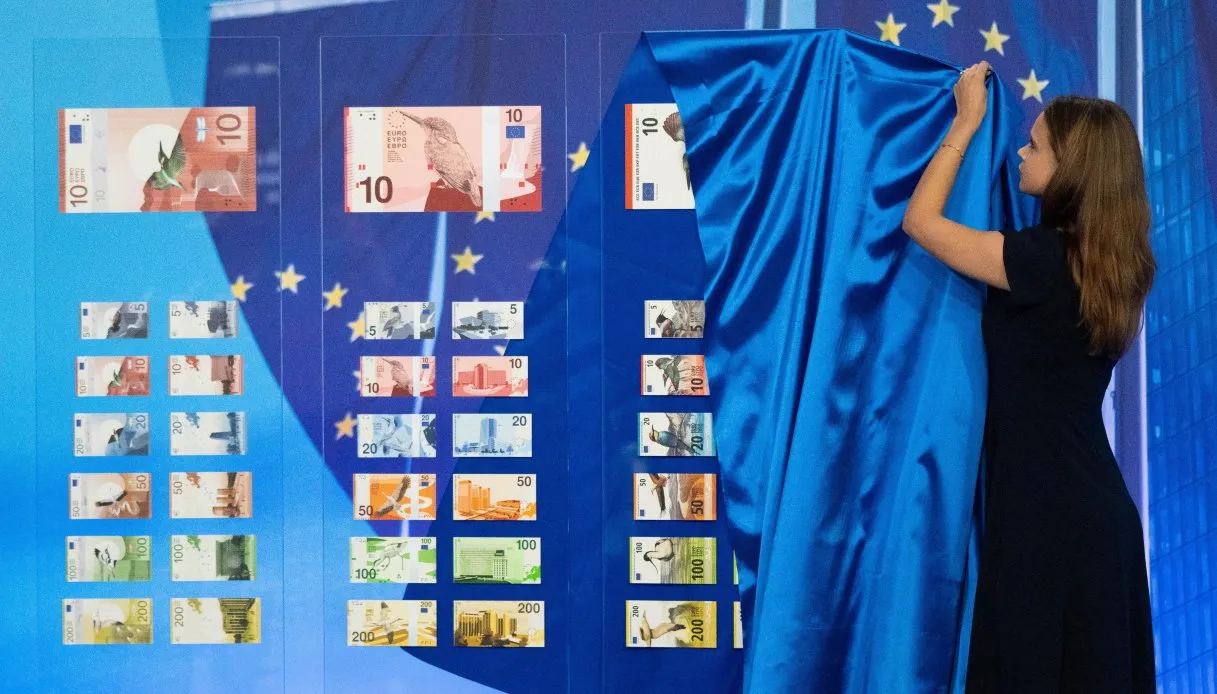
The European Central Bank has announced the two finalist themes for the designs of the new euro banknotes and presented the possible series that will replace the current ones in the coming years. Citizens will be able to choose between five different designs for each theme, ten in total, through a survey already available on the ECB website.
Euros have never changed the theme of their banknotes, but have only been redesigned with new designs. This is a first for the single currency.
The new euro banknotes
On the same day that the ECB announced its monetary policy decision, with rates remaining stable, Christine Lagarde attended the presentation of the new euro banknotes that could replace those in circulation. Ten finalist designs in total, based on two themes:
- European culture;
- birds, rivers and buildings of the European institutions.
It is the first time that the ECB has decided to change the euro in such a radical way. The previous theme had in fact been decided in 1996. The individual designs had been renewed, but never completely changed.
European culture and its protagonists
Half of the designs represent historical figures who contributed to European culture. Each banknote has a theme, from music to school, and each theme has a European artist chosen to represent a discipline:
- the 5 euro banknote is dedicated to the performing arts, with the singer Maria Callas on the front and street artists on the back;
- the 10 euro banknote is dedicated to music, with the musician Ludwig van Beethoven on the front and a music festival on the back;
- the 20 euro banknote is dedicated to school and university, with the Nobel Prize winner Marie Curie on the front and a school lesson on the back;
- the 50 euro banknote is dedicated to libraries, with the poet Miguel de Cervantes on the front and a library on the back;
- the 100 euro banknote is dedicated to museums and exhibitions, with the inventor Leonardo da Vinci on the front and examples of urban art on the back;
- the 200 euro banknote is dedicated to public squares, with the writer Bertha von Suttner on the front and a tree-lined square on the back.
Birds and rivers, with institutions on the back
The second theme is the natural one, with the representation of rivers and birds on the front and the headquarters of the European institutions on the back:
- the 5 euro banknote represents a mountain spring, with a wallcreeper on the front and the European Parliament on the back;
- the 10 euro banknote represents a waterfall, with a kingfisher on the front and the European Commission on the back;
- the 20 euro banknote represents a river valley, with a colony of bee-eaters on the front and the ECB on the back;
- the 50 euro banknote represents a meandering river, with a white stork on the front and the Court of Justice of the European Union on the back;
- the 100 euro banknote represents a river mouth, with an avocet on the front and the European Council and Council of the European Union on the back;
- the 200 euro banknote represents a seascape, with a gannet on the front and the European Court of Auditors on the back.
When the new euros arrive
The ECB will make a final decision on the theme and design by the end of the year. A jury will contribute to the decision, but also a public survey, which all citizens can complete until 21 September 2026. Once the decision has been made, however, it will take a few years before the new banknotes begin to circulate.
The old euros and the bridges that don’t exist
Redesigning euro banknotes is a very delicate step. The EU must in fact commit itself not to favor any single country, an attitude exemplified in the decision taken for the first design, that of 1996.
The idea was to represent the various European architectural styles through the details of some bridges, which had to convey the function of union of the single currency. To avoid showing favoritism, however, the EU decided not to use real structures. The bridges drawn on the euro banknotes, in fact, do not exist.