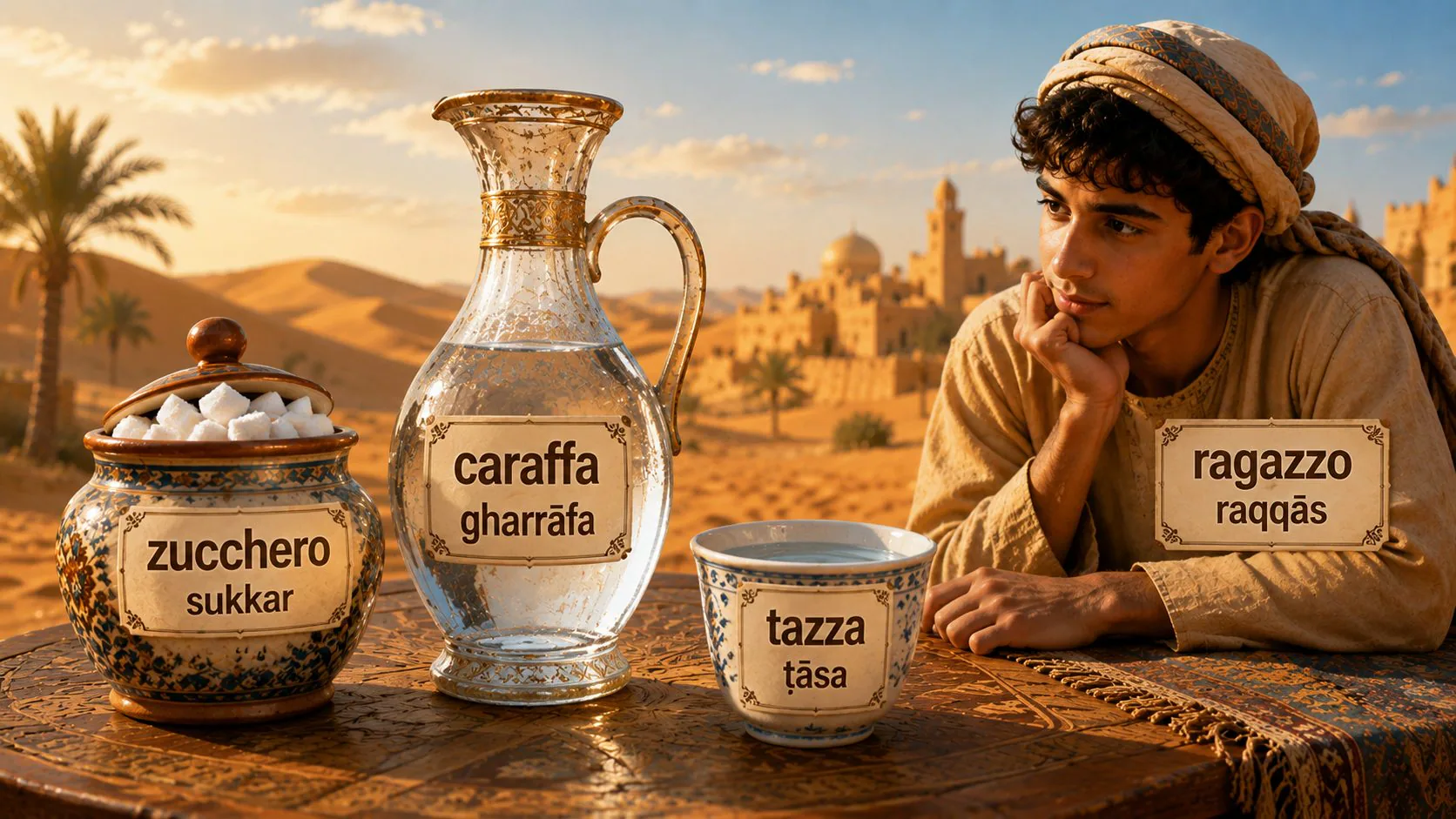
The Italian language is full of words that have come from far away and some are so common that they go unnoticed: coffee, alcohol and even expressions like “a galore” have an Arabic origin, as do dozens of terms related to cooking, commerce and daily life. Among these, there are also words that we use in our daily lives, such as boy, cup and sugar.
Centuries of trade in the Mediterranean, from Islamic Sicily to the mercantile routes between East and West, have left deep traces in our vocabulary. Some are still perfectly recognisable, others have changed shape and meaning along the journey.
- 1Warehouse
- 2Cup
- 3Boy
- 4Sugar
- 5Carafe
- 6Canopy
- 7Salamelecco
Warehouse
When we talk about a warehouse, we immediately think of a place intended for storing goods, materials and products. The etymology is reported both by Treccani and by the main Italian etymological dictionaries. It would be:
makhzan (مخزن) with the meaning of “place to keep or store something”.
The word derives from the verb khazana, that is “to guard” or “to store”, and through the plural makhāzin it arrived in European languages taking on forms such as warehouse, warehouse and finally warehouse. There is also a curious semantic evolution: in historical Morocco the term makhzen even indicated the central power and administration of the sultan, precisely because public goods and tributes were kept in government deposits.
Cup
The cup accompanies the daily life of millions of people, especially in the morning over a coffee or tea. Its name also comes from the Arab world. The origin is in fact traced back to Arabic ṭāsameaning “bowl”, “bowl” or “container”. From here the term passed to the Spanish taza, then to the French tasse and finally to the Italian cup.
The linguistic path also tells a story of commercial and cultural exchanges: drinks such as coffee and tea, both spread in Europe through the eastern routes, end up being consumed in an object which itself has a Middle Eastern etymological origin. According to the reconstructions reported by Treccani, language and material culture often travel together, leaving parallel traces in daily habits.
Lad
The etymology of boy is one of the most discussed and fascinating in the Italian language. For a long time, the idea was widespread that the word derived from the Asāsiyyīn, the famous order of warriors known in the West as “Assassins”. As explained by the Euro-Arab Institute, this explanation, however, is today considered a folk etymology, that is, a popular etymology without solid linguistic foundations. The hypothesis considered most reliable instead connects the term to Arabic:
raqqās meaning “quick messenger”, “courier” or “courier”.
In the medieval Maghreb this word indicated young people responsible for carrying letters and communications between offices and cities, appreciated for their speed and agility in travel. As time passed, the meaning broadened to generically indicate a young person or adolescent. The reconstruction appears in several etymological studies, although it remains a question still discussed by specialists.
Sugar
Sugar is one of the most common ingredients in European cuisines today, but for centuries it was a rare and precious product. The word comes from Arabic:
sukkar (سُكر) which in turn comes from the Persian shakar.
Through Mediterranean trade, the term spread to European languages, taking on very similar forms: the Spanish azúcar, the French sucre and finally the Italian sugar. Before its diffusion by the Arabs, sugar was known in Europe almost exclusively as a medicinal substance or luxury spice. It was precisely the cultivations and commercial networks of the Islamic world that transformed it into a much more widespread consumer product.
Carafe
The carafe is the container used to serve water, wine and other drinks, characterized by a wide base and a narrower neck. Its origin is traced back to Arabic:
gharrāfa (غرفة) i.e. “liquid container” or “pouring container”.
Through exchanges in the Mediterranean the term entered European languages up to modern Italian. This is not just a linguistic loan: elegant containers intended for serving drinks were in fact very widespread in the material culture of the Near East and the Islamic world, where the ritual of hospitality had and continues to have a central role.
Canopy
The canopy is the decorative structure that dominates beds, thrones, altars or chairs and which traditionally represents prestige and authority. The name is directly connected to the city of Baghdād (once called Baldacco). This city was one of the most important centers of production of fine fabrics of the Islamic Middle Ages, famous throughout Europe for the quality and richness of the decorations. The so-called “Baghdad fabrics” thus ended up identifying first the fabric itself and subsequently the structure created with those precious drapes.
Through French baldaquin the term arrived in Italian transforming into canopy. It is one of the most curious cases in the history of the language: the name of a city which, through international trade, is transformed into the name of a commonly used object.
Salaam
Making a salamelecco means showing an exaggerated, ceremonious and often self-interested courtesy, with a touch of flattery or flattery. The word comes from the Arabic expression:
al-salāmu ʿalaykum
or “peace be upon you”.
This is the traditional greeting of the Islamic world, still widespread today and comparable to our “good morning” or “hello”. In the transition to Italian, however, the term underwent a shift in meaning: in commercial relations between the Mediterranean and the Levant, those very formal and repeated greetings ended up being associated with a courtesy perceived as excessive or interested. Hence the modern meaning of salamelecco, understood as an overly emphatic compliment or excessively obsequious behavior. As Treccani recalls, it is one of the most interesting examples of how contact between cultures can profoundly modify the original value of a word.