When the Sun, Earth and Moon are perfectly aligned, the Moon projects a cone of shadow on the Earth’s surface, obscuring the Sun: this is how a solar eclipse occurs, a rather rare astronomical and optical phenomenon. After 27 years of absence, and for only the sixteenth time in the 21st century, the total solar eclipse will be visible again in Europe on 12 August 2026: at its point of maximum duration, it will last between one and two minutes, and in Italy it will only be partially visible and will begin around 7.30pm, at sunset, when the Sun will be very low on the horizon.
This phenomenon has fascinated humanity for centuries, giving rise to stories and folklore, so the eclipse often acts as a harbinger of crisis or as a metaphor for spiritual and social anxiety, before becoming an object of scientific study: precisely on the basis of these suggestions there are many works that portray solar eclipses. Let’s see the most famous and interesting ones.
- 1Medieval frescoes: the case of the Basilica of Santa Croce in Florence
- 2Raphael and the eclipse in the Vatican
- 3Caron’s “astrological” eclipse
- 4Rubens’ eclipse in Antwerp
- 5The advent of photography: Berkowski’s shot
- 6The eclipse of politics: Grosz and corruption
- 7The cubist eclipse in the twentieth century: Diego Rivera and Roy Lichtenstein
Medieval frescoes: the case of the Basilica of Santa Croce in Florence
Created for the Cenacle of the Basilica of Santa Croce in Florence, the ancient refectory of the complex, the cycle of the Triumph of Death was painted in the 1540s by the artist Andrea Orcagna, born Andrea di Cione. In the fresco (which Boccaccio probably also saw) we can clearly observe the representation of a total solar eclipse, probably inspired by a real eclipse that occurred a few years earlier, on 7 July 1339.
Raphael and the eclipse in the Vatican
The fresco created by Raffaello Sanzio and his workshop in 1518-19 for the Vatican Palaces which portrays Isaac and Rebecca is very famous. This is an episode from Genesis in which Isaac, who had lied to the Philistine king Abimelech by saying that his wife Rebecca was his sister, is discovered by him after a moment of intimacy. This “revelatory” representation could also be linked to a real annular eclipse that crossed Italy in June 1518.
Caron’s “astrological” eclipse
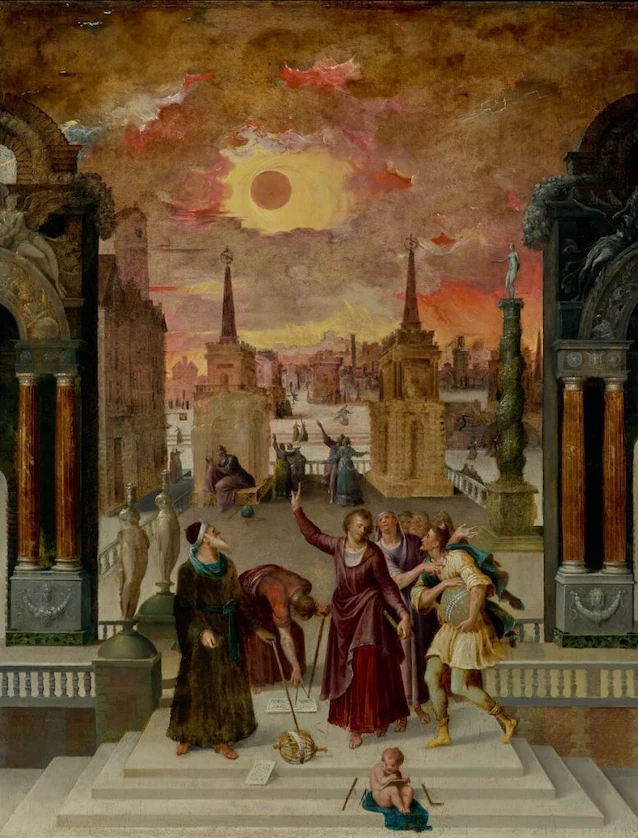
Almost contemporary but very different is the work Dionysus the Aeropagite who converts the pagan philosophers by Antoine Caron, court painter of Catherine de’ Medici. Painted between 1570-1580, the painting has been interpreted as a celebration of rational thought, although more likely it is a praise to astrology, which Catherine de’ Medici was passionate about.
Rubens’ eclipse in Antwerp
In 1610 Peter Paul Rubens (1577-1640) painted a partial eclipse in the upper corner of the right panel of his triptych of the Elevation of the Cross, created for the Antwerp Cathedral: the Sun appears to the left of Christ, recalling the dramatic light of Jesus’ death described in the Gospel.
The advent of photography: Berkowski’s shot
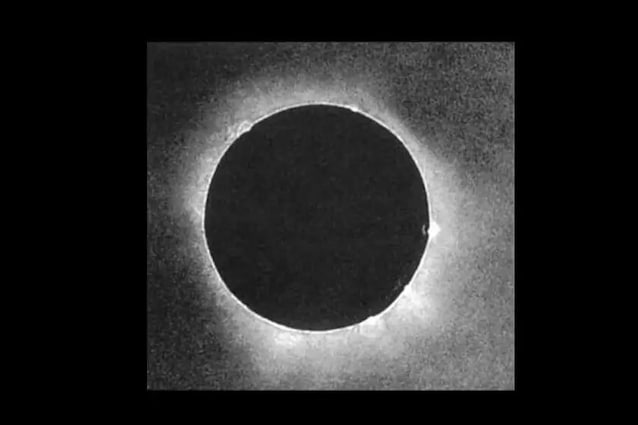
In 1851, working from the Royal Observatory in Königsberg, Johann Berkowski took a historic photograph of an eclipse: it was said at the time that it was immediately taken to the Great Exhibition in London to be admired, but this is not an established fact. This daguerreotype clearly captures the solar corona, representing the beginning of a new phase in the knowledge of celestial phenomena.
The eclipse of politics: Grosz and corruption
The one painted in 1926 by George Grosz (1893 – 1959), one of the best-known German expressionist painters, is the most disturbing painting dedicated to the solar eclipse. The oil painting on canvas Eclipse of the Sun lays bare the corruption and desperation of Berlin in the 1920s: the political class is foolish and corrupt, servant of industry and subjected to military power, represented by the then president of the Weimar Republic and former supreme general of the German army Paul von Hindenburg. And the eclipse? It’s outside the window: a giant dollar sign coin ironically blocks the sun.
The cubist eclipse in the twentieth century: Diego Rivera and Roy Lichtenstein
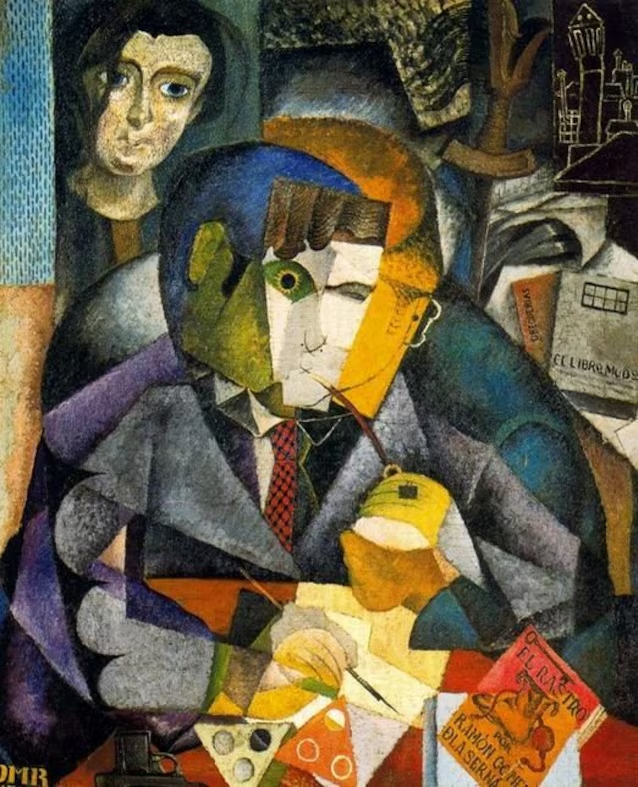
Among the many works created in the twentieth century on eclipses, two are particularly significant. The first is the Portrait of Ramon Gomez de la Serna, painted in 1915 by the famous Mexican painter Diego Rivera (1886 – 1957) in cubist style: if you look into the poet’s eye you will find a total eclipse. Rivera was passionate about science, and one day, while painting his famous murals, he rushed to the roof of the Detroit Institute of Art to witness a partial eclipse. The second is the Pop Art artist Roy Lichtenstein (1923–1997), in whose career science has always occupied a prominent place: the American painter dedicated two of his 1975 paintings to the solar eclipse, which took up Cubofuturism’s fascination with the sun and its metaphorical force.